
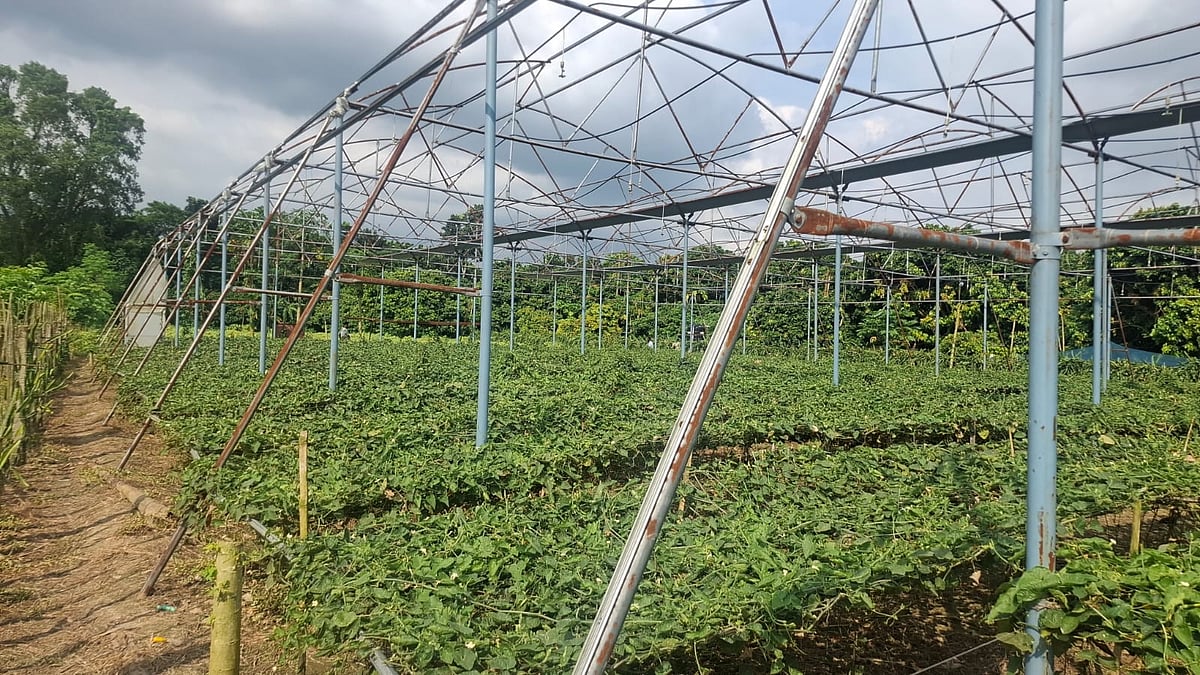
The agriculture department built 102 polynet houses free of charge for farmers across Rajshahi division, promising year-round crops under controlled conditions. Three years on, most of the structures grow nothing: the polythene is torn, the misting systems are dead, and many farmers have planted grapevines simply to show something is happening. Department of Agricultural Extension figures put the cost of the 102 houses in 2023-24 at about Tk 250 million, or roughly Tk 2.4 million each.
The houses were part of a Tk 1.87 billion project, 'Agricultural development of Rajshahi division through expansion of modern technology', taken up by the previous Awami League government. Rajshahi got 22, Natore 29, Naogaon 7, Chapainawabganj 6, Pabna 17, Joypurhat 6, Bogura 11 and Sirajganj 4. Each covers 25 decimals of a one-bigha plot with polythene, netting and a steel frame, and was meant for capsicum, tomato, broccoli, strawberry and lettuce as well as roses, gerbera and marigold. Farmers signed 25-year agreements that oblige them to keep the house in use and, if it is abandoned, to repay the construction cost within seven days.
Of 16 recipients interviewed in August, 10 said they were carrying heavy losses. Of the six who said they had not lost money, four are seedling producers, one grows grapes and one flowers. Of seven houses visited, four had torn polythene and one had been stripped entirely. Nazrul Islam of Bakhtarpur in Ishwardi said the interior was so hot that no labourer would work inside; he removed the polythene and now grows pointed gourd there, noting he could have earned Tk 100,000 a year simply by leasing the land.
Farmers say substandard materials made the houses fragile and impossible to keep cool. Masud Rana of Raninagar in Naogaon said the installers had spoken of 200-micron polythene but fitted less than 100 microns. On an expert's advice he spent Tk 100,000 on imported capsicum and tomato seed and a further Tk 300,000 to grow it, and got less than half the yield an open field would have given; his total loss is Tk 1 million. Mortuza Ahmed of Baragachhi in Paba said he had spent Tk 1 million and not earned a taka. Most of the 'mixed irrigation' misting units are out of order: officials blame the iron-rich hard water of the Barind tract, farmers say every machine failed within a year and the promised repairs never came.
One Naogaon grower tried 28 crops over three years without a single success. Speaking anonymously, he said that at a review meeting at the Pabna horticulture centre a year into the project, farmers were made to recite invented success stories under the watch of sub-assistant agriculture officers — until one let the truth slip and the rest followed. A Bogura Sadar farmer whom the department has promoted as a success said the scheme had become a showpiece.
S M Hasanuzzaman, additional director of the extension department and the project's director, said farmers had failed because they were unwilling to work hard and ignored advice; nobody was forced to take a house, and it is a durable technology for grapes. The contractor gave one year of free service and three years of polythene repair, he said, and now the farmers must run the houses themselves. The project also distributed 10,733 farm machines at a 70 per cent subsidy and built two office buildings in Bogura and Rajshahi for Tk 115 million.
Md Ahsanul Haque, professor of entomology at Gazipur Agricultural University, said greenhouses make sense in cold countries, but in tropical Bangladesh the temperature, humidity and airflow inside must be tuned to each crop. The country's polynet houses use almost the same set-up for every crop, he said — which is why the project is not working.
Source: Prothom Alo


Comments
(0)