
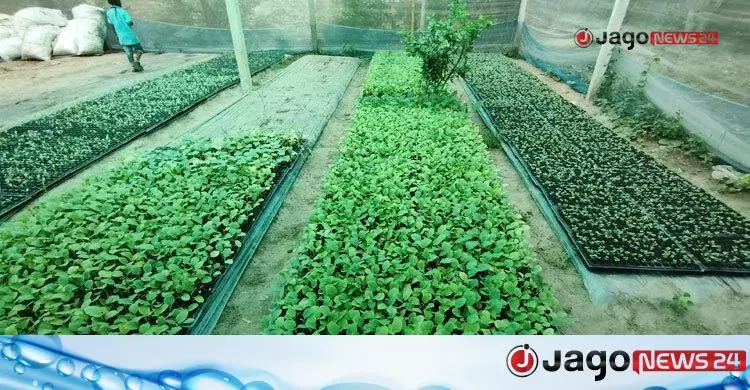
Farmers used to worry that every heavy rain would ruin their seedbeds. Now, in Paba upazila of Rajshahi, thousands of vegetable seedlings are grown in plastic trays filled with cocopeat, made from coconut husk, inside polynet houses with a controlled environment. The approach is producing better seedlings and helping farmers cope with climate risks.
A 200 sq m polynet house
In the Kashba area of Paba, farmer Nazrul Islam has a polynet house of about 200 square metres in his yard, built by the Department of Agricultural Extension (DAE) with government funding under the project to expand modern agricultural technology in char areas of Bangladesh (first revised). DAE also set up a pilot polynet house at Kharkhari in Paba, and many farmers now want to build their own.
A polynet house works like a greenhouse, allowing temperature, light and humidity to be largely controlled and reducing the effects of heavy rain, strong sun, insects and viral disease. Instead of soil seedbeds, sterile cocopeat is used, which lets roots spread easily and lowers the risk of soil-borne disease.
How the seedlings are raised
- Each seed is sown in its own cell of a plastic tray filled with cocopeat.
- With set care and irrigation, seedlings are ready for transplanting in only 18 to 20 days.
- Roots are not damaged when seedlings are lifted, so mortality after transplanting is close to zero.
- Shade net controls temperature inside, and modern measures keep insects out.
Green chilli, year-round chilli, tomato, aubergine, bottle gourd, papaya and other seedlings are produced and sold at Tk 2 to Tk 3 each, including seedlings for rooftop gardens.
"I used to raise seedlings in soil beds, but a little extra rain would ruin them, and heat damaged them too," Nazrul Islam said. "On DAE's advice I started using cocopeat trays in the polynet house. Now about 90 percent of seeds germinate and the seedlings grow evenly." Farmers from surrounding areas buy from him, and seedling sales bring good income despite the initial construction cost.
Caretaker Khaled Mahmud said demand is growing and the house will be enlarged if demand rises. Farmer Khaled said he had bought 300 Green Ball aubergine seedlings after a good crop from earlier purchases, and Siddique Mollah bought 500 chilli seedlings for the first time.
Why officials back it
DAE says conventional seedbeds lose many seedlings to heavy rain, waterlogging, strong sun or fungal disease, often forcing farmers to sow again. In trays each seed sits in a separate cell, so problems do not spread and seed waste is lower.
Paba upazila agriculture officer Md. Abdul Mannan said climate change has made safe, quality seedlings more important, and polynet seedlings are disease-free, uniform and grow quickly after transplanting; farmers are receiving training and technical support. Papia Rahman Mouri, additional deputy director (horticulture) of DAE Rajshahi, said several projects are expanding modern seedling technology so farmers can plant on time, cut costs and grow more vegetables.
Source: Jagonews24. First published in Bengali on The Agro News.
Comments
(0)