
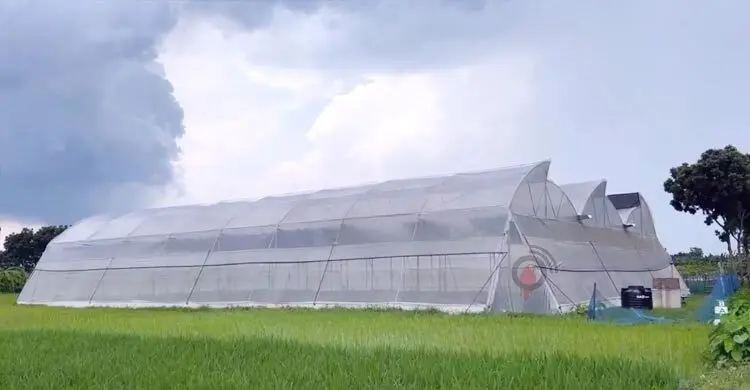
Severe drought or heavy rain has often destroyed seedbeds, disrupting seedling production and leaving farmers behind with seasonal vegetables and fruit. To avoid this, farmer Anisur Rahman has succeeded by raising seedlings in a science-based polynet house.
In the Mirzapur area of Dapunia union, Pabna, his disease-free seedlings, protected from natural disasters, have given good yields, making him a successful entrepreneur. He profits both from farming his own land and from selling seedlings.
How a polynet house works
Modelled on a greenhouse, the polynet house is a local farming system that controls climate, prevents disease, maintains seedbed quality and allows high-value crops out of season. Seedlings stay safe even in heavy rain, extreme heat, insect attack and viral disease. Seedlings raised in pots of soil and cocopeat made from coconut husk at controlled temperatures are of good quality, raising yields and farmers' interest.
"Because these disease-free seedlings yield well, I am profiting from both my own crops and seedling sales," Anisur said. The high-quality poly sheeting stops harmful sun rays from getting in, so crops are not damaged, and because harmful insects cannot get in, no pesticide is needed, allowing poison-free vegetables to be grown.
Official view
Dr. Md. Jamal Uddin, deputy director of the Department of Agricultural Extension (DAE) in Pabna, said crop production in polynet houses is 20 percent higher than with traditional methods and pest attacks are more than 70 percent lower. Although the initial cost is somewhat higher, production costs are very low, so farmers benefit in the long run.
Source: Jagonews24. First published in Bengali on The Agro News.
Comments
(0)