
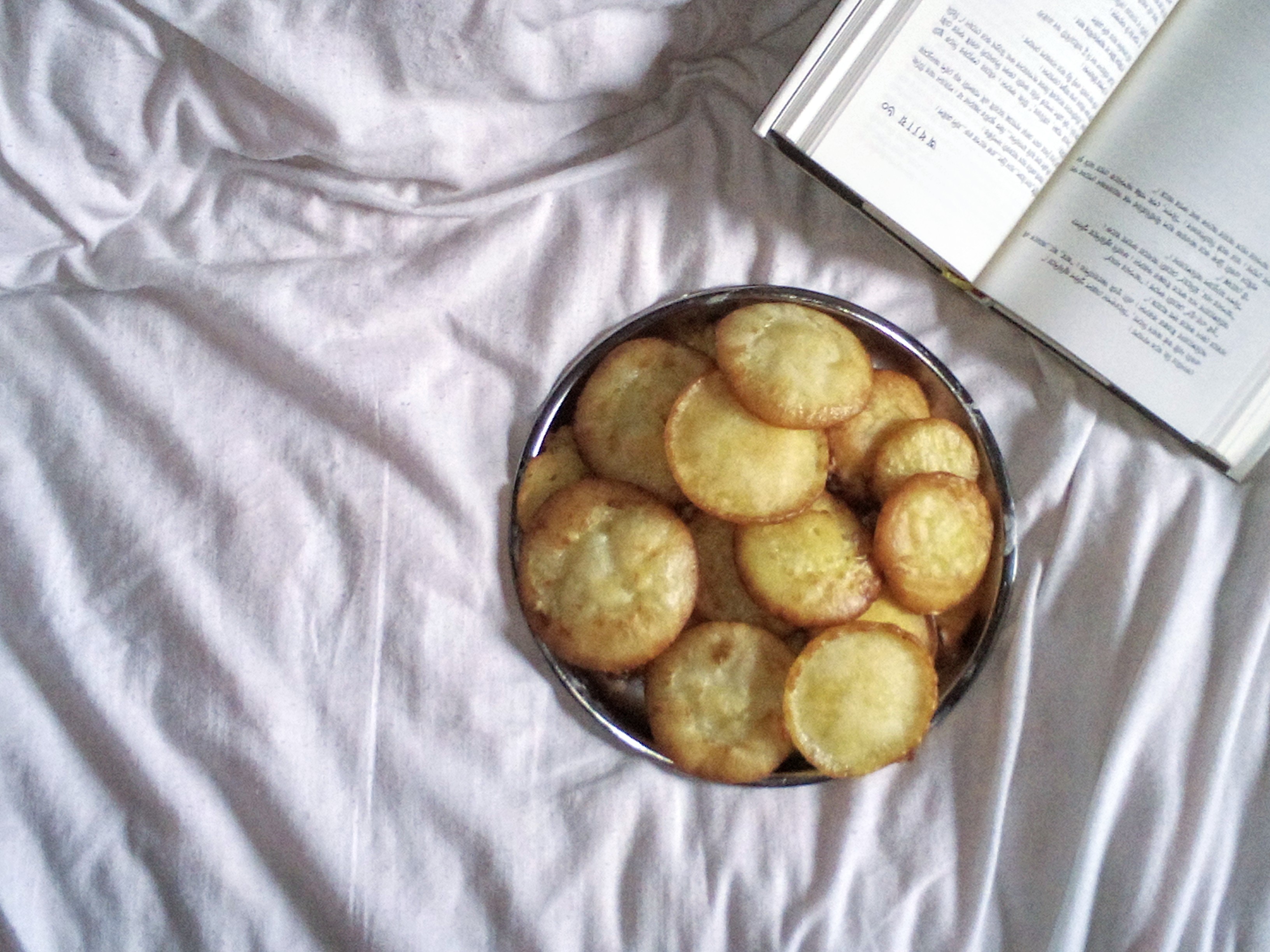
On 6 January 2026, in the middle of the winter pitha season, the lifestyle desk of the Bangladeshi news site Jagonews24 published a short recipe for poa pitha that does away with the step many home cooks find most tiresome: soaking raw rice and grinding it into batter. Instead, the recipe starts from dry rice flour, soaked for half an hour in lukewarm water, then mixed with gur (molasses), a little plain flour and salt, and fried a spoonful at a time in hot oil. The report described poa pitha as soft, sweet and traditional, and said the cakes could be made at home with few ingredients and in little time.
The recipe below is given as Jagonews24 published it. The sections after it explain what kind of pitha this is, where its ingredients come from in Bangladesh, and what health and safety authorities had said, up to the date of the recipe, about frying oil, sugar and the raw date-palm sap of the winter months.
Ingredients
Jagonews24 listed six ingredients. Cups are the ordinary kitchen measure; the recipe gives no weights, and the amount of water is left to the cook.
- Dry rice flour: 2 cups
- Plain flour (maida): half a cup
- Gur (molasses): 1 cup
- Salt: a little
- Water: as needed
- Oil: enough for frying
Method
- Put the dry rice flour in lukewarm water and leave it to soak for 30 minutes.
- Add the gur, the plain flour, the salt and as much water as needed to the soaked rice flour, and mix everything well into a batter.
- Heat oil in a karai (a deep frying pan).
- When the oil is well heated, pour in the batter with a round spoon, one pitha at a time.
- Keep the heat at medium and fry both sides well.
- When the pithas turn golden, lift them out and place them on tissue paper to drain.
- Serve in a bowl or plate of your choice.
The recipe does not say how thick the batter should be. The encyclopedic description of handesh, the closely related fried rice-flour and molasses cake of Sylhet, gives the same sequence: the molasses is mixed with water, rice flour and plain flour are added and whisked until the batter is smooth, and once the oil is hot the heat is lowered to low or medium before the batter is dropped in one portion at a time. Medium heat lets the centre of each cake cook through before the sugar-rich outside turns too dark.
What poa pitha is
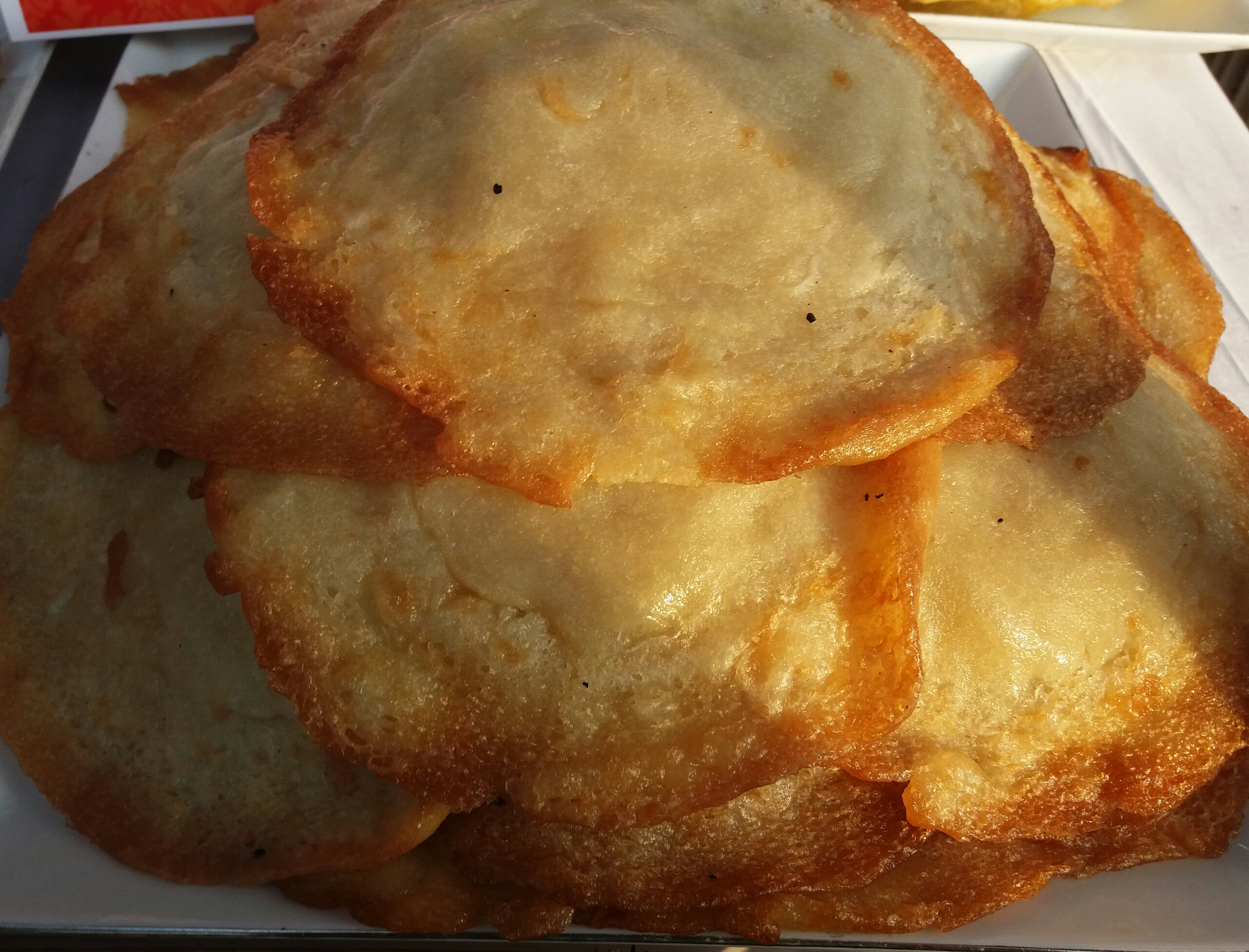
Poa pitha belongs to the family of fried, sweet rice-flour cakes made in Bangladeshi homes every winter. The Business Standard, in a feature on winter delicacies published on 2 January 2021, described tel-er pitha (oil pitha) as a common and popular winter item in Bangladesh, made from a mixture of rice flour sweetened with date-palm jaggery and deep-fried in hot oil, crunchy on the outside and sticky and soft inside. The same feature defined pitha in general as something similar to a palm-sized fritter, pancake, pastry or dumpling, sweet or savoury, usually made from a dough or a batter.
Names change from district to district. Banglapedia, the national encyclopedia published by the Asiatic Society of Bangladesh, notes that the same pitha often has different names in different areas and that each area has its own kinds. In Sylhet the fried rice-flour and molasses cake is called handesh, also known as teler pitha; encyclopedic accounts describe it as sweet and puffy, eaten as a dessert or with tea, made with molasses or sugar, rice flour, plain flour, water and oil, and especially popular at Eid, at naming ceremonies and at weddings. They also note that, like other pithas, it was once made from rice pounded in the foot-operated dheki, and that in Assam, across the border, it is called tel pitha.
A wider relative is malpua, the fried sweet pancake of the Indian subcontinent. Encyclopedic accounts say its batter varies by region: crushed ripe bananas in some places, coconut in Bangladesh, and in Bengal traditionally thickened milk with a little flour, sometimes rice flour. In parts of India the fried malpua is soaked in sugar syrup. Poa pitha, as Jagonews24 makes it, needs no syrup, because the gur is already in the batter.
Pitha in Bengali homes and the winter season
Banglapedia defines pitha as the traditional home-made cakes of Bangladesh. Many kinds, it says, are not part of the daily menu but are made for special occasions: receiving a bridegroom or a bride, entertaining guests, and bringing together family, relatives and friends. Children or older members of a family often ask for pitha, and mothers or grandmothers make them; in some places neighbouring families make pitha together and turn the work into a social occasion.
Most pithas are sweet and a few are hot, and while some are made all year, others are seasonal. Banglapedia calls the winter pithas the most delicious, because date juice and molasses from date juice and sugarcane are available in winter, and it says the pitha season starts in late autumn, when farmers harvest paddy from the field. The most common ingredients it lists are rice or wheat flour, molasses or sugar, coconut and oil, the same basic set as in this recipe.
The variety is large. Banglapedia records that an exhibition arranged by the Shishu Academy in 1991 displayed 106 categories of pitha, and it names among the nationally known kinds chitoi, patishapta, pakan, bhapa, andosha, kulshi, gokul, chutki, muthi, jamdani, hadi, chapdi, nakshi, pata, tejpata, jhuri, phuljhuri and bibikhana pitha. It also notes that commercially sold cakes and pastries were gradually replacing home-made pithas in the cities, while pitha exhibitions, specialised shops and street-corner vendors kept them popular there. The Business Standard's 2021 feature said much the same of the capital: in winter, homes, shops and roadside stalls fill with winter specials, and bhapa pitha can be found on almost every street corner in Dhaka.
Rice flour: from the Aman fields to the kitchen
Rice is the base of almost every pitha. Banglapedia describes rice as interwoven with Bengali culture and a symbol of wealth, grown in Bangladesh in three seasons, Aus, Aman and Boro. It notes that husked paddy is chal, and that rice is milled in two main forms: atap rice from sun-dried paddy and siddha rice from parboiled paddy. The Bangladesh Rice Research Institute (BRRI), set up in 1970 at Gazipur, carries out the country's rice research and keeps a gene bank of rice germplasm.
The winter pitha season follows the Aman harvest. According to a Department of Agricultural Extension (DAE) report cited by The Business Standard on 18 November 2025, the government had set a target of more than 4.41 crore tonnes of rice and wheat for the 2025-26 fiscal year. More than 1.81 crore tonnes of Aman rice were expected from more than 59 lakh hectares: about 17.50 lakh tonnes of hybrid, 1.51 crore tonnes of high-yielding varieties, 9.75 lakh tonnes of local varieties and about 3.30 lakh tonnes of broadcast or deepwater Aman. A director of the DAE's Field Service Wing said then that about 20 per cent of the harvest had been completed and that it would be finished by the first week of December. The same report gave Aus production of 29.93 lakh tonnes against a target of 32.22 lakh tonnes, and a Boro target of 2.27 crore tonnes.
Regional figures followed in December. The national news agency BSS reported from Rangpur on 21 December 2025 that farmers in the DAE's Rangpur region, covering the districts of Rangpur, Gaibandha, Kurigram, Lalmonirhat and Nilphamari, had produced 20,00,614 tonnes of clean Aman rice on 6,21,398 hectares, against a target of 20,10,505 tonnes, with an average yield of 3.23 tonnes of clean rice per hectare against 3.21 tonnes the year before. Coarse Aman paddy was then selling at Tk 1,200 to Tk 1,300 per 40 kg in the region's local markets.
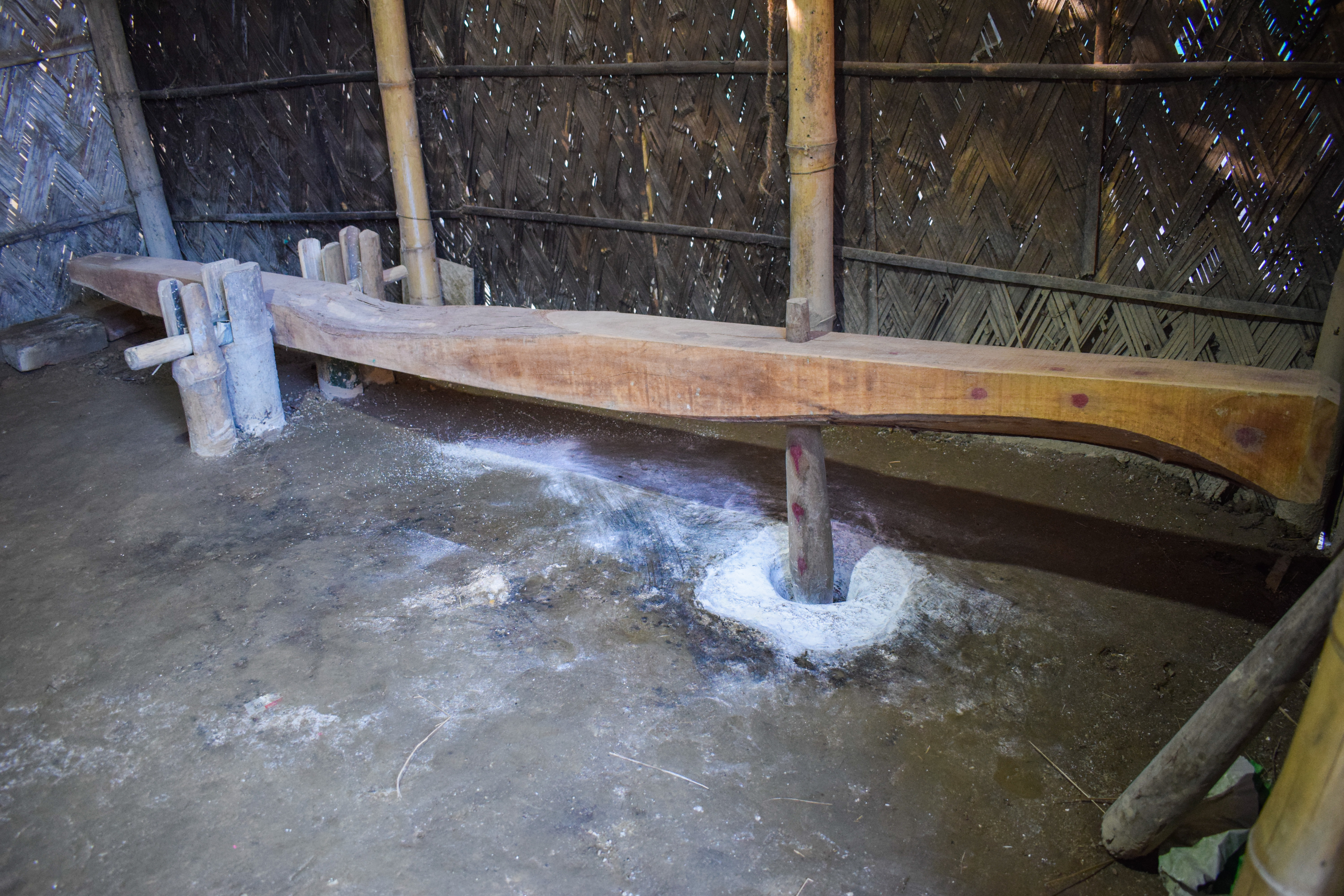
Before husking machines and rice mills, rice for the household, and for pitha, went through the dheki. Banglapedia describes it as a wooden lever about 72 inches long, pivoting on a bolt, with a pestle at one end; usually two or three women work it, one or two pressing the far end with their feet to raise the pestle and letting it fall, while another moves the grain in the hollow in the ground beneath. Banglapedia notes that dhekis were still in use in large numbers in villages, though the women-centred cottage industry of rice husking was gradually giving way to mills. Accounts of the Sylheti handesh likewise recall that it used to be made from rice pounded in the dheki.
Jagonews24 opened its recipe by noting that many people think poa pitha means the bother of soaking rice first. Its shortcut keeps the soaking but moves it to the flour: the dry rice flour is soaked for 30 minutes in lukewarm water before the gur, plain flour and salt go in.
Gur, the winter sweetener
Gur gives poa pitha its colour and its taste. Banglapedia defines gur as unbleached sugar made by boiling down the juice of date palm, sugarcane, palmyra palm or coconut, hard or soft according to demand. In Bangladesh most gur is made from cane juice and date juice; in some areas it comes from palm juice, and in the Khulna area also from golpata (nipa palm) juice.
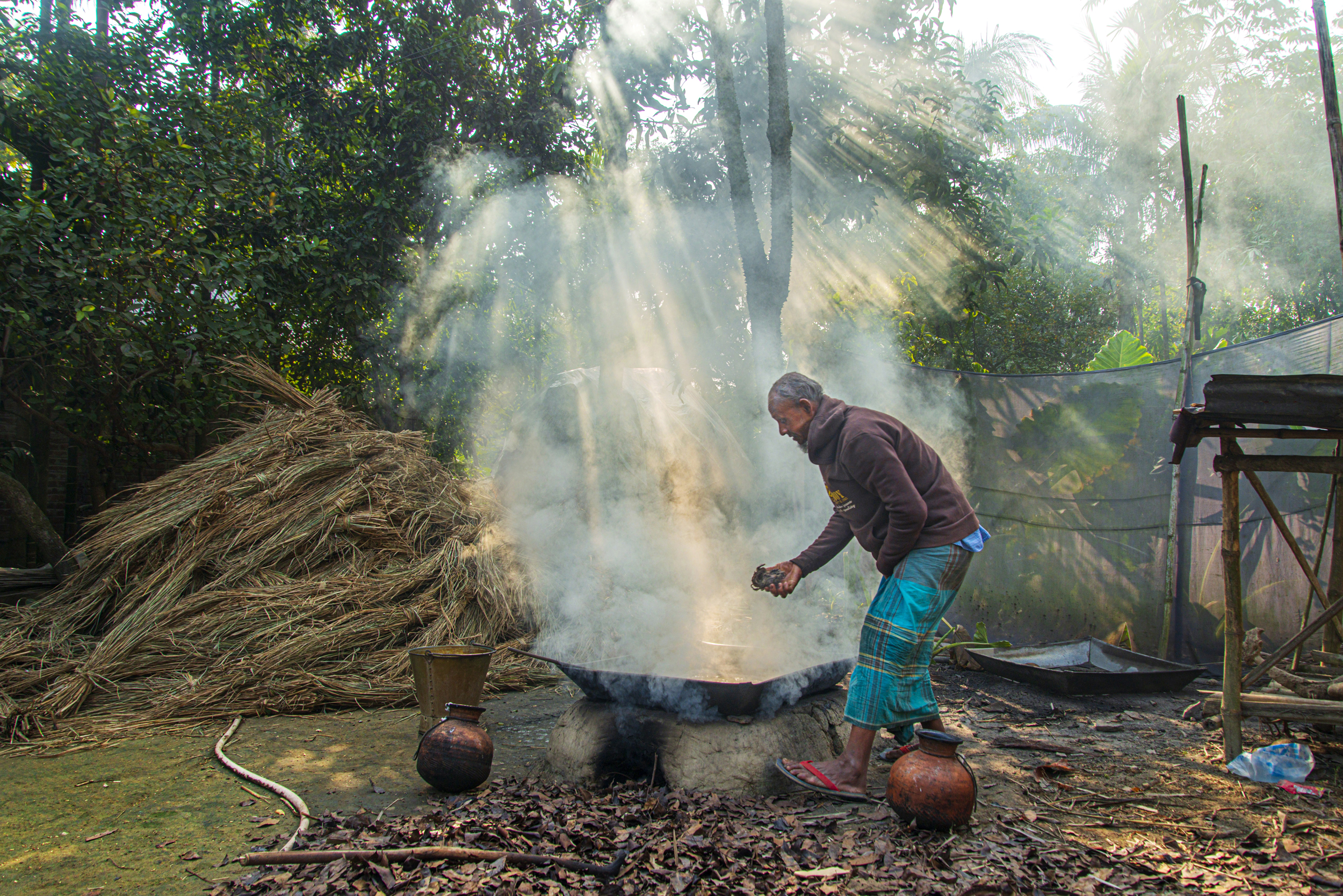
Date-palm gur is the gur of winter. According to Banglapedia, gachhis (sap collectors) tap the trees from mid-November to mid-March by slicing off part of the soft skin at the top of the trunk; the sap collects overnight in a pitcher through a narrow bamboo pipe and is boiled the next morning. Sap is collected in six-day cycles: the first night's juice, jiran, is the best in quality, sweetness and quantity, followed by doket and then jhara, after which the tree rests for three days. A healthy tree yields about six litres of sap a day, the largest yields come in December and January, and the sap has to be boiled quickly to keep it from fermenting. Banglapedia names the dry khajura gud of Jessore (Jashore) and the hazari gud of Madaripur as the most famous, and says many people of the lower and middle classes earn their living by collecting date juice, making gur and trading in it.
Sugarcane gur is made from cane crushed in a press, cleaned and boiled until it thickens into cakes; Banglapedia lists jhola (semi-liquid), nali and chita among its varieties. Palmyra gur is made from the sap of palm cones, collected from mid-April to mid-June. Any of them can sweeten poa pitha. The recipe uses one cup of gur to two cups of rice flour, so the flavour of the gur carries through the whole cake.
Raw date-palm sap and the Nipah warning
The winter that brings gur also brings fresh date-palm sap, and with it the risk of Nipah virus. In a Disease Outbreak News report dated 18 September 2025, the World Health Organization (WHO) said Bangladesh had notified four confirmed fatal Nipah cases between 1 January and 29 August 2025, from four districts in the Barisal, Dhaka and Rajshahi divisions. The first three had a history of drinking raw palm sap; the fourth, which occurred outside the usual December to April season, had no such history. WHO said Bangladesh had recorded 347 Nipah cases since the first recognised outbreak in 2001, with a case fatality rate of 71.7 per cent, and five laboratory-confirmed fatal cases in 2024.
Fruit bats are the natural hosts of the virus, which reaches people through food contaminated with the bats' saliva, urine or excreta, and can then pass from person to person through close contact. WHO said there was no specific drug or vaccine. Its advice was to keep bats away from date-palm sap and other fresh food, to boil freshly collected date-palm juice, and to wash and peel fruit and throw away any fruit with signs of bat bites. Gur is made by boiling the sap; raw date-palm sap should never be drunk.
Frying oil, trans fat and safety at the stove
Poa pitha is deep-fried, so the choice of oil matters. In its trans fat fact sheet of January 2024, WHO said industrially produced trans fat is found in margarine, vegetable shortening, vanaspati ghee, fried foods and baked goods, and that fried street and restaurant foods often contain it. Trans fat clogs arteries and raises the risk of heart attacks and death; WHO attributed more than 278,000 deaths a year worldwide to industrially produced trans fat and advised adults to keep trans fat below 1 per cent of total energy intake, less than 2.2 grams a day on a 2,000-calorie diet. Frying oil at high temperatures, WHO added, increases trans fat only modestly, up to 2 to 3 per cent, far less than the 25 to 45 per cent found in partially hydrogenated oil. Among the healthier replacements it named are oils rich in polyunsaturated fat, such as sunflower, corn and soybean oil.
Bangladesh regulates trans fat. The Financial Express reported on 2 December 2021 that the Bangladesh Food Safety Authority (BFSA) had adopted WHO's best-practice policy through regulations gazetted on 29 November 2021, limiting trans fat to 2 per cent of total fat in all oils, fats and foodstuffs by 31 December 2022. The paper said partially hydrogenated oil, known in the country as dalda or banaspati ghee, was the main source of trans fat, used in bakery items, deep-fried snacks and food from hotels, restaurants and street vendors; a 2019 study had found trans fat above the 2 per cent threshold in 92 per cent of samples of leading brands in Dhaka, and WHO placed Bangladesh among the 15 countries with the highest burden of heart-disease deaths caused by trans fat. For frying at home, the practical point of these sources is to use a liquid vegetable oil rather than dalda or vanaspati.
Hot oil is also a fire risk. The U.S. Fire Administration, in its cooking fire guidance, calls cooking by far the leading cause of home fires and home fire injuries in the United States. Its advice applies to any kitchen: stand by the pan, and turn the burner off if you leave; if you see smoke or the grease starts to boil, turn the burner off; turn pan handles towards the back of the stove so that no one can knock them; and keep a lid or a baking sheet nearby to cover the pan if it catches fire, which puts the fire out.
Sugar, fat and a balanced diet
A cup of gur makes poa pitha a sweet, and the frying oil adds fat. WHO's guideline on sugars, announced on 4 March 2015, recommends that adults and children keep their intake of free sugars below 10 per cent of total energy, and says a further reduction to below 5 per cent, roughly 25 grams or six teaspoons a day, would bring additional benefits. Free sugars, in WHO's definition, are sugars added to food by the manufacturer, the cook or the consumer, together with sugars naturally present in honey, syrups and fruit juices; gur stirred into a batter is an added sugar of this kind. WHO based the recommendation on evidence linking sugar intake to overweight, obesity and tooth decay.
None of this rules out a plate of pitha on a winter afternoon; it suggests keeping pitha as the occasional, special-occasion food that Banglapedia describes. People with diabetes, heart disease or another condition that needs a special diet should ask their doctor how sweets like poa pitha fit into their meals.
Photo: Mst. Shaira Akter Jupi / Wikimedia Commons (CC BY-SA 4.0)
Sources: Jagonews24, Banglapedia (Asiatic Society of Bangladesh), The Business Standard, Department of Agricultural Extension (DAE) via The Business Standard, Bangladesh Sangbad Sangstha (BSS), World Health Organization (WHO), Bangladesh Food Safety Authority (BFSA) via The Financial Express, U.S. Fire Administration, Wikipedia (handesh, malpua)

Comments
(0)