
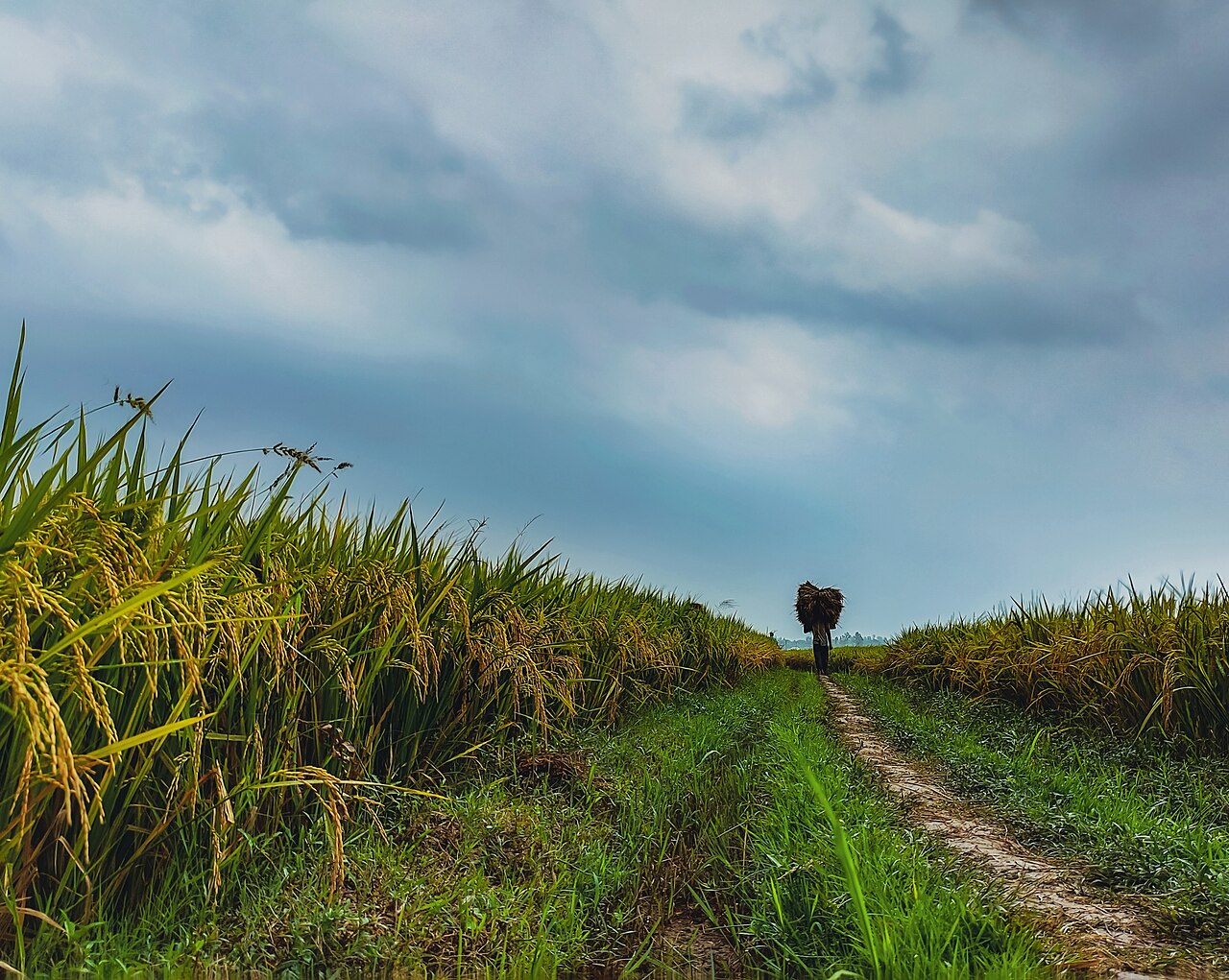
Farmers in Patuakhali expect a good Aman rice harvest this season. Favourable weather, timely field care, advice from the agriculture department and light pest and disease pressure have left plants and panicles filling out on most fields. But the spread of early watermelon farming means the district did not meet its Aman planting target this year.
According to the district Department of Agricultural Extension (DAE), the target for the season was 189,834 hectares of Aman. Farmers planted 188,938 hectares, 896 hectares short. Local white coarse and red coarse varieties were grown on 65,166 hectares. BR-23, BR-11, BR-22, BR-51, BR-49 and BR-52 are the main varieties in the district.
On Monday (2 November) most Aman fields visited across the district were at the grain-filling stage. Khalilur Rahman, a farmer in Bauphal upazila, planted 50 decimals each of BR-22 and BR-52. His costs are about Tk 200 a decimal. He expects 40 to 50 maunds of paddy an acre and hopes to sell at Tk 1,000 to Tk 1,200 a maund.
In Nazirpur union of the same upazila, Delowar Sikder (45) and Abdul Barek Howlader (55) together planted four acres of several Aman varieties. Their costs run at Tk 200 to Tk 250 a decimal, and they hope for 150 to 200 maunds from the four acres. Ramzan Ali, a farmer in Chhoto Bighai village of Sadar upazila, said the weather was favourable at planting, there was no major disaster, and disease in the fields was comparatively low.
There are worries too. Sobhan Mira, a farmer in Botkajol village of Adabaria union in Bauphal, said a storm or other natural disaster before harvest could still cause losses. He said the growth of early watermelon on some char land had reduced the area under Aman.
Redoan Talukder Junior, deputy agriculture officer for Bauphal upazila, said the upazila planted 34,679 hectares of Aman against a target of 34,720 hectares. Dr Md Amanul Islam, deputy director of the district DAE, said that while early watermelon had taken some Aman land, the area under other seasonal crops had grown, and he expects a positive effect on the district's overall farm output.
The report is by Bangladesh Sangbad Sangstha (BSS), published by Agricare24.
Photo: ZahidTushar / Wikimedia Commons (CC BY-SA 4.0)
Source: Agricare24
Comments
(0)