
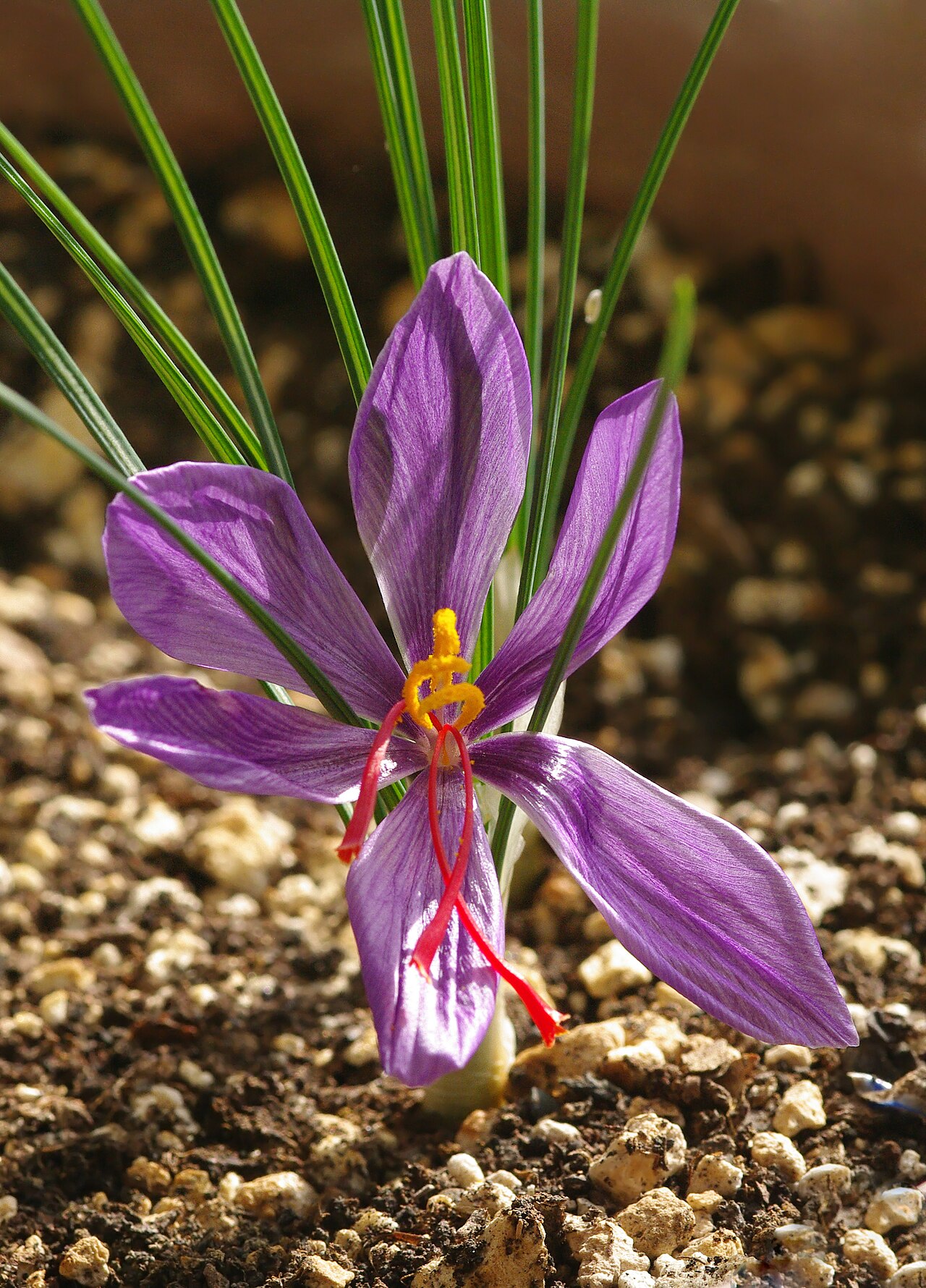
A trial to grow saffron on barren land in Ladakh, India, has flowered less than a month after planting, where the administration had expected it to take about two months. Officials say about 22 grams of saffron were collected over four days, Bangla Tribune's international desk reports.
About 90,000 high-quality Iranian saffron corms, weighing 800 kg in all, were planted on 1 October on some 4,000 square metres of reclaimed land at Spituk Pharka near Leh. On average 20 to 25 flowers opened each day; on Sunday morning 72 opened, the highest in a single day so far.
The project is driven by the territory's lieutenant governor, V.K. Saxena. After visiting the trial field he said the early flowering showed high-value crops are possible even in Ladakh's harsh terrain, and that commercial saffron could open new opportunities for local farmers and entrepreneurs.
The land was previously unfit for farming. It was reclaimed under Project Him Sarovar, which stores snowmelt to increase water availability. In May the administration identified about 800 acres of barren land near Spituk and planned to divert surplus water from the revived Igu-Phey irrigation canal to raise soil moisture. Ladakh gets under 100 mm of rain a year, and its farming depends mainly on glacier melt.
In India, saffron mostly means Kashmir, especially Pampore; according to the Ladakh administration, about 90 per cent of the country's output comes from Jammu and Kashmir. Each flower carries only three red stigmas, which must be picked and processed carefully, making the crop labour-intensive.
This is not Ladakh's first saffron trial. In March 2025 the administration said scientists of the Indian Institute of Integrative Medicine, under the Council of Scientific and Industrial Research (CSIR), had been working on it for two years. High-value flowers such as lilium and gladiolus have also been trialled there as alternative livelihoods.
Photo: Zeynel Cebeci / Wikimedia Commons (CC BY-SA 4.0)
Source: Bangla Tribune



Comments
(0)