
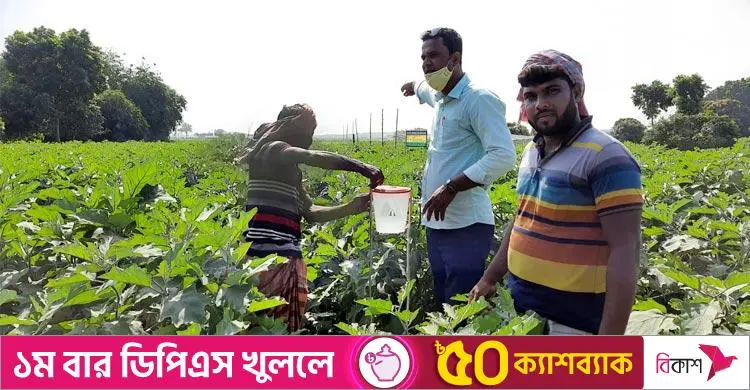
Farmers in Pabna have succeeded in replacing chemicals with organic technologies in vegetable farming, producing poison-free vegetables while cutting costs. With government and private efforts to spread these methods, the agriculture department hopes to make vegetable farming in the district 100 percent chemical-free.
A shift from chemicals
Winter vegetables are grown widely in Sadar, Atgharia and other upazilas. Muladuli village in Ishwardi is known as "Shim Sagar" for its bean production. Many farmers now use organic fertiliser for beans, and vermicompost and other scientific organic fertilisers instead of chemicals for cauliflower, tomato, aubergine and other crops. Over the past decade, pesticide and chemical fertiliser use rose sharply as disasters struck and soil fertility fell, and experts warned of serious health risks. The agriculture department and NGOs then trained farmers to make organic fertiliser and to use bio-pesticides and traps instead of pesticides.
- Nurul of Atgharia said land is never left idle and chemicals were used to speed up and boost production, but training showed him that overuse was making his own family ill, so he now uses more organic fertiliser.
- Aslam of Muladuli said farmers now make organic fertiliser using methods learned in training, lowering costs while producing safe vegetables.
- Altaf Malitha said using organic fertiliser and traps instead of pesticides has cut costs sharply, which pays off at a time of higher fertiliser prices.
Md. Shamsuddin, regional manager (agriculture) of the NGO ASA, said interest was low at first but farmers now show strong interest in safe vegetable farming, which has reduced costs.
Training and production figures
According to the agriculture department, by November this year 53,040 farmers in the district had been trained in making organic fertiliser and building and using traps for pest control without pesticides: 14,410 in Sadar, 6,900 in Atgharia, 5,805 in Ishwardi, 6,560 in Chatmohar, 3,425 in Bhangura, 3,290 in Faridpur, 6,280 in Bera, 1,890 in Santhia and 4,480 in Sujanagar. About 14,310 tonnes of organic fertiliser, including vermicompost, trico-compost, quick compost and compost, had been produced by November against a target of about 25,500 tonnes, which the department expects to exceed as more crops are planted.
Dr. Jamal Uddin, deputy director of DAE Pabna, said the goal used to be food security and is now safe food. Through the "Safe Nutrition Village" social movement, the department is working to end chemical use in vegetable production and expects all of the district's farmers to be growing safe vegetables soon.
Source: Jagonews24. First published in Bengali on The Agro News.
Comments
(0)