
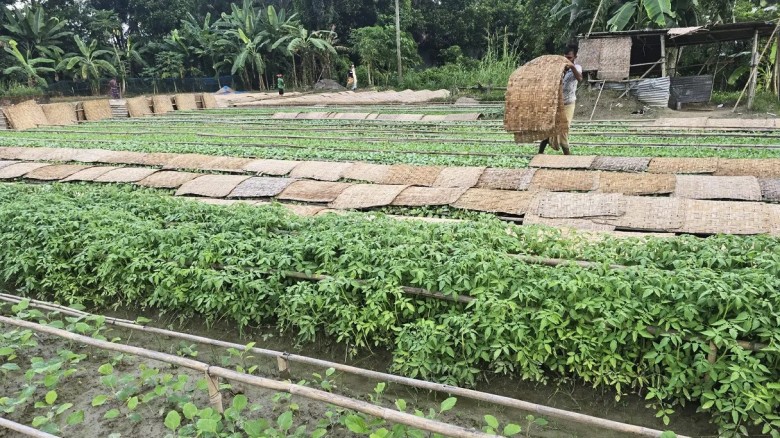
Sales of early winter vegetable seedlings have collapsed in Munshiganj, Krishi Shomoy's Munshiganj correspondent reports. A sudden rise in water levels and rain have left fields waterlogged, so farmers cannot transplant, and the district's seedling trade worth about Tk 20 crore has stalled.
According to the district office of the Department of Agricultural Extension, seedlings worth Tk 15-20 crore are sold in three or four rounds between August and December from about 10 hectares, and 25-30 entrepreneurs work the trade year-round. A seedling needs 25-30 days of care before sale, shaded with bamboo mats against the sun; heavy rain and storms are the worst enemies, and this year the rain has done the damage, traders said.
At Bhattacharjer Bagh and KP Bagh in Panchasar union, cauliflower, cabbage, broccoli, tomato, brinjal and chilli seedlings were rotting in rainwater beneath the mats; in some plots the seedlings have grown into plants with no buyer in sight. "If it rains any more I will not be able to save the seedlings. I am deep in loss," grower Barek Mia said. Nazrul Islam said that in 30-35 years of raising seedlings he had never seen sales this low.
Only a week earlier the growers were busy from dawn to afternoon. Munshiganj seedlings have become a brand because they are raised from high-yielding seed imported from Japan, Italy and other European countries at Tk 70,000 to Tk 1.5 lakh a kilogram; the trade predates independence and supplies Savar, Shariatpur, Madaripur, Narayanganj, Manikganj, Rangpur, Sylhet, Habiganj, Cumilla and Chandpur.
DAE deputy director Habibur Rahman said the seedlings' quality draws farmers from many districts and that wider use of high-yielding varieties is opening a new horizon for agriculture. If the rain does not stop, one of the country's main sources of early winter vegetable seedlings will fall short this season.
Reporting: Munshiganj correspondent, Krishi Shomoy.
Source: Krishi Shomoy
Comments
(0)