
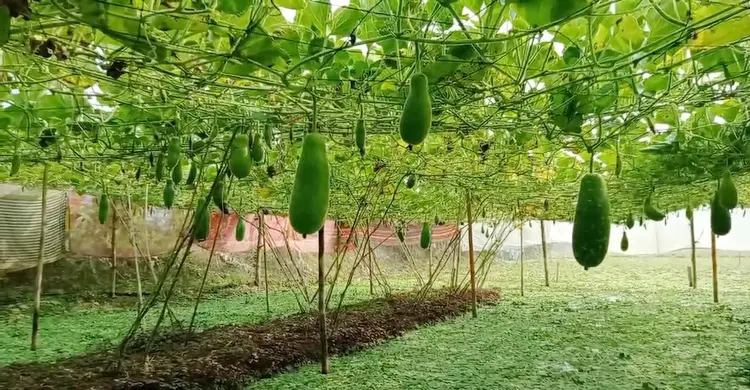
More than 50 farmers in Kalkini, Madaripur, have grown vegetables using the floating method. They have caused a stir by farming on abandoned, waterlogged land in Ramjanpur union, and many others in the district are becoming interested.
Local sources said the low land and fallow water bodies of Ramjanpur union stay under water, so with little chance to farm them, they lay abandoned for most of the year. Those lands are now full of vegetables all year round. About 50 farmers have set up floating vegetable gardens on their own land and other convenient plots, changing their fortunes. They build beds from water hyacinth on the fields and fallow water bodies, grow vegetables without chemical fertiliser and profit from selling them. They are pleased to farm cheaply and sell at a good profit, and demand is high because no pesticide is used.
Costs and crops
According to the Kalkini upazila Department of Agricultural Extension (DAE), vegetables are grown on 50 hectares in the upazila. Of this, 50 farmers in Ramjanpur union grow poison-free vegetables on floating beds on 20 bighas. The beds are made easily and cheaply from water hyacinth, and with DAE advice a floating garden can be set up for Tk 25,000 to 30,000 a bigha. Once a bed is made, vegetables can be grown on it all year. Bottle gourd, cucumber, bitter gourd and sweet pumpkin grow easily on the beds, as do red amaranth, stem amaranth, okra and other vegetables. Little fertiliser is needed, so the vegetables are poison-free.
Ashrafur Rahman, a farmer of North Ramjanpur, said a farmer named Shahin Rari first started floating vegetable farming there, and others learned from him. The method grows poison-free vegetables at very low cost and brings more profit, and many farmers in the union now use it.
How the beds are built
Shahin Rari said he was the first to start the method, with help from the upazila agriculture office, and had profited. Many had followed his example, and the union's idle land and water bodies were now full of vegetables.
He said the floating beds are made of water hyacinth, usually collected and piled up in Asharh and Shraban. Various creeping aquatic plants are then gathered and layered gradually. Built 2 to 3 feet thick, a floating bed is ready within 10 to 12 days. Some also use bamboo, coconut husk dust and rice husk. Building them needs a boat, a raft made of banana stems, or a palm trunk dugout. When all is ready, seedbeds are made and each farmer builds a floating garden as he likes.
Julhas Mollah, a farmer of South Ramjanpur, said he first built floating beds of water hyacinth on about 40 decimals of waterlogged land beside his house and then grew winter vegetables. He is now selling bottle gourds at the market.
Md Jalil, a farmer from the same area, said some of his land had been waterlogged year after year. He now grows cucumber, red amaranth, okra and bottle gourd on floating beds there. "By Allah's grace the yield has been good. Demand for these fertiliser-free vegetables is high in the market, so I have made a good profit at little cost."
Officials' view
Tanvir Ahmed, sub-assistant agriculture officer in Kalkini upazila, said Ramjanpur union is low-lying and much of its land holds water all year, so about 50 farmers there have changed their fortunes with floating vegetable farming. The upazila agriculture office gave them free training and technical support, and he had advised them all along.
Md Moazzem Hossain, deputy director of the DAE in Madaripur, said higher yields and good vegetable prices were letting farmers profit at low cost with the floating method, so it was gaining popularity across the district and farmers were becoming more interested.
Source: Jagonews24. First published in Bengali on The Agro News.

Comments
(0)