
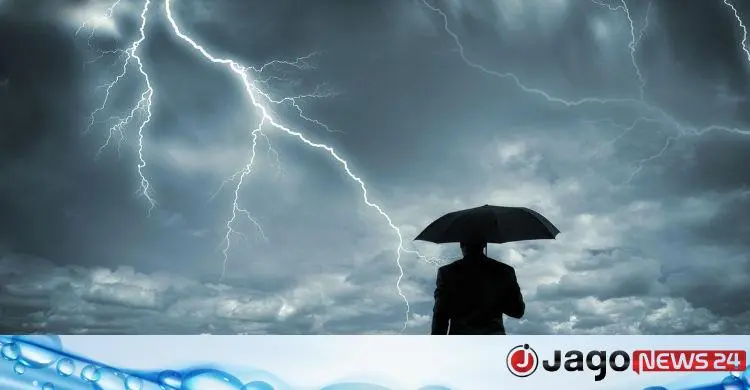
Lightning strikes have become much more frequent in Bangladesh, and deaths are rising with them. Experts say the number of palm trees and other tall trees has fallen almost everywhere. Popular belief holds that lightning used to strike palm trees or other tall trees and pass into the ground, sparing people.
Although the country has been reforested, the trees have not grown tall, which is seen as a main reason for the rise in lightning deaths. Planting palm seedlings nationwide has therefore been proposed, on the assumption that in 20 to 30 years the country will be full of palm trees that will intercept lightning.
The gap in the palm tree plan
The idea that lightning strikes palm trees because they are taller than other trees is folk knowledge gained from long experience, today called "citizen science". But depending on variety and location, a palm tree takes 20 to 30 years to grow tall enough to draw lightning. The writer asks what happens to the lives and property lost to lightning in the meantime, and whether people living now do not have a right to protection.
When traditional knowledge fails, new knowledge and technology emerge. Benjamin Franklin first used a lightning rod to protect against lightning between 1749 and 1752, and later showed with a kite that electricity in clouds causes lightning. Prokop Diviš, a scientist from what was then Czechoslovakia, improved the lightning conductor in 1754. Countries have since developed lightning protection systems suited to their own weather, and the strongest are used on aircraft.
How a lightning arrester works
A lightning arrester has three connected parts:
- an air terminal rod that captures the lightning;
- a conductor wire that carries the current;
- an earth rod that takes the current into the ground and neutralises it.
The writer says research could produce lightning arresters suited to Bangladesh's weather that would be much cheaper than imported ones.
A solution for the haor
Growing palm trees tall enough in the vast fields of the haor region is almost impossible because the land is under water for half the year and seedlings are unlikely to survive. Instead, lightning arresters could be mounted on towers like power-line trusses or mobile phone towers. There is no need to wait decades, the writer says; the government could install them now in lightning-prone areas, and wealthy landowners (jotdars) in the haor could be encouraged to install them on their land to protect the farmers working there.
Radar, detectors and apps
Expensive radar to detect lightning-producing clouds and lightning detectors have been imported and installed in a few regions, with forecasts delivered through an Android mobile app. The writer doubts how well this will work: it depends on how far in advance warnings can be given, whether farmers carry Android phones and whether they can reach shelter, which is almost impossible in many haor areas.
Some experts, he notes, argue there is no alternative to planting palm, coconut and betel nut trees and that lightning arresters are not economical for farmers. He calls this view contradictory: arresters have been used in the West for two and a half centuries, and it is odd to call radar, detectors and apps worthwhile but a device that reduces deaths and damage uneconomic without any feasibility study.
Source: Jagonews24. First published in Bengali on The Agro News.
Comments
(0)