
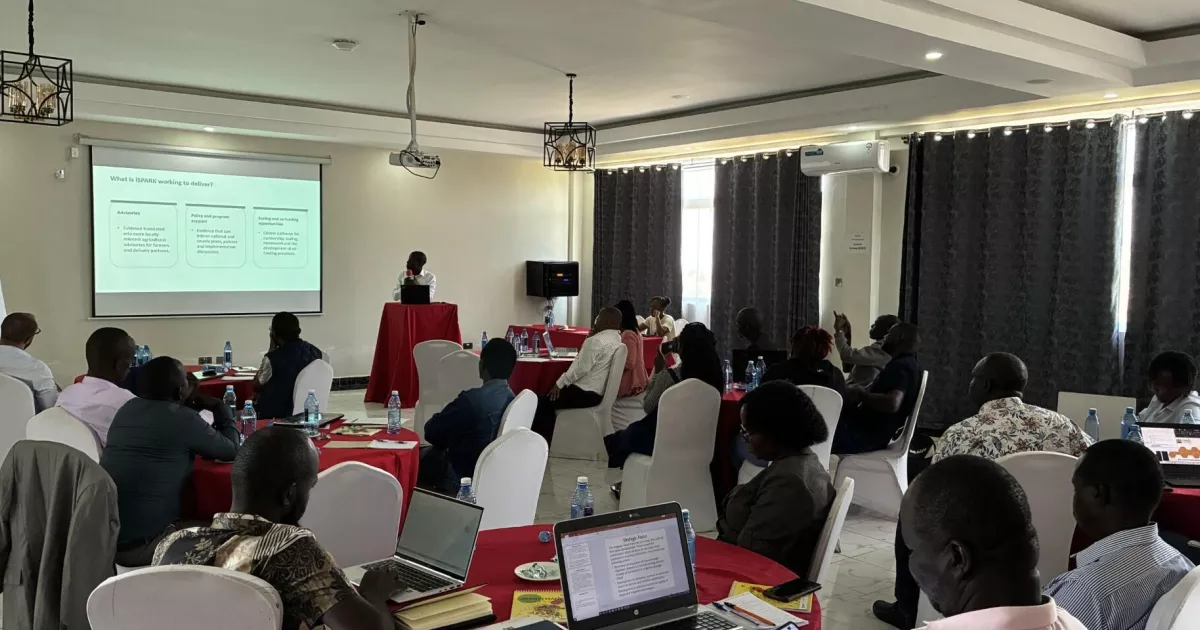
Representatives of four western Kenyan counties, two national ministries and research institutions spent two days in Kisumu examining how evidence on soil nutrient management and climate-smart irrigation can be written into county plans and budgets. The Policy Dialogue on Sustainable Soil Nutrient Management and Climate-Smart Irrigation was convened at the Fairways Hotel through the iSPARK (Innovation in Sustainability, Policy, Adaptation, and Resilience) project of the Alliance of Bioversity International and CIAT.
Kenya has a large body of research on soils, irrigation and climate adaptation, but the counties run their own agricultural programmes, planning cycles, budgets and technical structures, so national policy does not translate automatically into county action. The dialogue set out to connect the two.
Dorcas Jalang'o, a Research Team Leader at the Alliance, framed the discussion around Kenya's Agricultural Soil Management Policy (ASMP), whose priorities were presented by Eng. Angelica Weboko, Senior Superintending Engineer at the Ministry of Agriculture and Livestock. Maurice Opondo, Director of Irrigation Schemes, presented the National Irrigation Policy and the National Irrigation Sector Investment Plan, which let counties choose among farmer-led irrigation, public schemes, corporate agribusiness investment, irrigation in arid and semi-arid lands, community schemes and alternative sources such as water recycling and stormwater harvesting. Farmer-led irrigation, for example, may suit Vihiga County best.
On the research side, Gabriel Chege, a soil analyst at KALRO Kakamega, presented work to make soil testing cheaper and turn results into advice. Dr. Degefie Tibebe, Data Scientist for Agronomy and Climate Services at the Alliance, presented AgWise, a model developed with KALRO, IITA, GIZ and the iSPARK team to give site-specific, season-smart fertiliser recommendations in Kenya. Oscar Bautista-Cespedes, Data Scientist at IITA, led the review of soil-improvement interventions, with private-sector input from CropNuts on what farmers and institutions can actually adopt.
Dr. Chris Mwungu, Agricultural Economist at the Alliance, presented the Targeted Climate-Smart Irrigation Advisory, which combines climate, agricultural and irrigation information to guide irrigation decisions. Government irrigation experts, county technical officers and the Kenya Meteorological Department reviewed the evidence, and Valentine Musavi of Kenya Met in Kisumu spoke on turning climate data into advisories that extension staff and farmers can use.
Officers from Kisumu, Siaya, Busia and Vihiga said where the tools might fit existing programmes, what extra information they needed and where local adaptation was required. Because the interventions are still under development, their input can shape them before they are finished, which is the iSPARK approach. The dialogue produced inputs for two policy briefs, one on irrigation and one on fertiliser and soil improvement, which participants will continue to review.
In closing, Eng. Jeanmarie Morata and Maurice Opondo pointed to the chance to build on the relationships formed and to co-develop soil and irrigation policies, plans and tools with counties, researchers and development partners.
Source: CGIAR
Comments
(0)