
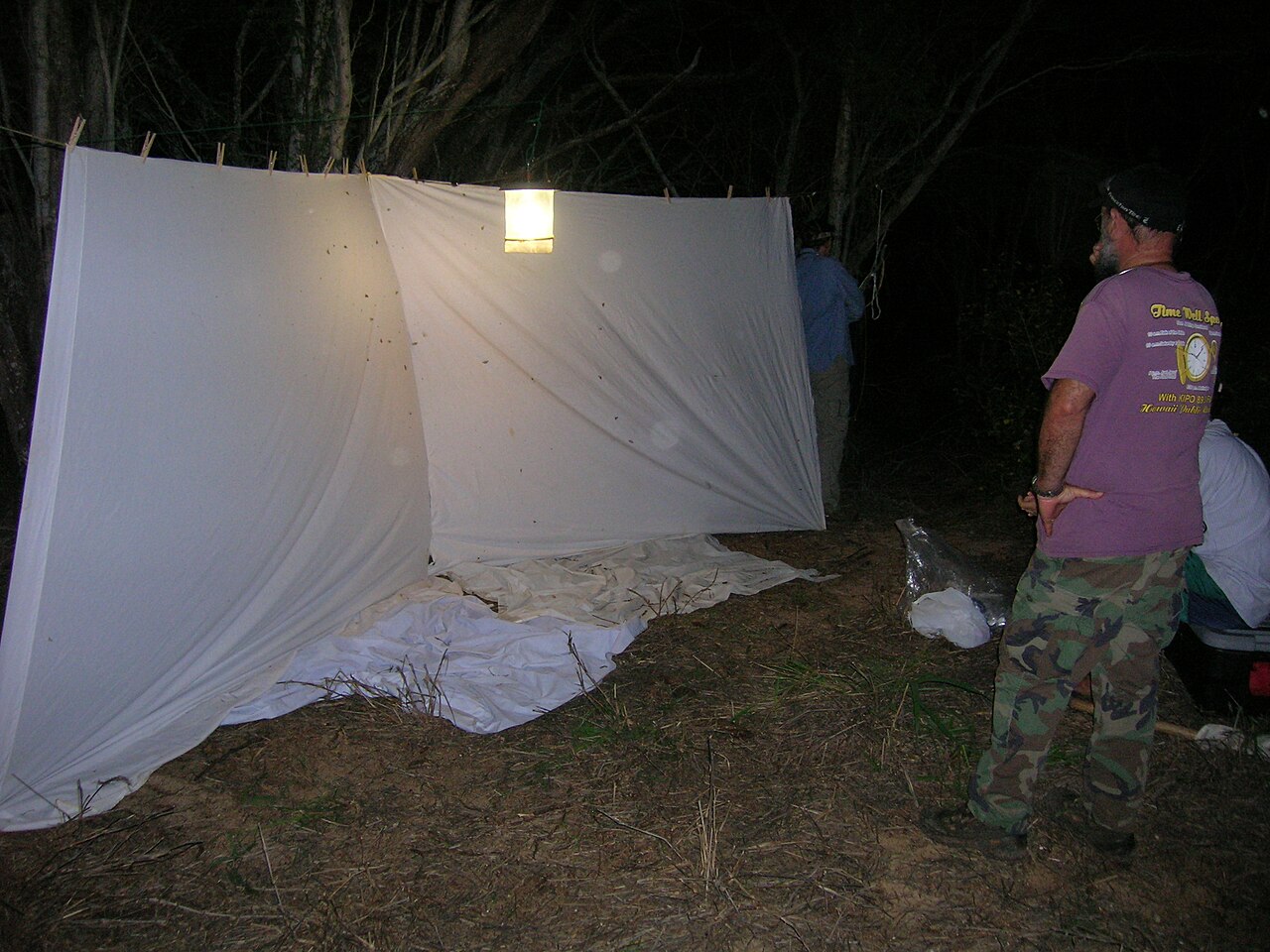
In Bhairab, Kishoreganj, the agriculture office is setting light traps in aman rice fields to find out which pests are present before anyone sprays. Farmers turn out to look at the traps and listen to the officers, but many cannot bring themselves to trust the advice that, for now, no pesticide is needed.
A light trap is a lamp left burning in a field for a short time at night. Pests drawn to light, such as stem borers, rice hispa and leaf folders, fly in and are caught, and the catch tells officers what the field needs. It is a cheap method that cuts unnecessary spraying.
The upazila agriculture office says 2,465 hectares of transplanted aman were planted in Bhairab this season. It plans 220 traps across 22 blocks, and 175 are already in place. Each trap covers about 20 hectares; it is lit for an hour to an hour and a half and never set twice in the same spot.
On Tuesday evening a trap at Darichandiber in the municipality block caught 2 stem borers, 3 leaf folders, 3 green leafhoppers and 25 short-horned grasshoppers, along with some beneficial insects. The brown planthopper, one of rice's worst pests, was not found. Officers advised farmers to hold off on pesticide and to use perching: sticks or branches pushed into the field so that insect-eating birds can sit and hunt.
Murad Mia, who grows aman on 65 decimals, asked how his rice would survive without poison. Zahir Mia, with 35 decimals, put it bluntly: "What if they eat all the rice?" Nabi Hossain had a different story. On 70 decimals he used to spend about 2,500 taka on pesticide; following the advice he spent 800 taka this season, and his crop is doing well so far.
Deputy assistant plant protection officer Mizanur Rahman said farmers are interested, but fear that a missed spray will ruin the crop. Chandan Kumar Sutradhar, a sub-assistant agriculture extension officer in Jhagrarchar block, said the benefit of the traps is not something farmers can see directly. Officers also concede that a pest missing from a trap is not proof it is absent from nearby fields.
Trap results are recorded by block officers, discussed at the agriculture office and reported to the district. No trap has found brown planthopper this year, the office says. Winning farmers' trust in a method that saves them money on chemicals is now the office's main task.
This report is based on Prothom Alo Bhairab correspondent Suman Molla's story.
Photo: a light trap set at night to catch insects, Forest & Kim Starr / Wikimedia Commons (CC BY 3.0)
Source: Prothom Alo

Comments
(0)