
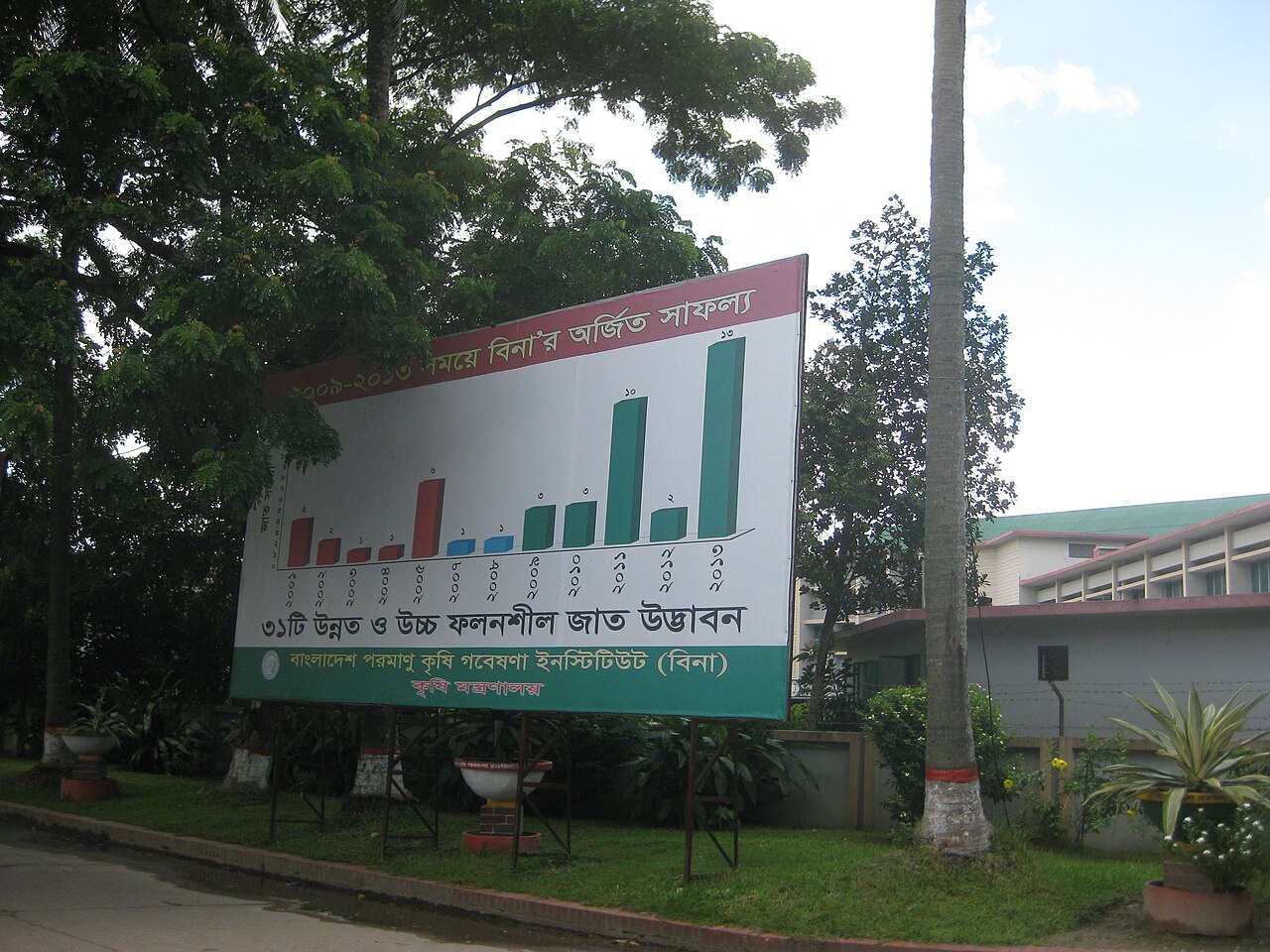
The Bangladesh Institute of Nuclear Agriculture (BINA) has developed 139 high-yielding, improved varieties of 22 crops, 96 of them directly through mutation breeding using radiation. It has also produced 10 biofertilisers and 57 farming technologies, according to a special report by the state news agency BSS.
Mutation breeding exposes plants to radiation such as gamma rays, X-rays or ion beams to change their genes, and breeders then select plants with the traits they want. BINA's acting director general Shariful Haque Bhuiyan told BSS that the peaceful, controlled use of nuclear energy had brought many changes to the country's farming.
The report points to Binadhan-14 as an example. Breeding a rice variety conventionally takes 8 to 12 years; with ion-beam technology BINA produced this short-duration, high-yielding variety in four. The report also credits salt- and flood-tolerant varieties such as Binadhan-10 and Binadhan-23 with bringing 40 to 50 percent of the coast's fallow land into cultivation.
The varieties comprise 26 of rice (2 aus, 14 aman, 10 boro), one of wheat, 37 oilseeds (12 mustard, 12 groundnut, 7 soybean, 6 sesame), 41 pulses (12 lentil, 13 mung bean, 11 chickpea, 3 black gram, 2 grass pea), 25 horticultural crops (13 tomato, 3 lemon, 2 each of onion and chilli, and one each of turmeric, garlic, jujube, sapodilla and black cumin) and 4 of jute.
BINA's biofertilisers are now produced and supplied for chickpea, lentil, groundnut, soybean, mung bean, black gram, yardlong bean and dhaincha. The institute says they raise yields of pulses and beans by 20 to 45 percent and of soybean by 75 to 150 percent, with no need for extra urea.
BINA has also sequenced the genomes of local crops to make it easier to breed varieties that withstand drought, heat, disease and pests. It has won 31 national and international awards, 22 at home and 9 abroad, including the Independence Award in 2019.
Photo: BINA's sign on the Bangladesh Agricultural University campus, Ibrahim Husain Meraj / Wikimedia Commons (CC BY-SA 4.0)
Source: BSS


Comments
(0)