
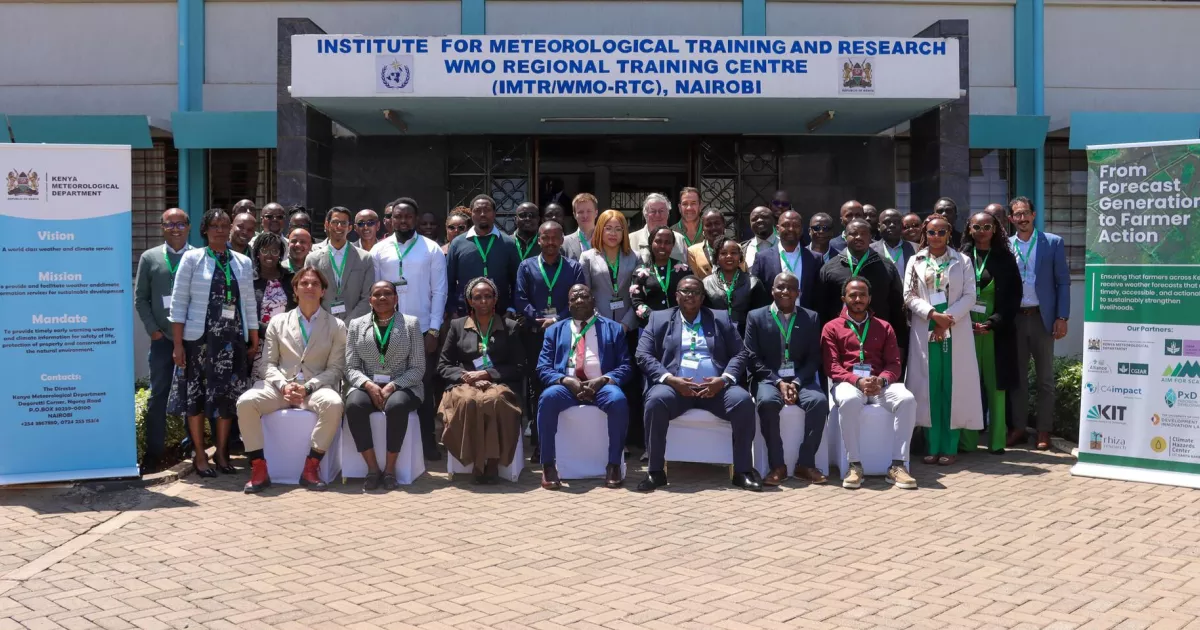
Kenya's weather service and agricultural researchers have launched a pilot to convert new rainy-season onset and sub-seasonal forecasts into practical advice for farmers before the 2026 short rains. The Kenya Meteorological Service Authority (KMSA), the Alliance of Bioversity International and CIAT and the AIM4Scale partnership are behind the effort, which was set out at a workshop reported by the Alliance on 24 August 2026.
For a farmer watching the first rains, the question is not whether rain is coming but whether there will be enough of it, for long enough, to make planting worthwhile. The pilot targets the two-to-six-week window in which planting decisions are made, combining established forecasting science with AI-based approaches and improved ground observations.
"A forecast translated into when to plant, what to plant, where to plant, and how to manage emerging climate risks becomes a decision support tool," said Simon Mulwa of KALRO. Charles Mugah of KMSA called for partners to build a data-driven, AI-enabled climate services value chain that strengthens farmers' confidence, and Dr. Agnes Kalibata, speaking for AIM4Scale, stressed that farmers need localised information that goes beyond whether it will rain.
The forecasting products were developed with KMSA by the Climate Hazards Center, the University Corporation for Atmospheric Research (UCAR), the Karlsruhe Institute of Technology and Rhiza Research. ECMWF-based sub-seasonal products giving six-week outlooks will be made available through APIs and machine-readable formats so that advisory partners can plug them into their own systems.
Presentations from FEWS NET and Precision Development underlined that complex climate information has to be turned into short, actionable messages. Participants reviewed a proposed non-binding charter under which partners commit to delivering location-specific forecast information, with KMSA as the authoritative source of weather information and technical working groups deciding how the products fit existing advisory channels.
A technical working group will now draw up a data-sharing framework. Consortium partners will run the pilot through the short rains and next year's long rains, with research institutions checking the forecasts against ground observations. Organisations are reviewing the charter and access conditions, with expressions of interest due shortly before the first working-group meeting and forecast data dissemination beginning in early September.
Joshua Deutschmann of the University of Chicago said the point of the exercise is to learn whether better forecasts actually change farmers' decisions. The workshop's achievement, the Alliance authors write, was to put in place a shared charter, common data standards, an authoritative source and a committed coalition so that improved forecasts can reach farmers at scale.
Source: CGIAR
Comments
(0)