
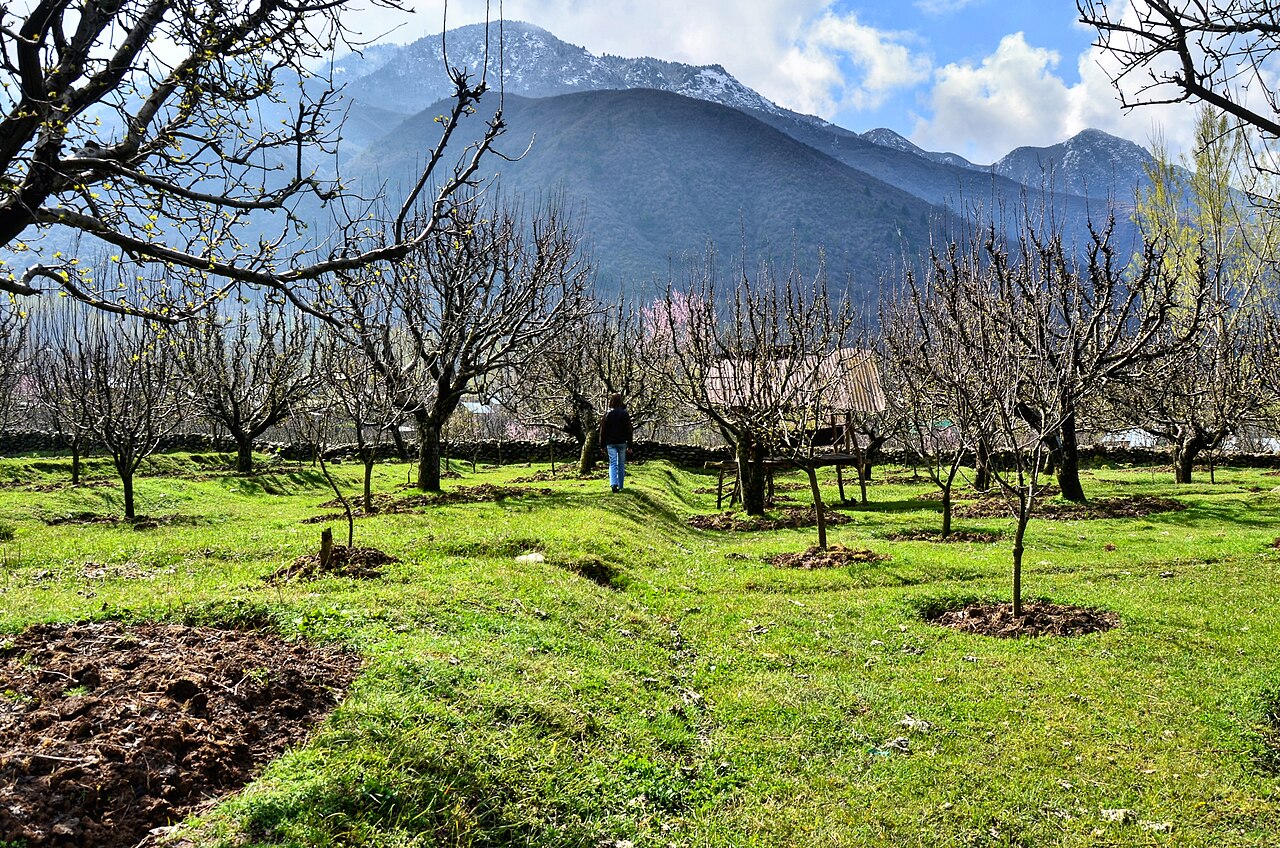
"Twenty years ago, all this was paddy," says Nazir Ahmad, a farmer in Qaimoh in south Kashmir's Kulgam district, pointing to rows of apple saplings, Mongabay India reports. The irrigation channels built for rice still run through the fields, but across the Kashmir Valley farmers are replacing food crops with orchards, above all high-density apple plantations, as costs rise and rice pays little.
The arithmetic is plain for individual growers. Nisar Ahmed earned ₹30,000 to ₹50,000 a year from rice on nine kanals (0.46 hectares) in Kulgam; after converting to a high-density orchard, his family earns around ₹4 lakh to ₹5 lakh a season. Jammu and Kashmir's paddy area fell to 258,840 hectares in 2024-25 from 304,500 hectares in 2015-16, about 15 percent, while apple area rose to 173,073 hectares from 107,930 hectares in 2004-05. In Kulgam, apples now cover 18,255 hectares against 6,951 under paddy.
The region produced about 650,000 tonnes of rice in 2024-25, yet brought in 4.86 lakh tonnes from surplus states, mainly Punjab and Haryana, up from 4.36 lakh tonnes the year before and 3.74 lakh tonnes in 2022-23. Ashaq Hussain, a professor of agronomy at the Sher-e-Kashmir University of Agricultural Sciences and Technology of Kashmir (SKUAST-K), estimates the territory grows only 50 to 55 percent of the rice it needs. Kashmir's agriculture director, Sartaj Ahmad Shah, said his department keeps no data on how much paddy land has been converted, though he acknowledged dependence on outside rice has grown. No policy specifically protects paddy land from conversion to orchards.
Scientists point to wider effects. SKUAST-K researcher Sameena Lone said orchards change soil structure and moisture, and a narrower range of crops exposes farmers to market swings, pests and weather; a recent hailstorm damaged orchards in Shopian and Kulgam, some for the third time that season. Pir Rayees Ahmad, a hydrogeologist at the Central Ground Water Board, said flooded paddies recharge shallow aquifers and store rain like a buffer, so losing them can mean less recharge and higher flood peaks in the Jhelum floodplain. Low-lying, moist land also suits rice better than trees, Hussain said, warning of root rot and disease when such land is planted with orchards.
Economists disagree on the risk. Ejaz Ayoub argues Kashmir should grow what it does best, such as apples, saffron, almonds and walnuts, and buy rice with the income. Javaid Iqbal Khan of the University of Kashmir calls the trend a "macro-level structural hazard": rational for each farmer, but risky when added up, since it ties the Valley's food supply to roads, markets and supply routes.
Photo: Revoshots / Wikimedia Commons (CC BY-SA 4.0)
Source: Mongabay India

Comments
(0)