
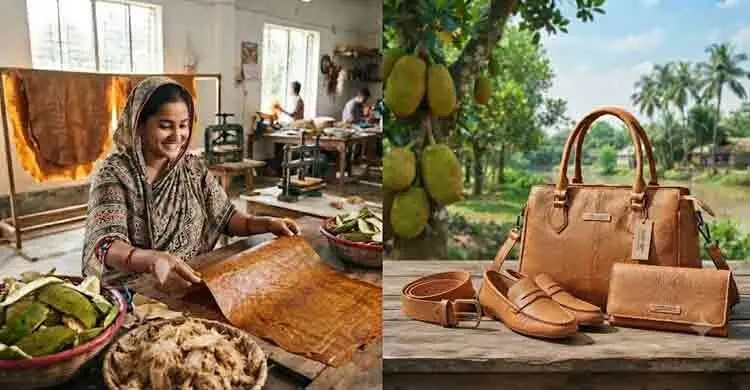
A quiet revolution has begun in the fashion industry amid the global push for climate action and sustainable development. With ethical debate over animal leather and the environmental damage of synthetic leather growing, researchers have long searched for a fully natural, eco-friendly alternative, and Bangladesh's national fruit, the jackfruit, is now at the centre of that search.
Jackfruit peel, stems and inner fibre, once discarded as waste, are now being made into plant-based "vegan leather". Recent initiatives by researchers and the Food and Agriculture Organization of the United Nations (FAO) show that eco-friendly leather can be made from jackfruit waste, and it is emerging as an alternative to plastic and animal leather.
A large, unused resource
As the world's second-largest jackfruit producer, Bangladesh could open a new chapter with this industry. About 60 per cent of the hundreds of thousands of tonnes of jackfruit grown each year goes to waste. According to the Department of Agricultural Extension (DAE), the country produces more than 1.05 million tonnes of jackfruit a year, but for lack of cold storage and processing much of it rots in the field or is dumped. The report argues that commercialising this biopolymer technology could, within a decade, bring export earnings alongside the traditional leather industry.
How the leather is made
Drawing on waste-management research and the Philippine LANGKAtulad project (2025), the report describes five main steps:
- collecting and sorting discarded peel, stems and fibre, then washing them free of bacteria;
- crushing them in hydraulic machines and extracting lignocellulosic fibre by chemical or enzymatic treatment;
- mixing the fibre with natural resins, plant waxes and eco-friendly polymers such as polyvinyl alcohol to improve durability and water resistance, a stage called biomimetic material design;
- rolling the mixture into thin sheets and drying them at a set temperature;
- dyeing the material with natural colours and pressing a leather-like grain texture onto it.
The result looks and feels like real leather, with no harm to animals and a carbon footprint close to zero.
Why it matters
Toxic chemicals such as chromium and cadmium used in tanning harm the environment and public health, and waste from the Hazaribagh and Savar tanneries has polluted the Buriganga and Dhaleshwari rivers. Commercial jackfruit leather is still mainly at the start-up and laboratory stage, less mature than pineapple or mushroom leather.
Under FAO's "One Country One Priority Product" (OCOP) initiative, jackfruit has been selected as Bangladesh's priority product, and several women entrepreneurs trained under FAO have begun making plant-based leather on a small scale alongside jackfruit pickles, burgers and cakes. Linking jackfruit waste to Savar's tanning experience could create a major sustainable backward linkage.
Benefits and challenges
Buying peel and waste would give farmers extra income when jackfruit prices collapse in season, cut the stench and methane from rotting peel, and create jobs, particularly for rural women. The challenges are a lack of high-tech machines and laboratories, a raw material available only from April to August, which would need storage or dried pulp, and a shortage of investment and green finance.
Sources cited by the original report include FAO and SCRIBD.
Source: Jagonews24. First published in Bengali on The Agro News.
Comments
(0)