
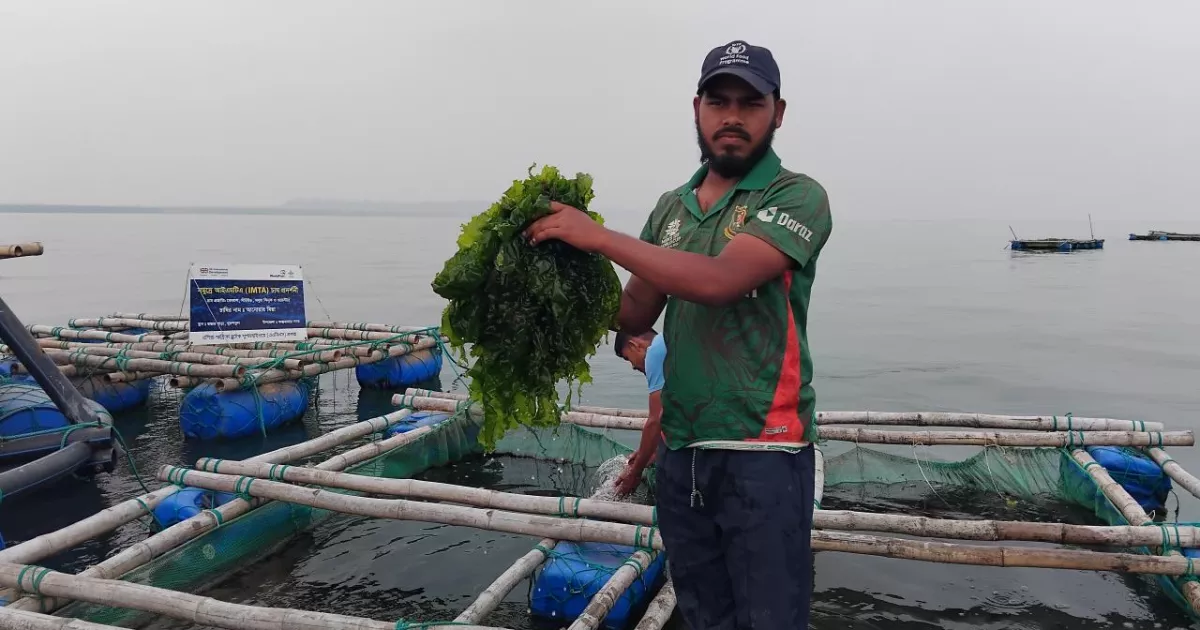
Fish, shrimp, shellfish and aquatic plants grown together in one system can produce more food from the same water. Between June 2025 and March 2026, WorldFish tested that idea on the Bangladeshi coast with 131 farmers in Khulna and Cox's Bazar, running seven models of integrated multi-trophic aquaculture — four pond-based and three nearshore marine — under the Asia-Africa BlueTech Superhighway project.
The principle is that species use different parts of the system. Shrimp, prawn and finfish are stocked alongside extractive organisms — mussels, oysters, seaweed, aquatic plants — so that nutrients one species releases are taken up by another, and the farmer harvests more than one product from the same pond or the same stretch of water.
Results varied sharply between models. Among the pond systems, the golda prawn (Macrobrachium rosenbergii) with rui (Labeo rohita) model gave the highest total yield, 4,190 kilograms a hectare per cycle. The bagda shrimp (Penaeus monodon) with nona tengra (Mystus gulio) and parshe (Liza parsia) model gave the best return: a benefit-cost ratio of 2.81 and a 181 per cent return on investment. Across the pond systems assessed, shrimp, prawn and finfish biomass ran 2.7 to 9.5 times higher than in the conventional systems used for comparison, and some models more than doubled survival rates.
Among the marine models, the parshe-seaweed-mussel-oyster combination made the highest net profit, BDT 1,945 per cubic metre.
The trials also showed where the difficulty lies, and it is mostly in the sea. Marine integrated systems need substantial investment, and the seasons of the different species do not always line up. Quality seed is scarce for several marine species — farmers still depend on wild sources for Asian seabass, nona tengra, seaweed and bivalves — and specialised feed for marine finfish is not widely made in Bangladesh.
Beyond production, the markets are thin. There is limited demand for seaweed and bivalves, and wider use will need stronger food safety and handling systems, including standard procedures for bivalve depuration — the controlled process of holding live shellfish in clean water to reduce contamination.
The project trained 1,127 farmers in pond-based practices, and 400 coastal women in Cox's Bazar took part in nutrition activities including cooking demonstrations using seaweed and bivalves. It produced five peer-reviewed journal articles, three publications in Department of Fisheries compendiums, and Bangla-language material including an IMTA manual and display banners.
The clearest finding, in the authors' words, is that "there is no single IMTA model for all coastal areas" — performance depends on local conditions, the species combined, costs, access to seed and feed, farmer capacity and the market. The findings were presented at a closing workshop at the Department of Fisheries in Dhaka on 2 September 2026.
Source: CGIAR
Comments
(0)