
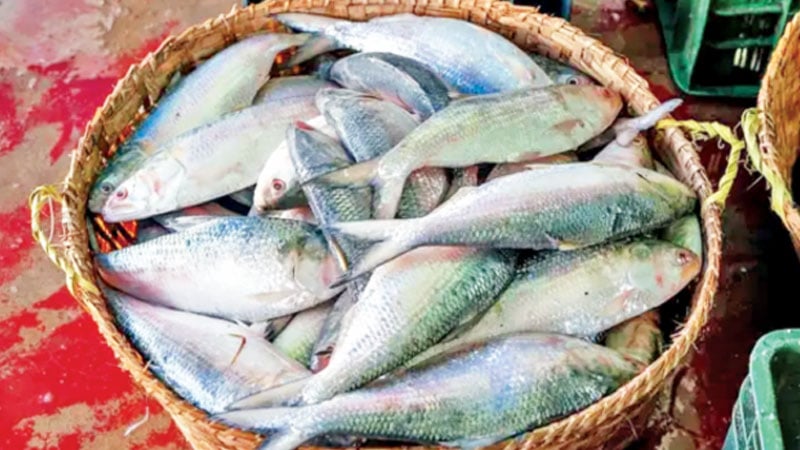
Hilsa is being shipped from Gujarat in India into Bangladesh. At the same time, the Indian traders sending that fish are asking for permission to take hilsa from the Padma and the Meghna out of Bangladesh. Two very different markets sit behind this two-way trade.
Syed Anwar Maksud, general secretary of the Howrah Wholesale Fish Market Association and the Fish Importers' Association of India, told Kolkata media that about 500 tonnes of hilsa had been sent from India to Bangladesh over the past two to three months, with orders for another 150 to 200 tonnes in the next week or two.
National Board of Revenue figures show 22 firms imported 352,786kg of hilsa through the Benapole land port in July and August of the 2026-27 financial year, at an import value of Tk6.92 crore. Across the first nine and a half months of the year, about 427,000kg of hilsa has come from India.
Even so, on 9 September the Fish Importers' Association of India wrote separately to the Prime Minister's Office, the Ministry of Foreign Affairs and the Ministry of Commerce asking for Bangladeshi hilsa. Eighteen Bangladeshi firms sought permission to export hilsa to India in the same period. The commerce ministry has asked the Ministry of Fisheries and Livestock for its view.
What draws buyers to Gujarat's hilsa is the roe. The Narmada meets the sea at Bhadbhut in Bharuch, and a significant quantity of hilsa is caught in that estuary. Traders say hilsa costs 700 to 800 Indian rupees a kilogram in Gujarat, falling to 300 to 400 rupees when supply rises; Maksud said the fish sells to Bangladeshi importers at an average of about 600 rupees before transport.
Abdur Rahman, a fish trader at Karwan Bazar in Dhaka, said Bangladeshi hilsa carries little roe because of the ban during the spawning season, while Gujarat's fish is larger and full of it. Some importers are therefore after the roe: it is separated, processed and packed for markets in the United States, the United Kingdom, Europe and the Middle East, while the rest of the fish is salted, dried or otherwise processed and sold.
A study by researchers at the Bangladesh Fisheries Research Institute's Chandpur river station, published in 2018, found that roe was collected from some of the cheaper hilsa landed at Chandpur, packed in plastic boxes with ice and sent to seafood companies in Chattogram. Observation between August and November 2016 recorded 3,225 boxes in transit, each holding about 2.5kg of roe — roughly eight tonnes in that period alone.
Dr Md Khaled Kanak, director general of the Department of Fisheries, said he had heard that hilsa roe goes abroad through Chattogram every year and that salted hilsa moves around the country in tins, but that the department keeps no record or statistics of it.
Source: Samakal (report by Zahidur Rahman)
Comments
(0)