
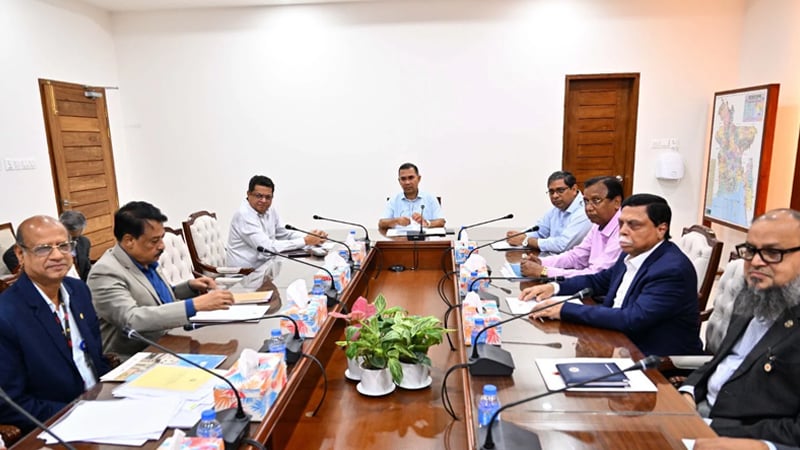
Prime Minister Tarique Rahman has ordered a coordinated drive to stop pollution and improve the environment of the Gulshan, Banani, Baridhara, Niketan and Dhanmondi lakes in Dhaka. He stressed cutting off the flow of sewage into the lakes, regular removal of waste, installation of sewage treatment plants (STPs) and faster work by the agencies responsible.
The directives came at a meeting the Prime Minister chaired on Thursday noon in the Cabinet Division conference room at the Secretariat, deputy press secretary Sujauddaula Sujan Mahmud said. The meeting reviewed the present condition of the lakes in Gulshan, Banani, Baridhara and Niketan, the sources of their pollution and the plans for their restoration, and the Prime Minister examined the progress of Dhaka South City Corporation's work on Dhanmondi Lake, including its renovation, sludge removal and pilot project.
The meeting was told that six primary and six secondary points have been identified through which polluted water and sewage enter Gulshan Lake. A technical committee set up to address the problem presented short-, medium- and long-term recommendations: closing the sewage inlets, building-level STPs and a detailed survey of the existing sewerage network. Directions were also given on conditional collection of sewerage bills in the Gulshan-Banani area and on creating catchment areas to improve drainage.
To speed up cleaning, the Prime Minister ordered the number of mechanical boats removing floating waste to be raised from two to ten, and stressed removing the sludge on the lake beds with floating excavators and keeping up regular cleaning. The meeting also emphasised that buildings covered by the Dhaka Metropolitan Building Rules 2025 must install STPs within the set deadline.
Dhaka WASA and Dhaka North City Corporation were asked to work together to identify homes and commercial premises whose sewer lines discharge directly into storm drains or the lakes, and to cut off the illegal connections. Proposals were also tabled to install aerators to raise the oxygen level of the water, to combine biological and chemical methods to remove the stench, and to build a long-term sanitation network. RAJUK reported that five special teams of 42 staff are already deployed to conserve, clean and maintain the lakes under its charge.
Housing and Public Works Minister Zakaria Taher, State Minister for Local Government, Rural Development and Cooperatives Mir Shahe Alam, Dhaka South City Corporation administrator Md. Abdus Salam, Dhaka North City Corporation administrator Md. Shafiqul Islam Khan and the Prime Minister's principal secretary A B M Abdus Sattar attended along with senior officials. The technical committee's case is that once sewage stops entering the lakes, their oxygen and aquatic life can recover. The report was carried by BSS.
Source: Samakal

Comments
(0)