
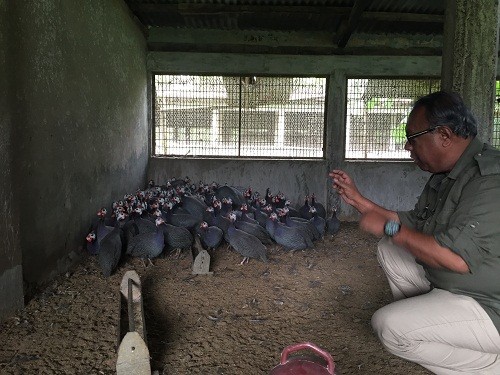
The nearly endangered guinea fowl (titir) is showing new commercial potential. A government project is under way at the Faculty of Poultry Science of Bangladesh Agricultural University (BAU), and the bird is already spreading.
From Africa to South Asia
The noisy bird that fills the farm with constant calls was domesticated from the wild in Africa 700 years ago and reached South Asia via Europe during British colonial times. In Bangladesh it is somewhat known as "China chicken", but commercial poultry pushed it towards extinction.
Heavier than native chickens
Professor Subash Chandra Das of BAU's poultry science department says it has great value as a source of eggs and meat. A native chicken weighs 700 to 800 g, at most 1 kg, at six months, while a guinea fowl weighs 1,500 to 1,600 g or more. After six years of observation, he says the bird copes with adversity where commercial chickens cannot. With all stages from hatching to rearing completed at the research farm, it is now spreading to entrepreneurs' farms.
Cheap to feed
Farmers say the disease-resistant bird costs much less to feed than commercial or native chickens. Farmer Ibrahim Khalil said there is no grass the guinea fowl will not eat; they live on natural food. His birds eat 6 kg of paddy in 24 hours, costing 100 taka, whereas one meal of poultry feed would cost 400 taka.
Source: Shykh Seraj, Hridoye Mati O Manush. First published in Bengali on The Agro News.



Comments
(0)