
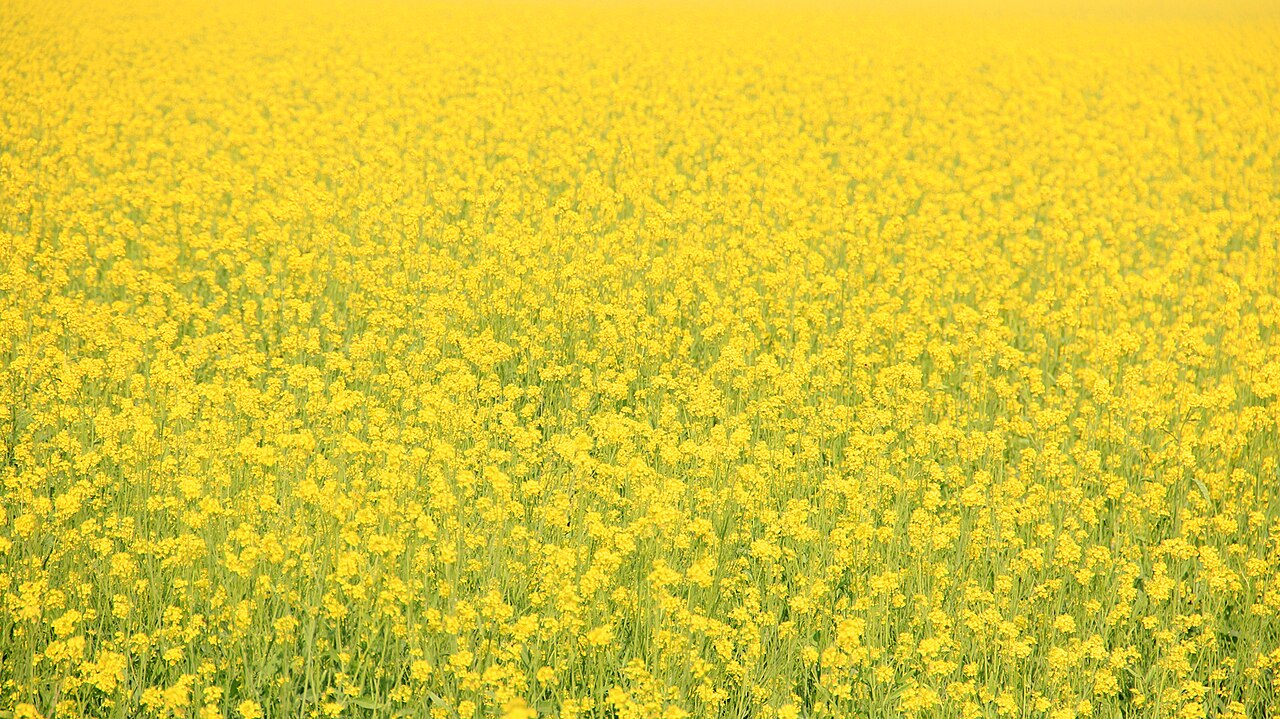
Field demonstrations of green ammonia as a nitrogen source for mustard are under way on about 300 acres in Mahendergarh district of Haryana, and senior officials of the Indian Council of Agricultural Research (ICAR) have visited Khatodhara village to review them.
The demonstrations are run by the Krishi Vigyan Kendra (KVK), Mahendergarh, under Chaudhary Charan Singh Haryana Agricultural University (CCS HAU), Hisar. They compare green ammonia with conventional urea-based nitrogen management in mustard, measuring crop growth, productivity, nitrogen use efficiency and economic viability. The team saw good crop establishment at the early stage in fields sown after green ammonia was applied.
Dr Rajbir Singh, ICAR's Deputy Director General for Agricultural Extension, said liquid ammonia contains about 82% nitrogen and is placed at the right soil depth with specialised equipment, and that the trials would show whether it can improve nitrogen availability and use efficiency. He asked scientists to collect systematic data on growth, yield, fertiliser use, cultivation costs and returns, and to give farmers accurate, evidence-based information on emerging technologies.
Dr A. K. Nayak, ICAR's Deputy Director General for Natural Resource Management, said the aim is to find effective, affordable and resource-efficient nitrogen options for mustard growers in the district, and asked farmers to bring their problems to ICAR and CCS HAU through the KVK.
The results will be evaluated for agronomic performance and economic benefit under local conditions, and are expected to guide future nitrogen recommendations for mustard, according to ICAR's Agricultural Technology Application Research Institute, Zone-II, Jodhpur. The officials' visit coincided with the Dussehra festival.
Photo: Nitin Das / Wikimedia Commons (CC BY-SA 3.0)
Source: ICAR
Comments
(0)