
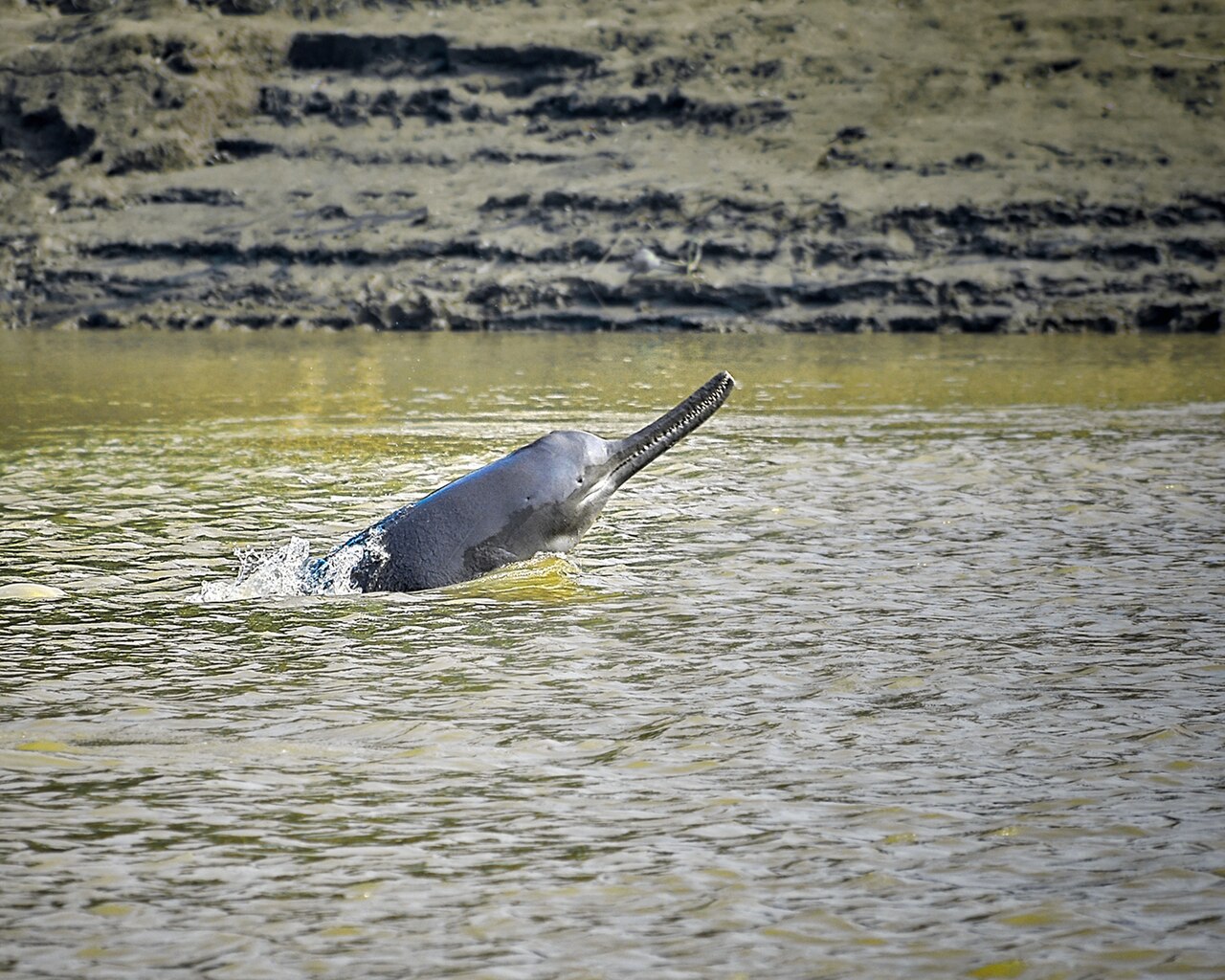
Ganges river dolphins in the tidal Rupnarayan river in West Bengal are detected most often at dawn and dusk and at lower water levels, a month-long acoustic study published in Aquatic Mammals has found, Mongabay India reports.
Researchers from the Wildlife Institute of India (WII) anchored an underwater recorder, an F-POD that listens for the echolocation clicks dolphins use to find their way and their food, at one site from 4 to 31 January 2024. It logged 651 hours. The team counted 'detection positive minutes', the minutes in each hour with at least one train of dolphin clicks, and compared them with time of day, tide height and the phase of the moon.
Detections peaked around 4-6 am and 6-8 pm and were lowest between about 10 am and 3 pm, a pattern that did not match earlier studies, said corresponding author Vishnupriya Kolipakam, a scientist at WII. The clearest link was with the tide: detections peaked at water levels of about 1.5 to 2 metres and fell sharply above about four metres. First author Gargi Roy Chowdhury said lower water may concentrate prey, or dolphins may spread out and move beyond the recorder's range when the river is high.
Detections also fell towards the new moon and rose as the moon waxed, but that finding is preliminary because the study covered only one lunar cycle, and it did not measure prey. Imran Samad of the Indian Institute of Science, who was not involved, said the clicks show the dolphins are present but cannot reveal exactly what they are doing.
The Rupnarayan is an 85-km tributary of the Hooghly, with tides from the Bay of Bengal, intense motorised fishing and the Kolaghat thermal power plant downstream. The authors say dolphin surveys should standardise tidal state, and Chowdhury noted that the largest, loudest vessels and the dolphins are active at similar times, with commercial traffic concentrated around high water, so the risk to the animals falls in identifiable windows.
The report was written by Priyanka Shankar for Mongabay India.
Photo: Kukil Gogoi / Wikimedia Commons (CC BY-SA 4.0)
Source: Mongabay India

Comments
(0)