
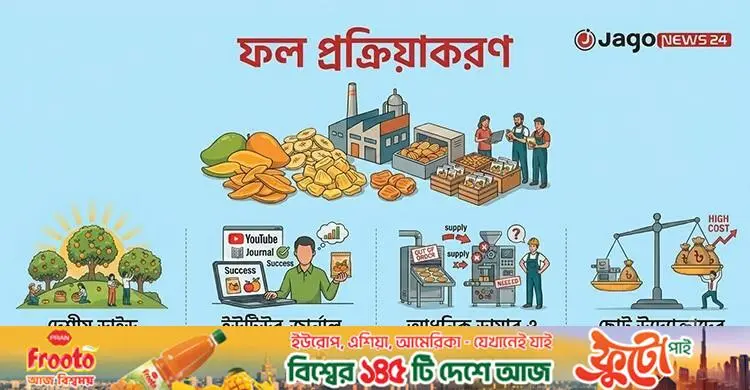
Fruit processing entrepreneurs in Bangladesh can find training, but they are short of modern machinery and technical support. Many teach themselves from YouTube and foreign research papers to make value-added products. Officials say government support is growing but remains limited compared with need.
Entrepreneurs say access to drying, processing and packaging machines is still a major challenge, and many still process fruit with traditional knives and blades. They also say they often cannot get the help they need from agriculture officials and scientists on how to process a particular fruit.
Learning by trial and error
Ismail Khan Shamim, general secretary of the Shibganj Mango Producer Cooperative Society in Chapainawabganj and owner of "Nawabi Mango", makes aamshotto (mango leather), mango bars, dried mango slices and dried mango, dried pineapple and pineapple candy, and dried papaya. He failed 40 times while mastering dried mango slices, losing about 100 maunds of mangoes. "Every product I make comes from my own research and development," he said. Journals from other countries helped most, followed by YouTube videos from the Philippines, Brazil and Mexico, each giving part of the information; his last breakthrough, keeping the colour, came from a Philippine video. Local experts, he said, often cannot answer his questions on texture and quality. He said the local dried fruit market is large but mostly supplied by imports, and with support entrepreneurs could build a strong local brand while cutting waste.
Md. Sohel Rana of Barendra Agro Park in Sapahar, Naogaon, dries tomato, mango, banana, moringa leaves, neem leaves and arjun and makes powders using a hybrid smart dryer that runs on solar power by day and electricity at night. He needs powder-making and packaging machines and modern packaging materials, which are expensive for small entrepreneurs. He has received training but no machinery; the PARTNER project now offers up to 70 percent support for buying processing equipment, but he wants special initiatives for dryers and packaging in the mango regions of Naogaon and Chapainawabganj.
Mohammad Kanchan Mia, managing director of Hajera Agro Private Limited and owner of Arot Agro BD, makes jackfruit chips, fresh-cut jackfruit, jackfruit pickle and jam, and jackfruit seed powder. The biggest challenge is the fruit's sticky latex, and fast ripening leaves little time for processing. Most work is done with knives, blades and axes, while developed countries use automatic machines for washing, cutting, sizing and packaging. Jackfruit products have strong demand in the UK, France, Italy, Germany, the Netherlands, Sweden, Denmark and Norway, he said, but Bangladesh has not established itself because of technological limits.
What the agencies say
- Mitul Kumar Saha, joint director (marketing) of the Hortex Foundation, said it trains mainly women entrepreneurs in processing mango, jackfruit, tomato and other produce and supplies dryers, jackfruit chip equipment, chemicals and small pack houses with washing, grading, sorting, drying, packaging and weighing facilities, but its budget is limited.
- Mohammad Munsur Alam Khan, director at the Department of Agricultural Marketing, said projects provide training and cost-shared financial support to buy machinery, though resources cannot cover everyone.
- Dr. Md. Golam Ferdous Chowdhury, chief scientific officer of BARI's Postharvest Technology Division, said the sector was long neglected as investment focused on production. Under the PARTNER project, the Department of Agricultural Marketing aims to develop about 20,000 entrepreneurs nationwide with 11 to 12 days of hands-on training in processing, storage, packaging, marketing, certification and export, plus matching grants for machinery and packaging. BARI is developing new processing technologies.
Entrepreneurs say that although training has increased, they are still not getting the technical support and modern machinery they need.
Source: Jagonews24. First published in Bengali on The Agro News.
Comments
(0)