
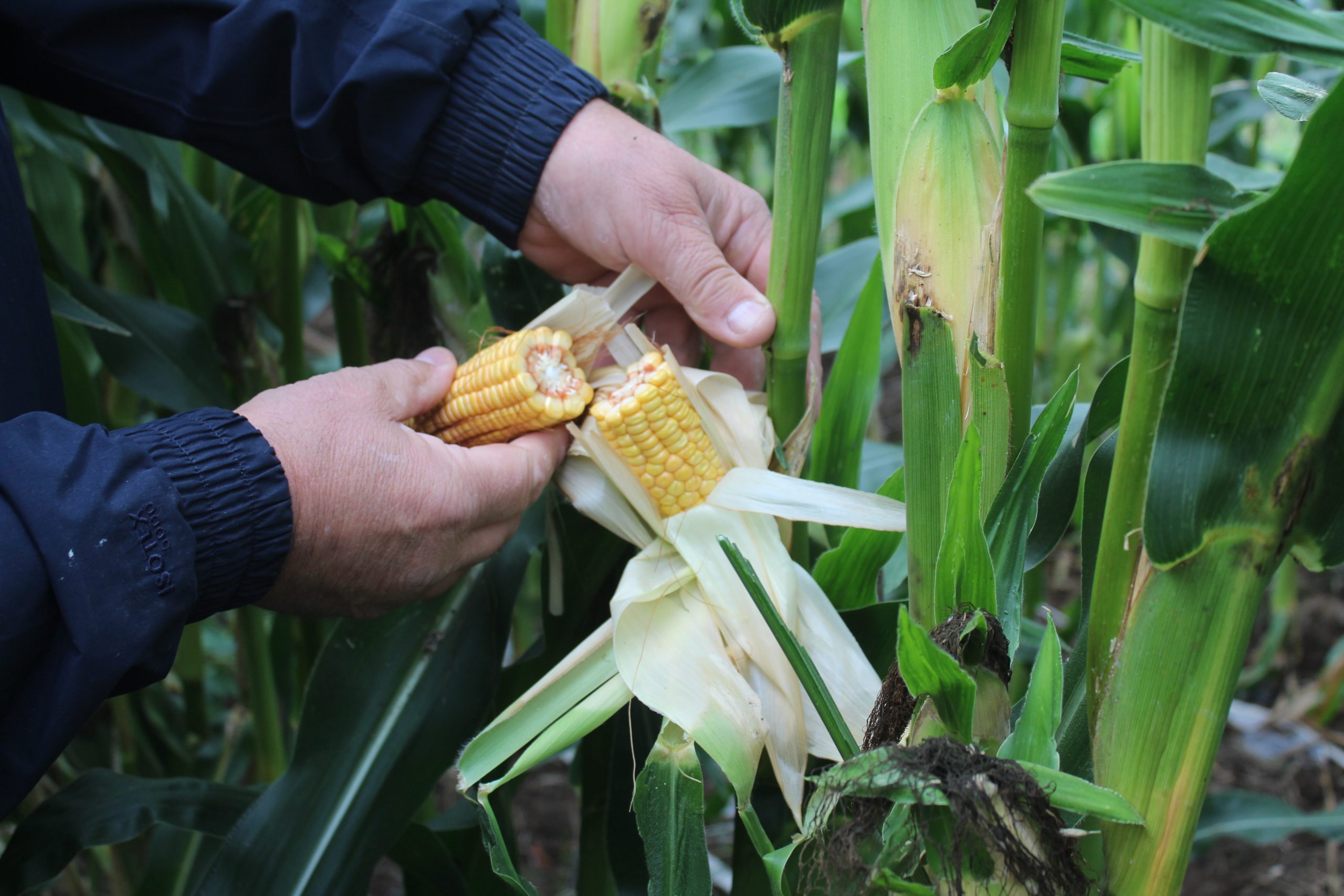
This year's forage maize harvest in Northern Ireland could be one of the earliest on record, with a significant acreage expected to be ensiled in the last few days of September. A troublesome spring and a challenging June left many crops looking backward, but the dry, warm July and August turned them round, according to Maizetech's Robert Duncan, who walked crops on his own Co. Antrim farm to show how harvest readiness is judged.
Cobs on the outside of a field are no guide, Duncan said, because they have had all the week's sunshine. The test is to walk into the crop, pick an average plant and judge its top cob: peel back the sheath and, when the inner leaf touching the kernels feels like tissue paper, dry matter should be above 30 per cent and the plant will have stopped moving sugars into the cob. Break the cob in half and squeeze a kernel; no moisture should come out.
His most advanced crops, of the Pioneer 7034 variety, should be ready for the silo within a fortnight. The key criteria are full starch maturity and dry matter of 30 per cent or more while the plant is not fully desiccated, so that digestible fibre in the whole plant is captured. Before film established crops, he recalled, maize was left until November and looked as if it had been sprayed with glyphosate; today's crops go into the pit with high levels of green material.
Varieties fall into dent and flint types. Starch in a dent variety is available almost at once, so its silage can be fed within about a week of cutting; flint types take three or four weeks. A grower who wants to feed maize early in the season should put dent forage at the front of the pit. Dent varieties were unavailable in Ireland for many years, and 7034 is in its third season in Northern Ireland.
Duncan endorsed a silage additive on maize, not to drive fermentation but to stabilise the forage at feed-out, especially for pits kept into a warmer spring. He also warned against chasing fresh weight: an immature crop might yield 18–20 tonnes an acre fresh, but a fully mature one at 30 per cent-plus dry matter will come in at around 17 tonnes with far higher feeding value. Sugars are still moving from leaf to cob while air temperatures stay above 10°C, and he recommended a cutting height of 8–10 inches to keep the stem's digestible fibre without skimming soil.
On nutrition, he said trial work now favours holding back part of the crop's nitrogen and trace elements at sowing and applying the balance as a foliar feed when the crop is knee-high, just before its main growth surge, rather than putting the full requirement into the seedbed.
Reported by Richard Halleron for Agriland.
Source: Agriland

Comments
(0)