
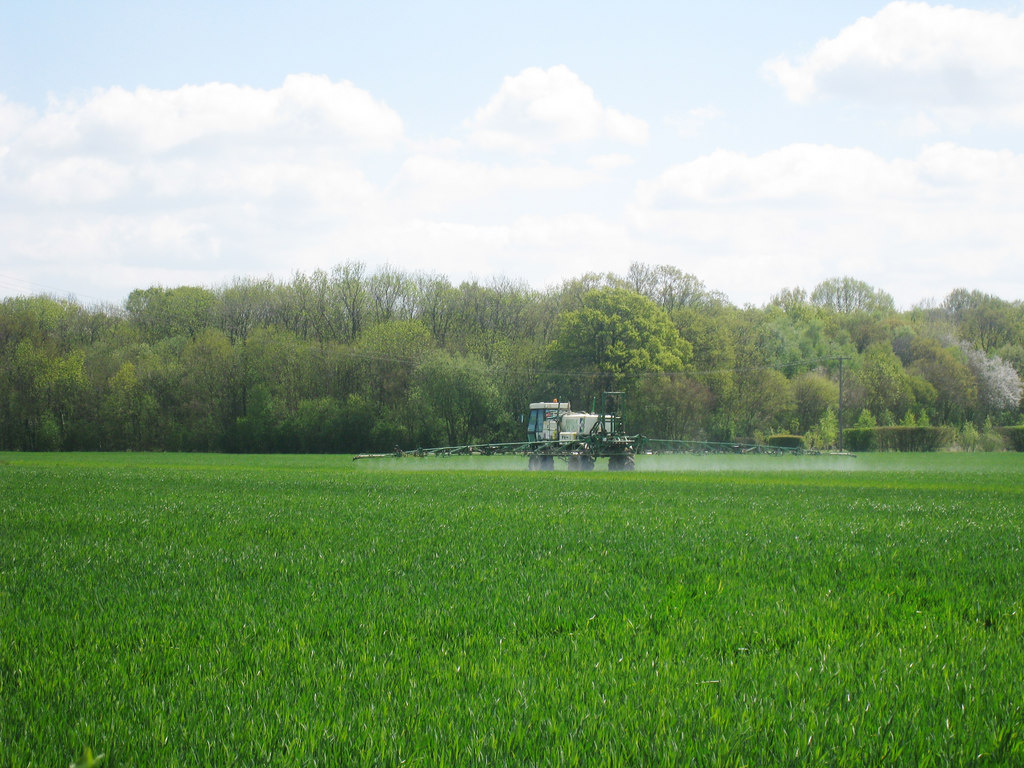
Applying later-season nitrogen to the leaf instead of the soil is catching on with some UK farmers aiming to use nitrogen more efficiently and cut inputs, Farmers Weekly reports from three farms. Many learned the principles from Joel Williams of Integrated Soils, whose online foliar nitrogen masterclass launched in 2023.
Rhys Jones, farm manager at Pearson Gape Farming Partnership in Cambridgeshire, started when growing wheat for Wildfarmed, which capped total N at 80 kg/ha, and reached 6 t/ha at 13% protein. Finding bought-in products expensive, he now melts urea on farm: 800 kg of urea in a 2,000-litre cone tank of rainwater pre-heated to 30C, agitated by a compressor, takes about four hours. Diluted by half, it supplies about 10 kg/ha of N, 90% from urea and 10% from ammonium sulphate, with fulvic acid, seaweed, amino acids and molasses. Foliar sprays start around flag leaf after about 140 kg/ha of soil N, roughly a 20% cut without any effect on yield or quality, and are applied at night when droplets will sit on the leaf. The farm now leads an Adopt project to gather hard data.
In Suffolk, James Bucher of Hall Farm uses a bought product at about 10 kg/ha of N with fish hydrolysate, seaweed, humic acid and trace elements chosen from sap analysis, sprayed early in the morning to avoid scorch. Combined with digestate and 40 kg/ha of granular N in March, his total has fallen from 200-220 kg/ha to about 120 kg/ha, and with costs near £900/ha he is trying a protein hydrolysate made from his own beans.
Pembrokeshire dairy farmer Andrew Rees followed a European Innovation Partnership project showing the same grass could be grown with up to 50% less nitrogen. Cutting from 220 kg/ha in 2019 to 83 kg/ha in 2021 gave a flat line in dry matter used, he said, while cows failing to get back in calf and mastitis cases both roughly halved. He mixes urea in the tank with a Tow and Fert applicator and now applies virtually no synthetic nitrogen to grazing ground, using separated slurry instead.
Photo: Oast House Archive / Wikimedia Commons (CC BY-SA 2.0)
Source: Farmers Weekly

Comments
(0)