
Around six million Cambodians work in fisheries or related activities, and fishery products are worth roughly USD 1.5 billion a year — between 8 and 12 per cent of the country's GDP. The country also has a long tradition of processing freshwater fish into paste, fermented fish, salted and dried fish, smoked fish and fish sauce. What a cooperative in Prey Veng province has shown is how quickly that tradition converts into a second income when someone teaches the technique properly.
The Mean Chey Agricultural Cooperative had been supported since 2022 through the Asian Mega Delta initiative under the Nutrition-Sensitive Agri-Food System programme, led by WorldFish with the International Institute of Rural Reconstruction. Thirty-nine households received technical training in fish farming — pond preparation, stocking, feeding — and fingerlings were supplied to small-scale households. Two fish-raising groups were formed and followed up.
A needs assessment then found what members actually wanted next: how to make fermented fish, Trey Praheum, and how to produce, package and store fish sauce properly. None of them had had formal training in it.
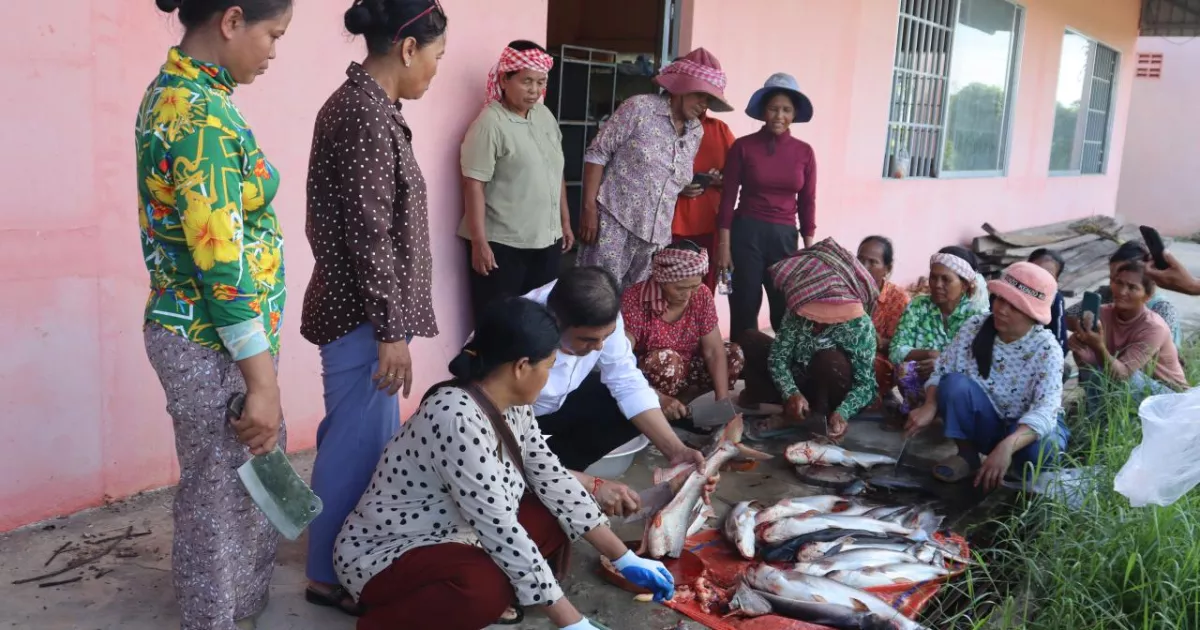
In October 2025, 19 participants — 18 of them women, from the cooperative committee and the Fish Producer Group — attended a post-harvest and fish processing training at the cooperative office in Theay Commune, Bar Phnom District. Yon Samnang, who runs a registered fish processing business in Siem Reap, led the session, covering fermented fish, dried fish (Trey Ngeat) and fish paste (Paok Trey) from selecting and cleaning raw fish through fermentation, drying and packaging.
Nearly a year on, the cooperative makes Trey Praheum twice a month for its own market and the provincial weekend market, buying about 100 kilograms of fresh pangasius a month from its producer group and the surrounding community. Two members work each processing cycle on rotation, paid 25,000 riels a day. The fermented fish sells for 30,000 riels a kilogram, and the cooperative reports monthly profits of 200,000 to 300,000 riels.
"Before the training, I had no experience producing Trey Praheum and mainly used traditional methods to make simple dried fish for my family," said Keo Veurn, a farmer in the processing group. "The training gave me the skills and confidence to produce fermented fish both at home and as part of the cooperative's fish processing group."
The CGIAR Multifunctional Landscapes programme has since added cold storage, which widened what the cooperative's market can carry — homemade fish sauce, fermented and dried fish, fresh chicken and vegetables, supplied by about 45 farmers from its producer groups.
The economics are the point. Processing absorbs a seasonal glut, steadies the price, cuts post-harvest loss and puts the extra margin in the hands of women who were already doing most of the work in the value chain. It is the same argument for shutki and fish sauce on the Bangladeshi coast, where the glut and the price collapse arrive together every year.
Source: CGIAR
Comments
(0)