
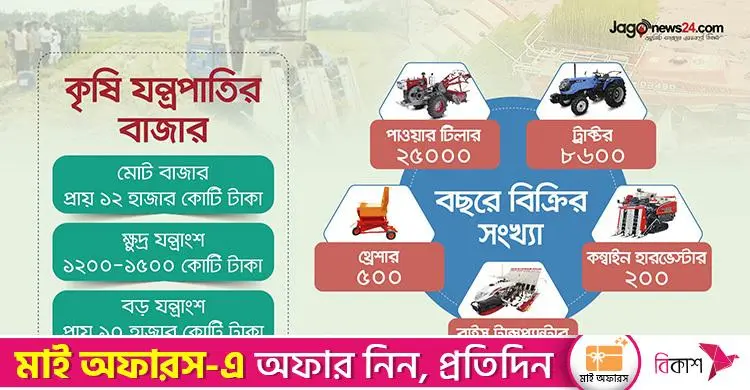
Although farm labourers are losing interest in agricultural work, food production keeps rising, and large machines such as tractors, power tillers, reapers and combine harvesters are becoming popular. Industry insiders say the overall market for farm machinery and parts is about Tk 12,000 crore, of which small parts account for Tk 1,200 crore to Tk 1,500 crore and large machinery about Tk 10,000 crore. The market is growing every day.
Imports dominate
Local companies hold less than a third of the market: they supply Tk 400 crore to Tk 450 crore of small parts, and most large machinery is imported. ACI is the largest supplier. In 2018 ACI Motors Limited set up the ACI Agri Machinery Factory in Jagir, Manikganj Sadar, working jointly with Japan's Yanmar. Dr. F. H. Ansari, managing director and chief executive of ACI Agribusiness, said ACI holds 50 percent of tractor sales, 43 percent of combine harvesters, 34 percent of power tillers and 10 percent of parts. Machinery use will grow much more as labour becomes scarce and wages rise.
According to the Agriculture Machinery Manufacturers Association Bangladesh, about 80 private firms make or assemble farm machinery commercially, 14 of them medium or large, and about a thousand light engineering firms make one or more parts. Half a dozen companies selling machinery from India, Japan, Korea, China, Indonesia and Cambodia hold 60 to 80 percent of the import market, and some foreign firms have opened factories in Bangladesh.
How far mechanisation has gone
- DAE data show power tillers and tractors are used on 90 to 95 percent of land for preparation, machines for 90 percent of pesticide application and 75 percent of threshing, but little for transplanting because transplanters are costly and heavy.
- Research by Bangladesh Agricultural University's Department of Farm Power and Machinery shows 80 to 95 percent mechanisation in tillage, irrigation, weeding and pesticide application, but less in planting, fertilising, harvesting, threshing, winnowing and drying.
- Each year about 25,000 power tillers, 8,600 tractors, about 500 threshers, about 3,000 reapers, about 200 combine harvesters (used since 2016-17) and 50 to 60 rice transplanters are sold.
Growing local production
Association president Alimul Ahsan Chowdhury said more local production would make machines cheaper and increase use, which is essential because farmland shrinks every year and 10 percent of people now feed the other 90 percent. At the recent Road to Made in Bangladesh and Agro Machinery Fair, Policy Exchange chairman M. Masrur Reaz said only 20 percent of farm machinery is made locally and 80 percent imported; with the right policy, finance, skilled workers and technology, the local share could rise to 40 to 60 percent. He added that 40 to 45 percent of crops, especially fruit and vegetables, are lost because of infrastructure and machinery gaps, making mechanisation and logistics urgent.
Source: Jagonews24. First published in Bengali on The Agro News.
Comments
(0)