
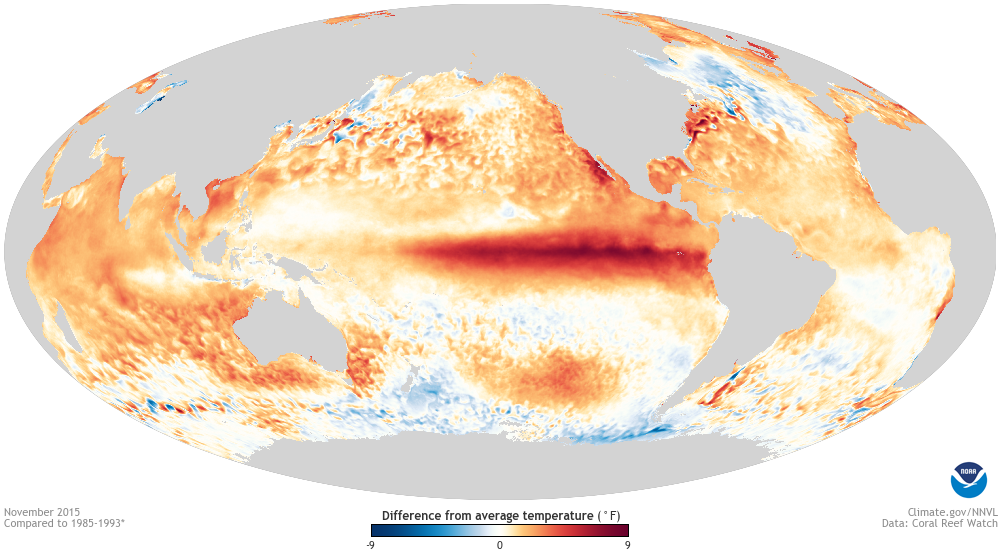
The El Nino that emerged in June has already set a record months before it is expected to peak, FarmingPortal reports in a story from Science News. On 21 September the daily sea surface temperature in the central and eastern equatorial Pacific, where El Nino develops, reached 3.08 degrees Celsius above the 1991 to 2020 average, more extreme than any El Nino ever recorded.
"It has been a remarkable event," said Nathaniel Johnson, a climate scientist at the Geophysical Fluid Dynamics Laboratory of the US National Oceanic and Atmospheric Administration (NOAA), adding that it will probably grow stronger still. NOAA has not yet declared it the strongest on record: it measures strength with a rolling three-month average and a newer Relative Oceanic Nino index, and by that measure the event has not yet passed the El Nino of 1997 and 1998. NOAA's latest seasonal forecast suggests that record is on track to be broken soon.
Researchers at the University of Chicago's Climate Impact Lab estimate that the ocean heat released could add about 1.2 degrees Celsius to global land temperatures over the coming months and lead to more than 450,000 additional heat-related deaths by February 2027, the report says.
The most predictable effects are in the tropics. Johnson said this year has already brought a suppressed Atlantic hurricane season, a busier Pacific one and droughts in Central America, and that El Nino tends to bring drought to northern South America and the Amazon and a weaker Indian monsoon. Later in the autumn it typically means a wetter southern United States and a drier Pacific Northwest.
Nathan Lenssen of the National Center for Atmospheric Research cautioned that a powerful event does not make its impacts more certain, because ocean warming has made some historical patterns less reliable. El Ninos usually last about a year, and after a big one a swing to La Nina is more likely; Johnson said the change from last winter's La Nina to a very strong El Nino in under a year may be the fastest transition yet seen.
Photo: NOAA / Wikimedia Commons (Public domain)
Source: FarmingPortal

Comments
(0)