
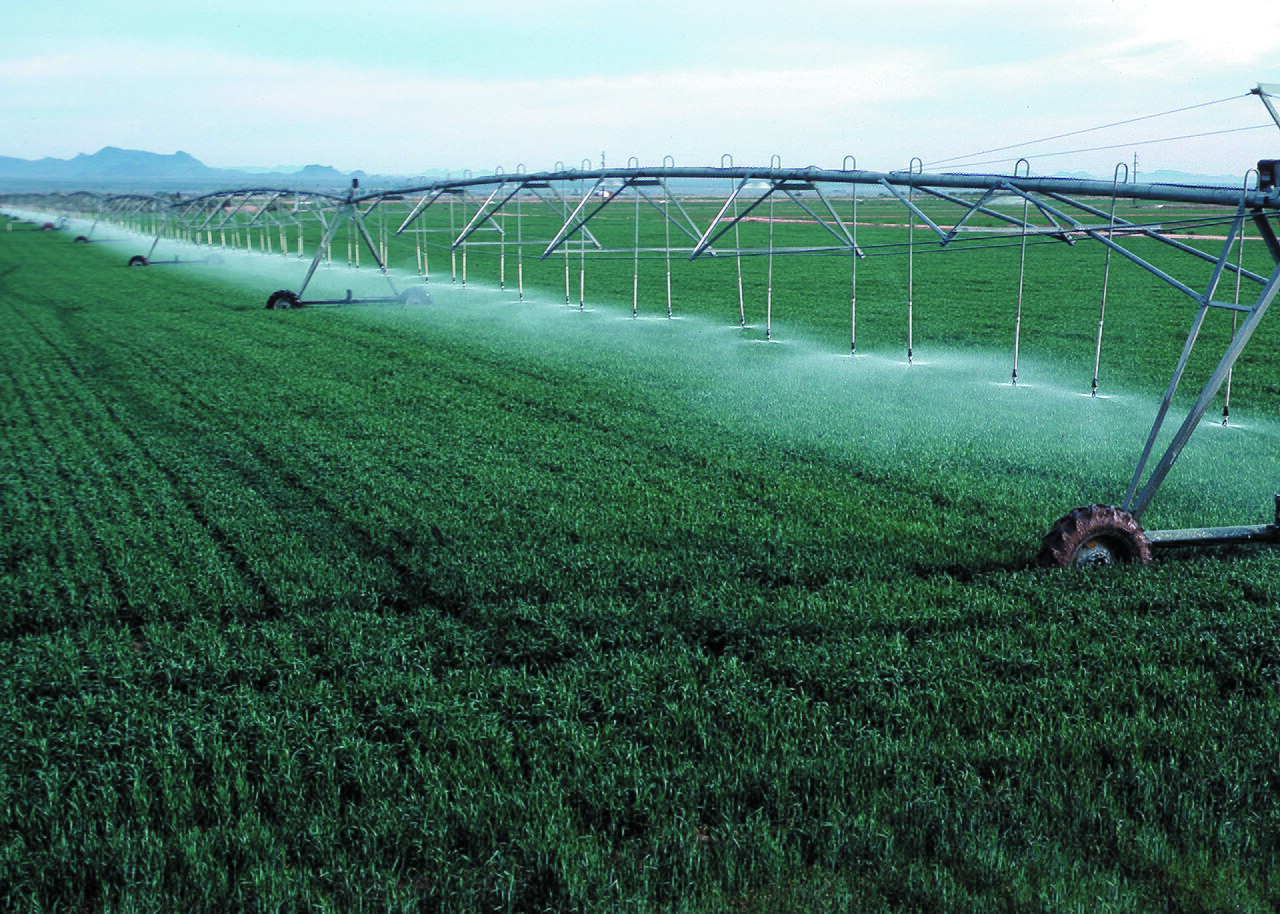
Irrigating US crops prevents far more greenhouse gas emissions than it causes, because growing more food on less land avoids the conversion of natural ecosystems, according to research from Colorado State University published this week in the Proceedings of the National Academy of Sciences. If irrigation were switched off, the land needed to make up the lost yield would release 363 times more emissions than irrigation itself produces, the equivalent of 363 years of today's US irrigation emissions.
Converting ecosystems to farmland releases carbon stored in soil and vegetation, and land use and conversion for food, fibre and fuel account for nearly a quarter of global greenhouse gas emissions. The avoided emissions from US irrigation come to 6.86 gigatonnes, more than the country's total emissions in 2024 (5.91 gigatonnes) and about 13 percent of global emissions that year, said lead author Avery Driscoll, who did the work as a CSU doctoral student and is now a postdoctoral researcher at Purdue University. "It was clear from this work that irrigation has a net positive effect on emissions," she said, "and that could decline further with electrification."
Pumping water, on farms and for inter-basin transfers, is the largest direct source of irrigation emissions and the easiest to fix by replacing fossil-fuel pumps with electric ones, the researchers say, suggesting incentives for electrification in climate-smart agriculture programmes; smaller direct sources are nitrous oxide from microbes and carbon dioxide released when groundwater is sprayed. The study is the first to weigh direct against indirect emissions: the team mapped county-level ratios of rain-fed to irrigated yields with survey data and machine learning, ran a global economic model of production, consumption and trade to see where land would be converted if all US cropping were rain-fed, and applied maps of soil and biomass carbon to estimate the resulting emissions. It did not cover other practices such as nitrogen fertiliser or livestock methane.
"When we talk about water use, particularly in the western U.S., there are trade-offs with every use and trade-offs beyond food and beyond greenhouse gas emissions," said co-author Nathan Mueller, a CSU associate professor. "Our work provides one piece of the puzzle." Alex Brown, whose family has farmed and ranched the same land in Yuma County, Colorado, for 120 years, said that without irrigation farmers would have to plough less productive, more sensitive pasture and depend on unreliable rain. The study was funded by the National Science Foundation and the USDA-supported AI Institute for Land, Economy, Agriculture & Forestry, with collaborators from the University of Minnesota, the US Forest Service, the University of Maine and The Nature Conservancy. Reporting by Rona Johnson.
Photo: Gene Alexander, USDA NRCS / Wikimedia Commons (public domain)
Source: The Fence Post
Comments
(0)