
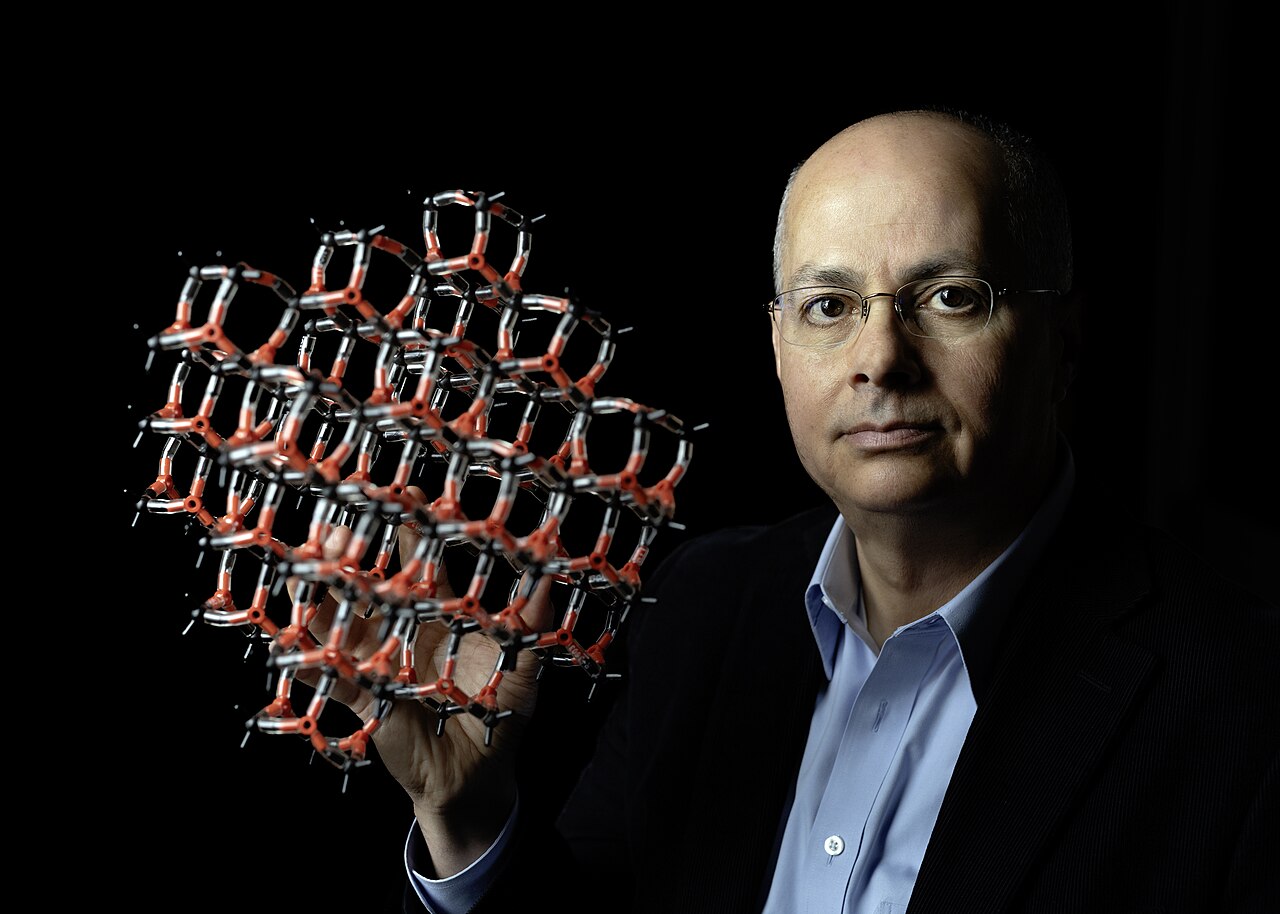
Drinking-water shortages in deserts and drought-prone regions are disrupting daily life, farming and industry. Omar M Yaghi, a professor at the University of California, Berkeley, is working on technology that harvests water from the humidity in the air, as a feature in Amar Desh's technology pages explains.
Metal-organic frameworks (MOFs) are crystals built from metal ions and organic molecules and riddled with tiny pores. Like a sponge, the pores trap water vapour from passing air; heating releases the vapour, which is cooled into liquid water. Conventional atmospheric water generators chill air to condense vapour, which takes much more energy when the air is dry, whereas MOFs can hold vapour even at low humidity.
Yaghi shared the 2025 Nobel Prize in Chemistry with Susumu Kitagawa of Japan and Richard Robson of Australia for developing MOFs. Atoco, the company he founded, aims to take the technology to market. According to the company, the internal surface area of one gram of a special reticular material can be as large as a football field.
According to a report in Wired, a test machine about 20 feet tall at Atoco's site in Irvine, California, was supplied with heat of about 150 degrees Fahrenheit to mimic industrial waste heat. Water collection needs no grid electricity; the heat can come from geothermal sources or unused low-grade industrial heat. A solar panel ran only some auxiliary systems, so social-media claims that the machine draws water using the sun's heat are not quite right.
Atoco chief executive Samer Taha says its material can capture and release vapour at about 100 degrees Fahrenheit and that the machine works at relative humidity as low as 10 percent. The test unit produces up to 300 litres a day. According to AgNavigator, the company is targeting 1,000 litres a day from an off-grid commercial unit and about 2,000 to 4,000 litres a day from grid-connected industrial units the size of a 20-foot container.
The report cautions that these figures are planned capacities, not commercial output available everywhere today. How effective and affordable the technology proves for water-short regions will only be clear once it is used at scale.
Photo: Christopher Michel / Wikimedia Commons (CC BY-SA 4.0)
Source: Amar Desh


Comments
(0)