
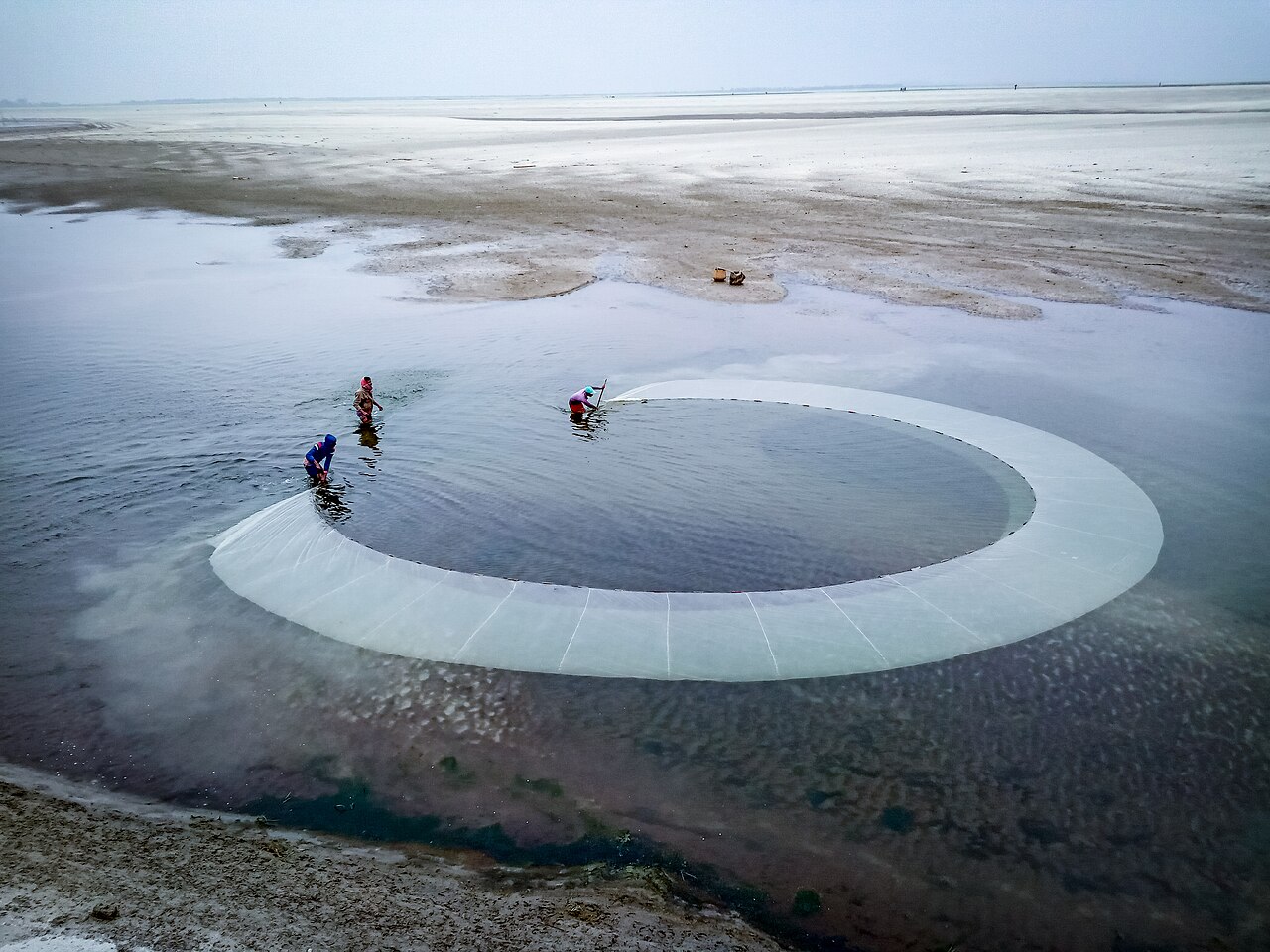
River erosion and a shortage of fish have forced most fishers in 10 villages along the Teesta in Kurigram to change jobs. The fishing hamlet of Biddyanondo village in Rajarhat upazila hangs on, with at least 20 families living in run-down huts on land lent by others. Banglavision's Kurigram correspondent Shafiqul Islam Bebu reported from the village.
Atul Chandra Das, in his sixties, has lost his home to the river seven times; his family has fished for three generations. He still takes the boat out now and then with his sons Sabuj Das and Ranjit Das. He and other fishers say that on some days a whole night on the river does not bring 100 taka worth of fish, and sometimes catching more than a kilogram is hard. From Kartik to Falgun, five months of the year, they go hungry or half-fed.
To repair his boat, Atul Chandra took a 10,000 taka advance (dadon) at 100 taka a month per thousand in interest, and with no fish in the river he lies awake over repaying it. Debts and advances threaten the whole fishing community.
Older residents say that ten years ago the Teesta gave rui, catla, air, boal, chital, chela, boirali, ujan teka, churkani, baim, shol, puti, tengra, ghaura, bacha, shrimp and even hilsa. Today four or five species turn up in small numbers, and the river's famous boirali has all but disappeared. In 2022 a muddy flood killed large numbers of fish; output recovered briefly but has slumped over the past two years.
The district fisheries office says Kurigram has eight fish sanctuaries but none on the 40-kilometre Teesta, while sanctuaries in six beels and channels, including the Brahmaputra's Hatia and Shakha Hati, are used to help native fish breed. Professor Shafiqul Islam Bebu, president of the district char development and implementation council, traces the scarcity to the severe flood from hill torrents out of India in 2017.
District fisheries officer Zahirul Islam Akand said a written proposal is being prepared for a large fish sanctuary centred on the Teesta and the Brahmaputra to protect native species and help them breed.
Photo: Ahamed Rafid / Wikimedia Commons (CC BY-SA 4.0)
Source: Banglavision

Comments
(0)