
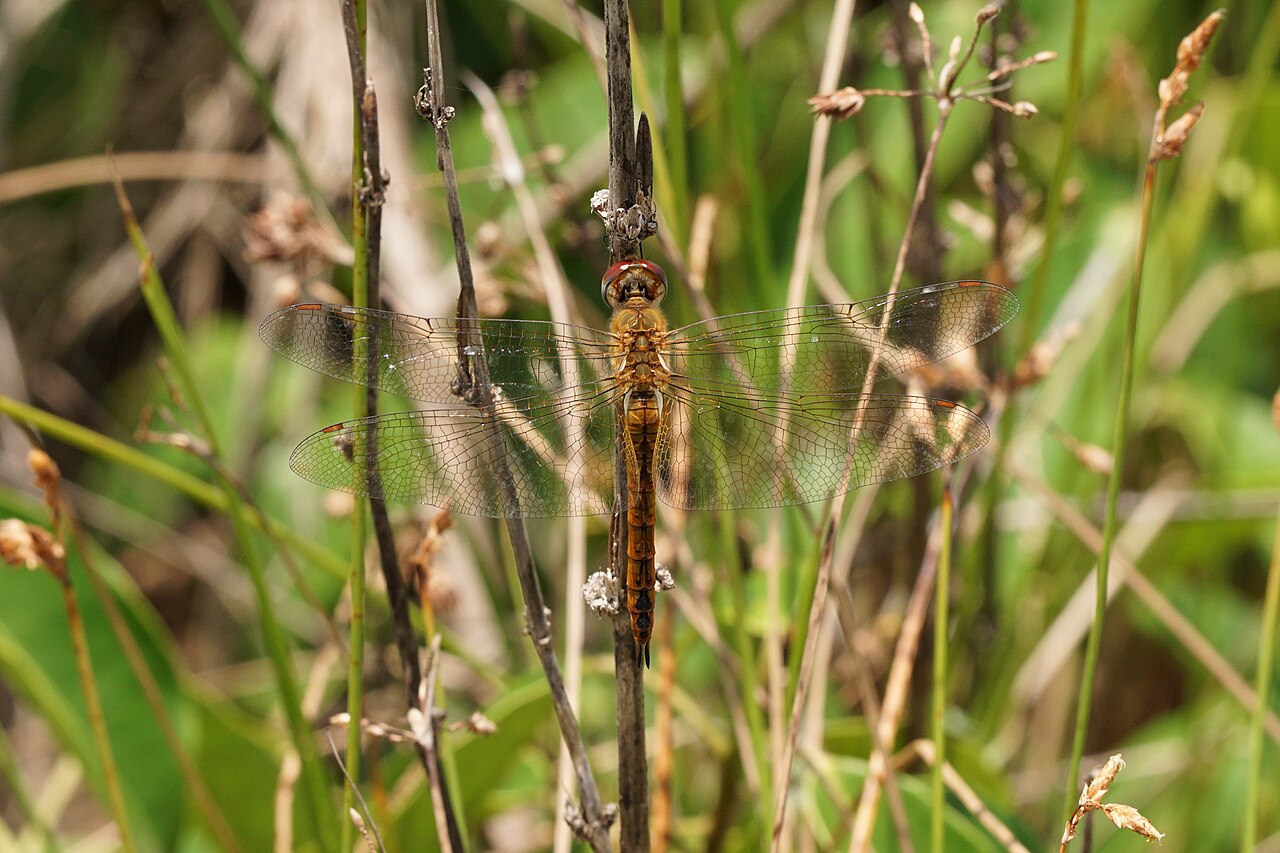
The globe skimmer, also called the wandering glider, weighs just 300 milligrams, less than a gram. Yet on its small wings it crosses the Indian Ocean from southern India to the Maldives and travels on to Africa. Ayantika Saha explains the science of the journey in a photo story for the Kolkata daily Ei Samay.
Every October millions of dragonflies appear in the Maldives, although the islands have no permanent source of fresh water. In 2009 the researcher R Charles Anderson first showed that they arrive from southern India, crossing 500 to 1,000 kilometres of sea. Unlike other dragonflies that lay eggs in rivers or ponds, globe skimmers breed in temporary monsoon pools, so when the rains end they head south in search of water.
Flapping continuously, a dragonfly would exhaust its energy within four hours. Like migrating birds, it instead uses favourable winds of the Intertropical Convergence Zone near the equator, flying more than 1,000 metres above the sea. A 2021 computer-model study led by Johanna Hedlund found that by gliding and flapping only when needed, the insects can stay aloft for about 230 hours.
A 2023 study by Sanatranjan Kumar, Amit A Power, Arnab Roy and Sandeep Saha of IIT Kharagpur traced the full route: India to the Maldives in October to December, on to mainland Africa in January to March, and back to India on the strong Somali Jet winds in May to July, carried by the next generation.
A dragonfly that leaves India never returns. It lays eggs in rainwater pools along the way, and the new generation matures in 45 to 60 days; four to five generations a year complete the circuit. No single dragonfly has yet been tracked the whole way, but satellite data and analyses of wind and weather support the theory.
Pictures and information: Ei Samay photo story, Ayantika Saha
Photo: Vengolis / Wikimedia Commons (CC BY-SA 4.0)
Source: Ei Samay



Comments
(0)