
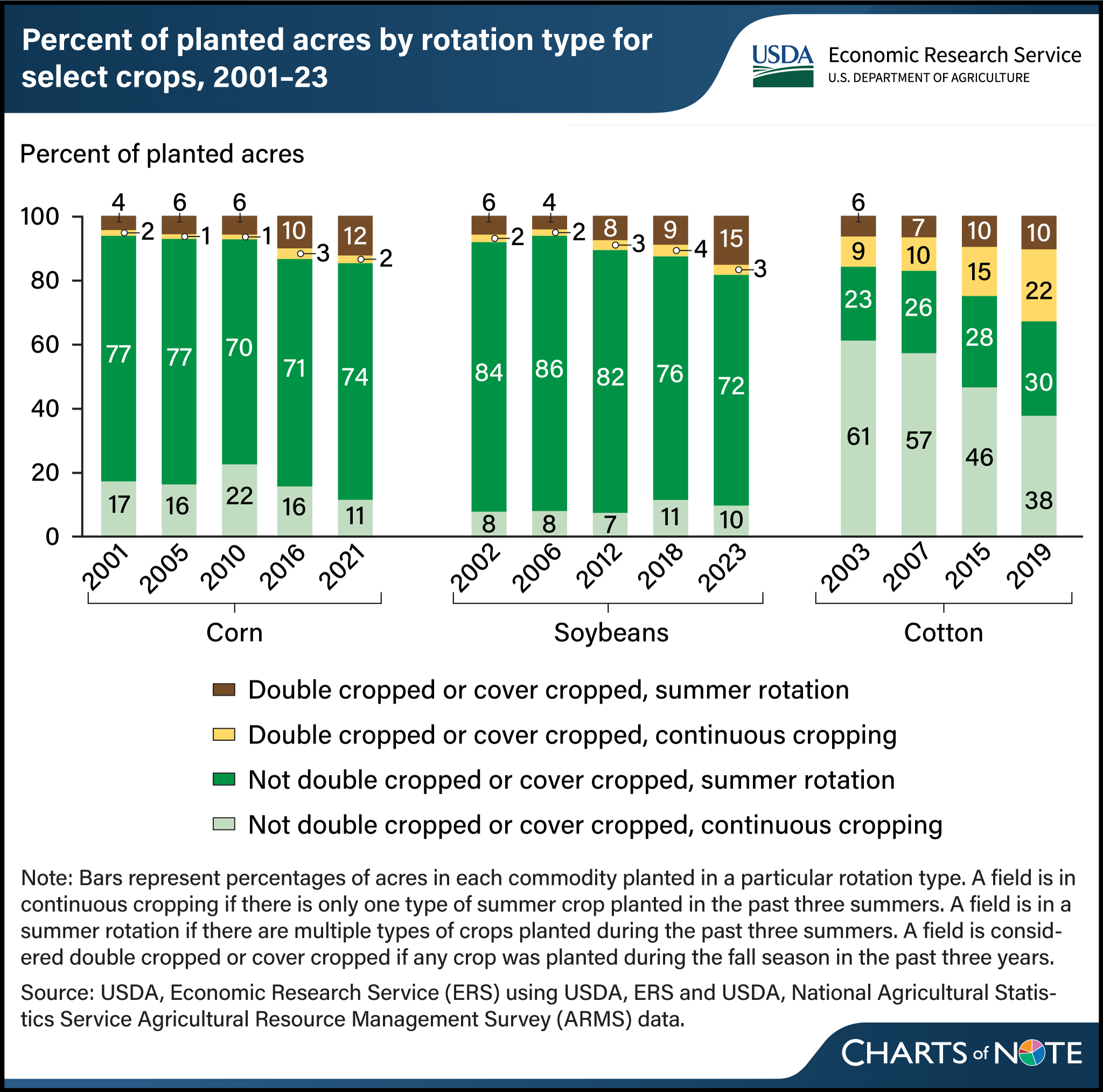
American growers of corn, soybeans and cotton have sharply expanded their use of double cropping and cover cropping over the past two decades, and the change is largest in cotton, according to a Chart of Note from USDA's Economic Research Service (ERS).
Double cropping is the practice of planting a crop in the fall between summer crops, such as sowing winter wheat after corn has been harvested or planting soybeans after a winter wheat harvest, to raise the productive value of a single field. Cover crops are unharvested winter crops grown primarily for their soil health and environmental benefits.
Cover cropping can be fitted into either a summer rotation, in which the summer crop in a field alternates across years, as in a corn-soybeans rotation, or into continuous cropping, in which the main warm-season crop stays the same for a period of years.
Cotton fields have seen the largest increase in these practices. The area under either double cropping or cover cropping grew from 15 percent of cotton acres in 2003 to 32 percent in 2019, ERS reports.
The data suggest that the decline in single cropping, where a field carries one crop and then sits bare, is driven largely by the expanded use of cover crops rather than by double cropping.
For growers the trend marks a shift in what a rotation is for: a field that once produced one cash crop a year is increasingly kept covered through the winter for the sake of its soil. The chart, prepared by ERS economist Andrew B. Rosenberg, can be found on the ERS topic page Soil Tillage and Crop Rotation, updated in December 2025.
Source: USDA Economic Research Service


Comments
(0)