
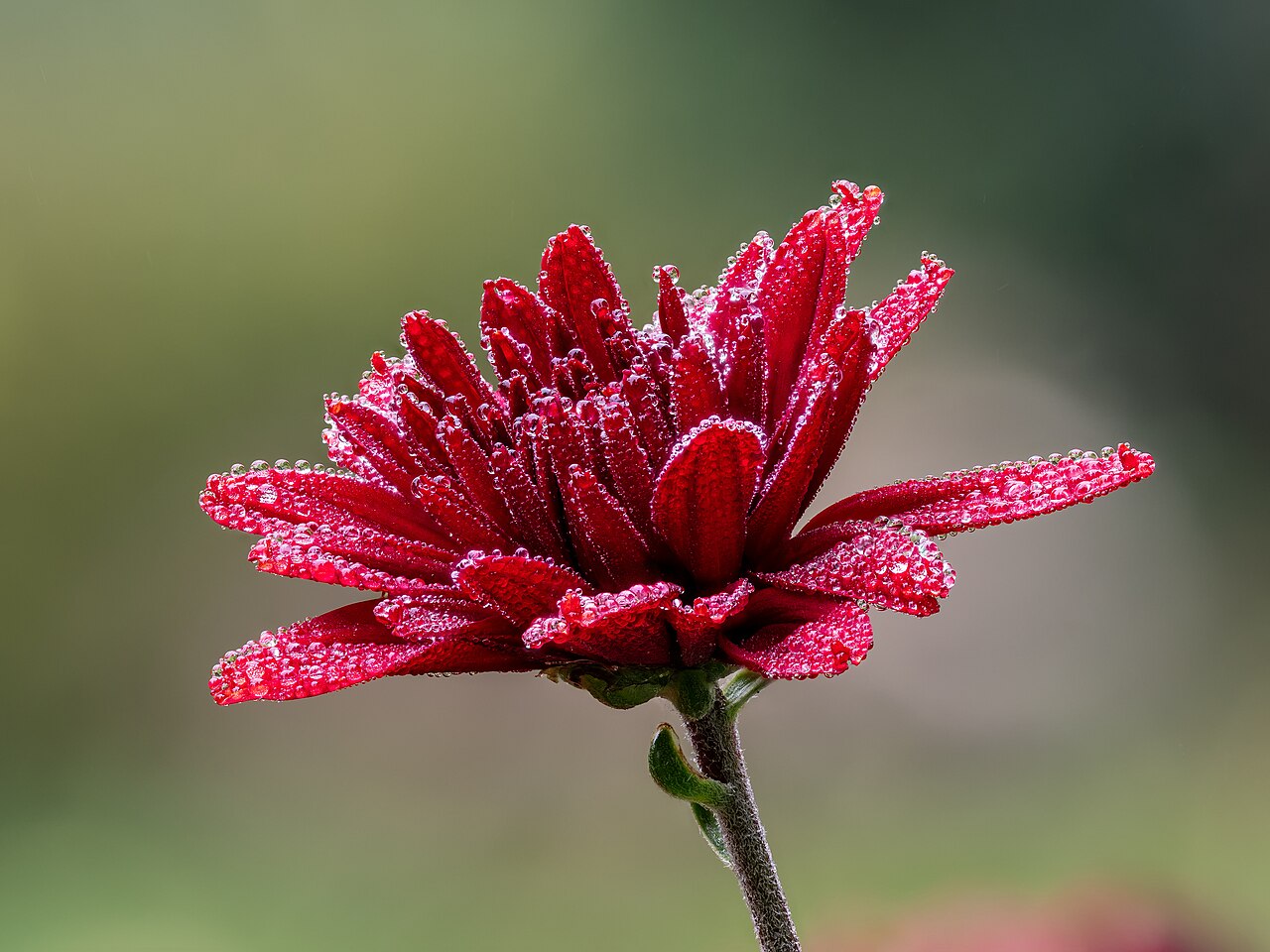
Step onto a rooftop garden on a misty November morning and the first thing that catches the eye is a row of pots crowded with golden, copper and purple blooms, their petals packed into round balls. This is the chrysanthemum (chandramallika). As winter comes, it takes over city rooftops, school gardens and flower fairs. From wedding stages to the Shaheed Minar on 21 February, the demand for flowers has turned the chrysanthemum from a hobbyist's plant into a profitable crop for many growers.
The chrysanthemum is a hugely popular flower, grown commercially in many countries, and its many colours put it in the first rank of the international cut-flower trade by value. In popularity it is second only to the rose. In Bangladesh it buds in October and blooms in November, and the flowers stay fresh on the plant for 20 to 25 days, longer than many other flowers. With demand in the market, there is good scope for commercial production in the country.
A riot of colour, and a name with a history
Chrysanthemums come in many shades. Copper, golden, yellow, purple, red and maroon varieties are especially popular. There is also a green chrysanthemum called Green Goddess, which many people at first refuse to believe is a real flower colour. Size varies too: some varieties carry blooms larger than the palm of a hand, others small button flowers in clusters along a stem.
Horticulturists group chrysanthemums by the shape of the bloom. In some the petals curve inwards, so the flower forms a neat ball; in others they curve outwards and droop. Pompons are small and round, rather like balls of wool. Spider types have long, thin, tubular petals radiating in every direction. Some varieties look much like daisies, with a central disc and a single ring of petals. Which to choose depends on the purpose: large-flowered types for shows, clustered small-flowered types for decorative pots, and long, sturdy-stemmed types for selling as cut flowers.
The botanical name, chrysanthemum, comes from Greek words meaning golden flower, because most of the early varieties were yellow. The flower has been cultivated in China for more than a thousand years, and in Japan it is the emblem of the imperial family; the Japanese throne is known as the Chrysanthemum Throne. From East Asia it spread through Europe to the rest of the world. Its Bengali name, chandramallika, is poetic too, and suits a full, round bloom that looks rather like the moon.
Any talk of flower farming in Bangladesh turns to Godkhali in Jhikargachha upazila of Jashore, known as the country's flower capital. Its farmers grow chrysanthemums alongside roses, gerberas, gladioli, tuberoses and marigolds. News reports say many farmers in Shyampur village of Maheshpur in neighbouring Jhenaidah have also turned to chrysanthemums.
According to a December 2025 report in The Business Standard, more than 6,000 farmers grow flowers on about 2,000 hectares in the Godkhali and Panisara area, and their flowers reach almost every district, Dhaka included. The report said December to April is the peak of the trade, when demand climbs around Victory Day, International Mother Language Day on 21 February, Independence Day, the spring festival and Bengali New Year. As a winter flower, the chrysanthemum is part of that season.
Climate and soil: it wants winter sun
The chrysanthemum prefers comparatively cool weather and a sunny position, which is why winter is the best season to grow it in Bangladesh. Pots or beds should stand where they get sun for most of the day; in shade the plants grow tall and weak and flower poorly.
The flower has another interesting trait. Botanists call it a short-day plant: when the days shorten and the nights lengthen, the plant receives its signal to flower. That is why chrysanthemums bloom in late autumn and winter. Commercial growers use lighting to manage this timing. A December 2020 report in The Daily Star described farmers in Shyampur, Maheshpur, growing chrysanthemums under LED lights. In their experience, the lights make the plants grow faster and give larger, more beautiful and more colourful flowers. According to that report, a plant yields about 100 flowers in a season, each selling for 2.5 to 5 taka.
The same report gave a real set of figures. A farmer who had switched from vegetables to chrysanthemums spent 150,000 taka on 20 decimals of land in the 2020 season and sold flowers worth 185,000 taka, a profit of 35,000 taka even in that difficult pandemic year. Growers also said they needed less fertiliser with the lights. The figures are one farmer's for one season and will not hold for everyone, but they show that a planned crop of chrysanthemums can pay even on a small plot.
As for soil, well-drained loam and sandy soils rich in organic matter suit the chrysanthemum. Standing water rots the roots, so it helps to raise the beds a little. The soil pH should ideally be 6.0 to 7.0. pH measures how acidic or alkaline soil is; 7 is neutral and anything lower is acidic. In other words the flower does best in slightly acidic to neutral soil.
Raising plants: cuttings and suckers, not seed
Chrysanthemums can be propagated from seed, suckers or stem cuttings. Seed, however, gives poor flowers and takes a long time to reach flowering, and seedlings do not keep the colour and form of the mother plant. Cuttings and suckers have none of these problems; the new plant flowers exactly like its parent.
In Bangladesh plants are usually raised from stem cuttings. The work begins in mid-July. Pieces 8 to 10 centimetres long are cut at a slant from fresh, vigorous one-year-old shoots and set in a bed or a bucket, where they root. A slanted cut exposes a larger surface, giving more room for roots to emerge. Sand or sandy soil is a good rooting medium, because water does not collect in it.
Raising plants from suckers is also common. Suckers are the young shoots that spring from the base of the plant. Around February, when flowering is over, the plants are cut back to 15 to 20 centimetres above the soil. After a while several suckers appear from the base. When they are 5 to 7 centimetres long, they are separated from the mother plant and planted in a shaded nursery bed or in pots.
So the plants should not be thrown away once flowering ends; the mother plants are the source of next year's stock. Kept in partial shade through the summer and watered moderately, the cut-back plants send up fresh suckers, and these provide the shoots for cuttings in July. Marking the plant that gave the finest, largest blooms and keeping it apart means the best variety is not lost the following season.
May to July is a hard time for young plants. Heavy rain and fierce sun both damage them, so they need protection from both. A light roof of polythene or matting on a bamboo frame keeps them safe. Many home gardeners move their pots onto a veranda or under a shelter during these months.
Planting out: one move to toughen them
Before the final planting in beds or pots, the young plants can be moved once to a separate bed or pot. This transplanting spreads the roots, toughens the plants and improves their flowering. The right time to plant out in the field or in pots is October to November. Depending on the variety, plant at a spacing of about 30 by 25 centimetres. Varieties with large blooms are better given a little more room for light and air.
Planting is best done in the afternoon, so the cool of the night helps the plants recover from the shock. Water the base lightly after planting and shade the plants from strong sun for the first few days. Tall varieties need staking later, or the stems bend or snap under the weight of the flowers.
Pinching: the trick for a bushy plant
Once the young plants are established, a common practice is pinching. When a plant has a few pairs of leaves, the soft tip of the main shoot is nipped out with the fingers. Instead of growing tall, the plant then sends out several side shoots, becomes bushy and carries flowers on more stems. Growers who want many flowers in one pot pinch the side shoots once as well. Pinching should stop, however, as budding time approaches, or flowering will be delayed.
Growers who want one enormous bloom for a show go the other way: they keep a single main stem and remove every side shoot so the plant puts all its strength into one flower. Which path to take depends on the kind of flowers you want. Either way, unwanted shoots rising from the base are best removed regularly.
Potting mix and fertiliser: measured doses
On rooftops and verandas chrysanthemums are usually grown in pots, and good flowers depend on the right potting mix. The recommended mix is:
- 2 parts soil
- 2 parts cow dung manure
- 1 part leaf mould
- 1 part bone meal
- plus 3 grams of TSP and 3 grams of muriate of potash per pot
Cow dung and leaf mould keep the soil loose and release food slowly. Bone meal is a good source of phosphorus and calcium, which help roots and flowers form. TSP supplies phosphorus and muriate of potash supplies potassium, which strengthens the plant and keeps the flower colour bright.
For nitrogen, give 8 grams of urea per pot in two doses. The first half goes in 25 to 30 days after planting the sucker or cutting, while the plant is growing; the second half when the flower buds appear. Fertiliser scattered around a growing plant like this is called top-dressing. Keep it off the leaves and water lightly afterwards. Too much urea produces leaves at the expense of flowers and invites aphids, so it pays to stick to the measure.
When watering, remember that the chrysanthemum dislikes soggy soil but cannot tolerate bone-dry soil either. Water when the top of the pot soil has dried. Water the base of the plant, not the leaves or flowers; wet leaves encourage fungus.
Disbudding: the secret of big blooms
The most skilful task in growing chrysanthemums is disbudding, removing unwanted and immature flower buds. If a young plant flowers too early, the flowers should be removed at once, because a small plant weakens itself by flowering and then cannot give good blooms in the main season.
For large blooms, keep the central bud of the three that form together at the tip of a stem and cut off the two side buds. All the plant's strength then goes into one bud, and the flower grows much larger. The huge chrysanthemums seen at shows and flower fairs are the result of this method. If you want many medium-sized flowers instead, remove the central bud; the side buds then open together and fill the stem. It is best done while the buds are still small, about the size of a pea; delay wastes the plant's energy.
Aphids: the small enemy of winter
The chrysanthemum's best-known enemy is the aphid. It is very small, soft-bodied and dark greenish-black. Aphid numbers rise sharply in winter, exactly the chrysanthemum's peak season. They cluster on the plant and suck the sap from leaves, tender shoots and flowers. Infested new buds and leaves curl, growth stops and the flowers come out small and misshapen. Aphids also excrete a sweet fluid on which a black sooty mould grows, darkening the leaves.
The first step in control is to keep watch. Checking the young shoots and the undersides of leaves every day catches an attack early. At the start, pick off the infested shoots and leaves by hand and destroy them. Then spray the plants with 5 grams of soap dissolved in a litre of water, every 7 to 10 days, two or three times. The soap solution coats the soft-bodied insects and kills them. Spray in the late afternoon when the sun has eased, and make sure the solution reaches the undersides of the leaves.
Useful insects such as ladybird beetles also eat aphids and keep their numbers down, so it makes no sense to kill these allies by spraying strong insecticide without need. Only if the attack is very heavy should an approved insecticide be used, on the advice of an agriculture officer.
Fungal spots and powdery mildew
Besides aphids, chrysanthemums suffer from fungal diseases. Brown or black spots appear on the leaves, grow larger, and the leaves dry and fall. Sometimes a white, powder-like coating appears on the leaves; this is powdery mildew. Such diseases are commonest on foggy, humid days.
Prevention costs little. Do not crowd the plants; leave enough space for air to move so that leaves dry quickly. Water at the base, not over the leaves. Remove infected leaves and throw them well away from the garden or burn them. If the attack is heavy, use an approved fungicide, again keeping to the dose and instructions.
Besides aphids, tiny insects called thrips sometimes rasp the petals and young leaves and feed on the sap, leaving silvery or brown streaks. In dry weather red spider mites spin fine webs under the leaves, which turn yellowish and pale. The rule for these is the same: regular inspection, removal of affected parts and, where necessary, an approved pesticide on the advice of an agriculture officer.
Cutting the flowers, and the market for them
Flowers for sale should be cut in the morning, when they are fully open and the plant is still fresh from the cool night. Cut in the midday sun, they wilt quickly. Cut with a long stalk using a sharp knife or scissors and put straight into a bucket of water, they stay fresh for a long time. After the first flush is cut, the plants flower again, so one season gives more than one harvest.
In a vase at home chrysanthemums usually last a long time, and a few habits extend that further: re-cut the base of each stem at a slant before arranging, strip off any leaves that would sit below the water line, and change the water every day or two. Leaves rotting in the water breed bacteria that block the stems and stop them drawing water.
The flower market in Bangladesh keeps growing. Demand jumps around Victory Day, the spring festival, Valentine's Day, 21 February and the wedding season, and much of that falls in winter, the chrysanthemum season. Long-lasting blooms, a wide range of colours and the chance to sell plants in pots make the chrysanthemum attractive to flower growers. Many nurseries earn well by selling potted plants in flower ahead of winter.
Whether you keep a rooftop garden or grow flowers for market, the formula for chrysanthemums is the same: cuttings in July, care for the young plants through the rains, planting out in October and November, measured fertiliser, timely disbudding and a sharp eye for aphids. Follow these few rules and the winter sun will light up a garden full of golden, purple and green blooms.
Photo: A red chrysanthemum with dew drops / Ermell / Wikimedia Commons (CC BY-SA 4.0)


Comments
(0)