
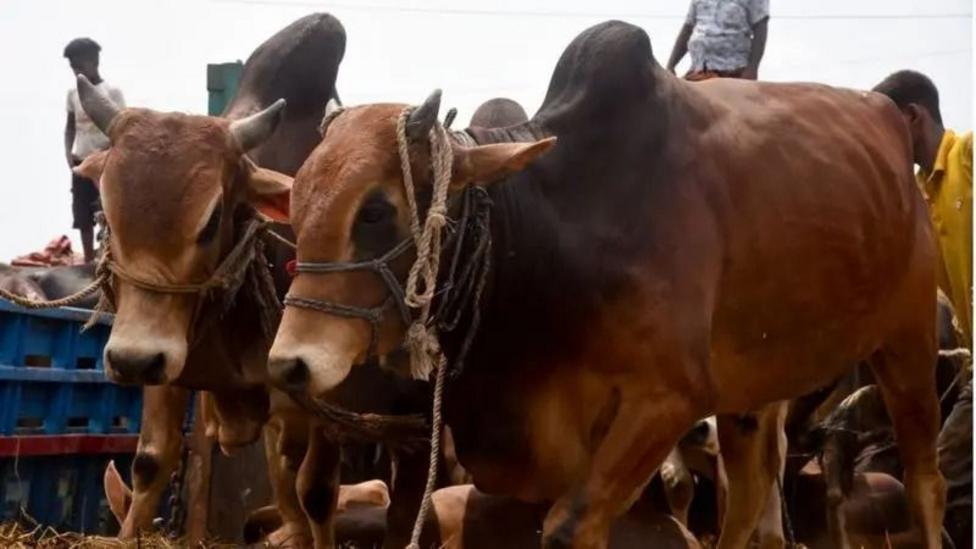
The number of cattle sacrificed at Eid-ul-Azha in Bangladesh is falling year on year, and small farmers say it is getting harder to recover what they spend on rearing. Department of Livestock Services statistics put cattle sacrifices at 5,659,000 in 2019; in 2025 the figure was 4,650,000, still a million short of the pre-Covid level several years after the pandemic.
The department's series shows 4,473,000 cattle sacrificed in 2017, rising to 5,391,000 in 2018 and 5,659,000 in 2019. The number then fell to 5 million in 2020, the Covid year, and to 4 million in 2021, a drop of roughly 1.6 million in two years. As conditions normalised it recovered to 4,565,000 in 2022, 4,581,000 in 2023 and 4,766,000 in 2024, before slipping again to 4,650,000 last year.
Sheikh Farid, a farmer in Manikganj near Dhaka, reared four cattle for last Eid and sold them all, but says he did not get a fair price; this year he bought a single animal, on a bank loan. His three-maund bull has cost him Tk 120,000 all told, and buyers are offering Tk 100,000. His shed holds seven cattle and now houses one; if the price is not there this time, he says, he will give up the farm. Ripon Kumar Mondal, professor of agricultural economics at Sher-e-Bangla Agricultural University, sees three causes: weaker purchasing power after Covid, higher cattle prices driven by production costs, and a shift to goats and sheep to save money.
"Inflation is running above nine percent," Professor Mondal said, "so many in the middle class in particular are buying a goat for eight or ten thousand taka rather than spending a lakh or more on a cow." Md Kabir, manager of a farm in Keraniganj with about two hundred animals this year, says demand is again strongest for small and medium cattle and that feed, labour and electricity have pushed prices up by Tk 10,000 to 15,000 per animal on last year, with bigger rises for large bulls.
Kuddus Molla, a farmer in Harirampur, Manikganj, says prices rise in the towns and ports but not in the village, because farmers sell to traders who will not pay more. He plans to take his cattle to the market himself this year and has decided not to sell if the price is not right.
On supply the department sees no shortage. It says farmers have readied about 5.7 million cattle and buffalo for this Eid, around 1.1 million more than the 4.6 million cattle sacrificed last year. At a press briefing in Dhaka early in May, Fisheries and Livestock Minister Mohammad Amin Ur Rashid put the number of sacrificial animals in the country at 12.3 million against expected sacrifices of 10.1 million, leaving a surplus of 2.25 million.
Asked how farmers absorb the loss on unsold cattle, Md Shariful Haque, the department's deputy director for farms, argued that half the year's cattle slaughter takes place at Eid and the other half through the year at weddings and functions, so an animal unsold at Eid is not a loss. Farmers reply that selling at meat prices does not cover a year of feed and labour. For the livestock trade the signal is clear: demand is moving towards smaller animals, and reducing dependence on traders for price is what keeps a marginal farmer in business.
Source: BBC Bangla
Comments
(0)