
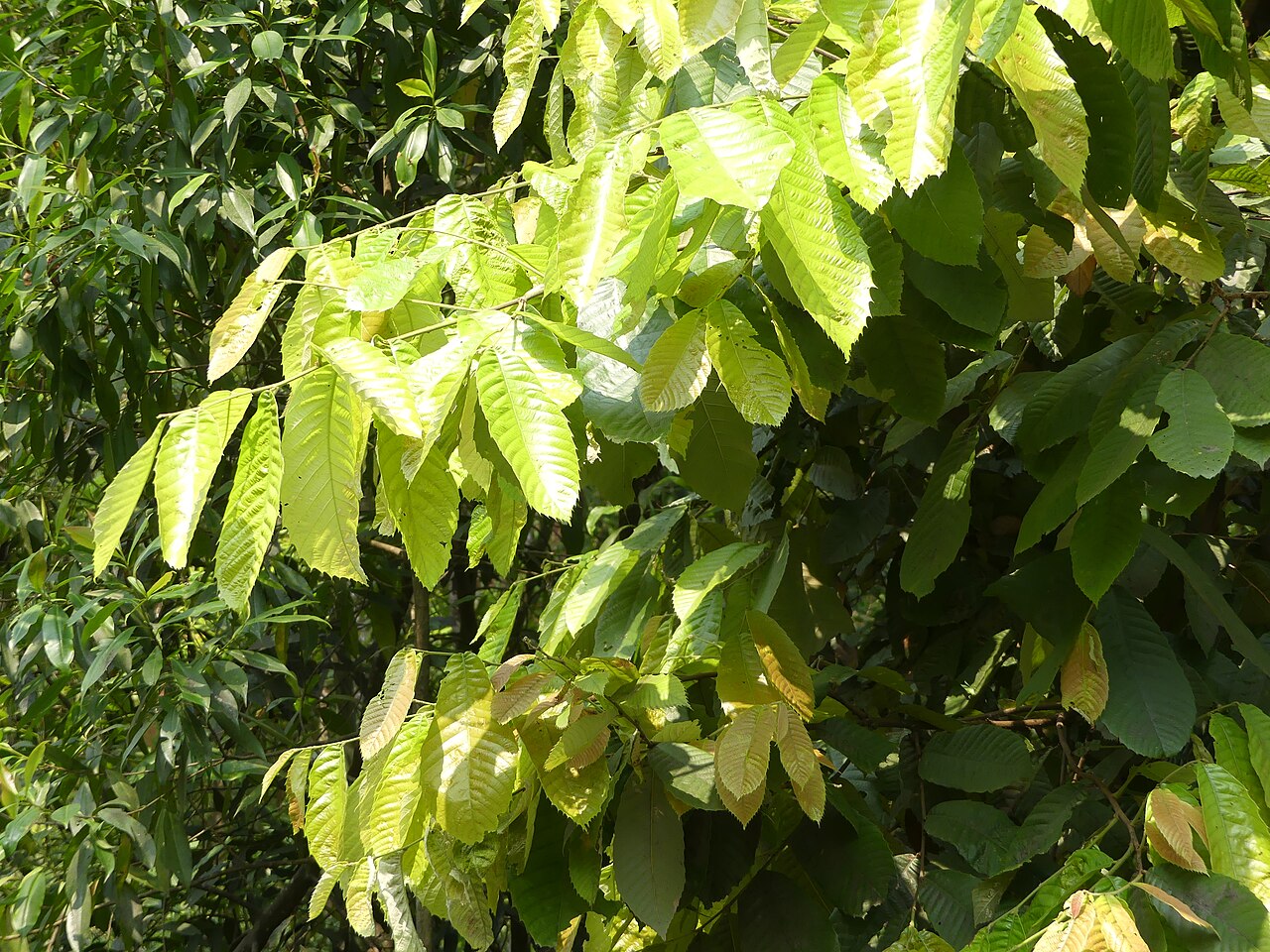
A member of the oak family described in 2019 from a single hillside in Upper Siang district, Arunachal Pradesh, may already be gone, and no one has gone back to look, writes Anurag Dhyani, senior scientist at the Jawaharlal Nehru Tropical Botanic Garden and Research Institute in Kerala and co-chair of the IUCN Species Survival Commission Global Tree Specialist Group, in a column for Down To Earth. The views are the writer's own.
Castanopsis pathakii was collected only once. Six years on it has no conservation plan and is missing from global biodiversity databases, while its forest faces road building, hydroelectric projects and the spread of farming. Early this year Dhyani and Joeri Strijk of the Alliance for Conservation Tree Genomics in Malaysia proposed a provisional "critically endangered" status for it, as part of a global assessment of Castanopsis (chinquapins) and Lithocarpus (stone oaks) with Botanic Gardens Conservation International and the IUCN tree specialist group.
The problem, he argues, is wider. At least 34 species of Castanopsis and Lithocarpus grow across Arunachal Pradesh, Assam, Meghalaya, Nagaland, Manipur, Mizoram, Tripura and Sikkim. Of the 29 assessed on the IUCN Red List, 11, or 38 per cent, are "data deficient", which does not mean they are safe: research suggests over half of such species worldwide are likely threatened.
These trees form the structure of the northeast's forests, feeding and sheltering hoolock gibbons, Asian elephants and Himalayan black bears and helping to regulate the watersheds that feed the Brahmaputra and its tributaries. Yet the Botanical Survey of India has published no national Red List assessment for either genus, they are absent from the Wild Life (Protection) Act of 1972, and there is no nursery or ex-situ programme to use them in restoration. IUCN notes that the Indian sites of Castanopsis armata "are believed to likely no longer hold individuals", a warning that prompted no survey.
India has committed to the Kunming-Montreal Global Biodiversity Framework, whose target 4 calls for urgent action to halt human-induced extinctions, and plans to assess about 7,000 plant species by 2030 under its National Red List Assessment Initiative. Dhyani says that needs data: the Central National Herbarium in Howrah is not fully digitised, and type specimens of endemic Lithocarpus species are missing from GBIF.
He asks the Botanical Survey of India to digitise and georeference northeastern Fagaceae collections, to publish coordinates for the four endemic Lithocarpus species, and to fund a survey of Upper Siang with a reporting deadline. The wildlife law, he adds, should protect endemic data-deficient species as a precaution. If the tree is not found, India will have to ask whether it lost a species without ever knowing it existed.
The picture shows a related species, Castanopsis indica, in north Bengal.
Photo: A. J. T. Johnsingh, WWF-India and NCF / Wikimedia Commons (CC BY-SA 3.0)
Source: Down To Earth

Comments
(0)