
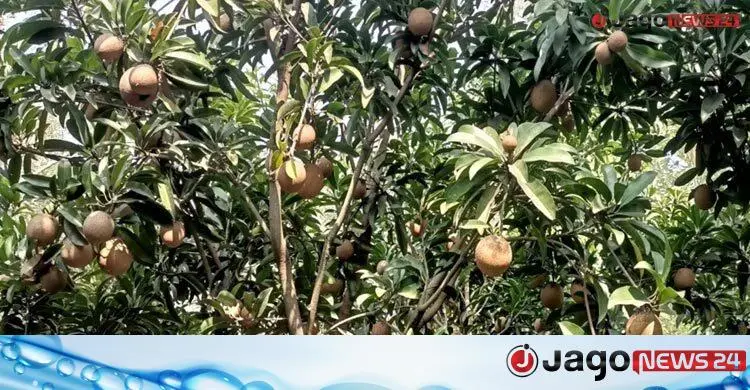
The Bangladesh Institute of Nuclear Agriculture (BINA) has achieved a new success in fruit research. After the success of its BINA lemons, its latest innovation is "BINA Sofeda-1", a sapodilla variety released to widen fruit diversity and give farmers a profitable alternative, researchers say.
How it was developed
In 2019, scientists applied gamma irradiation to scions of BARI Sofeda-2 and grafted them onto khirni rootstock. From the successful grafts, the mutant MZD60P1 was identified through intensive research. After breeding trials and yield tests in different regions proved satisfactory, it was selected as a variety, and in 2023 the National Seed Board registered it as BINA Sofeda-1 for farmers.
A larger fruit
Dr Md Shamsul Alam, senior scientific officer in BINA's horticulture division, who worked on the variety, said sapodilla is little known in Bangladesh but very tasty, rich in carbohydrates, natural sugar, vitamin C and antioxidants, and can be grown with little care. BINA Sofeda-1 is much larger than local types, with each fruit weighing 250 to 450 grams and containing 15.58 milligrams of vitamin C per 100 grams.
Growing conditions
Warm, dry climates are best, he said, but sapodilla adapts widely and can be grown in humid and cool conditions where temperatures range between 12 and 15 degrees Celsius; humidity helps at flowering. As a year-round variety, it can be planted throughout the year. Fertile loam with medium pH, irrigation and drainage is ideal, though it can be grown commercially on all soils in both hill and plain areas. Vegetatively propagated seedlings bear fruit within 18 months.
Pests and diseases
Disease pressure on BINA Sofeda-1 is much lower than on other varieties, though it can suffer dieback and sooty mould, for which a copper-based fungicide should be sprayed twice a year. Stem borers, leaf miners and aphids are often seen; leaves carrying eggs and larvae should be collected and buried.
Dr Mohammad Nurun-Nabi Mazumder, head of BINA's horticulture division, said the division, started in 2011, has already developed notable varieties, and BINA Lemon-1 and BINA Lemon-2 have drawn a strong response. He expects BINA Sofeda to do the same.
Source: Jagonews24. First published in Bengali on The Agro News.

Comments
(0)