
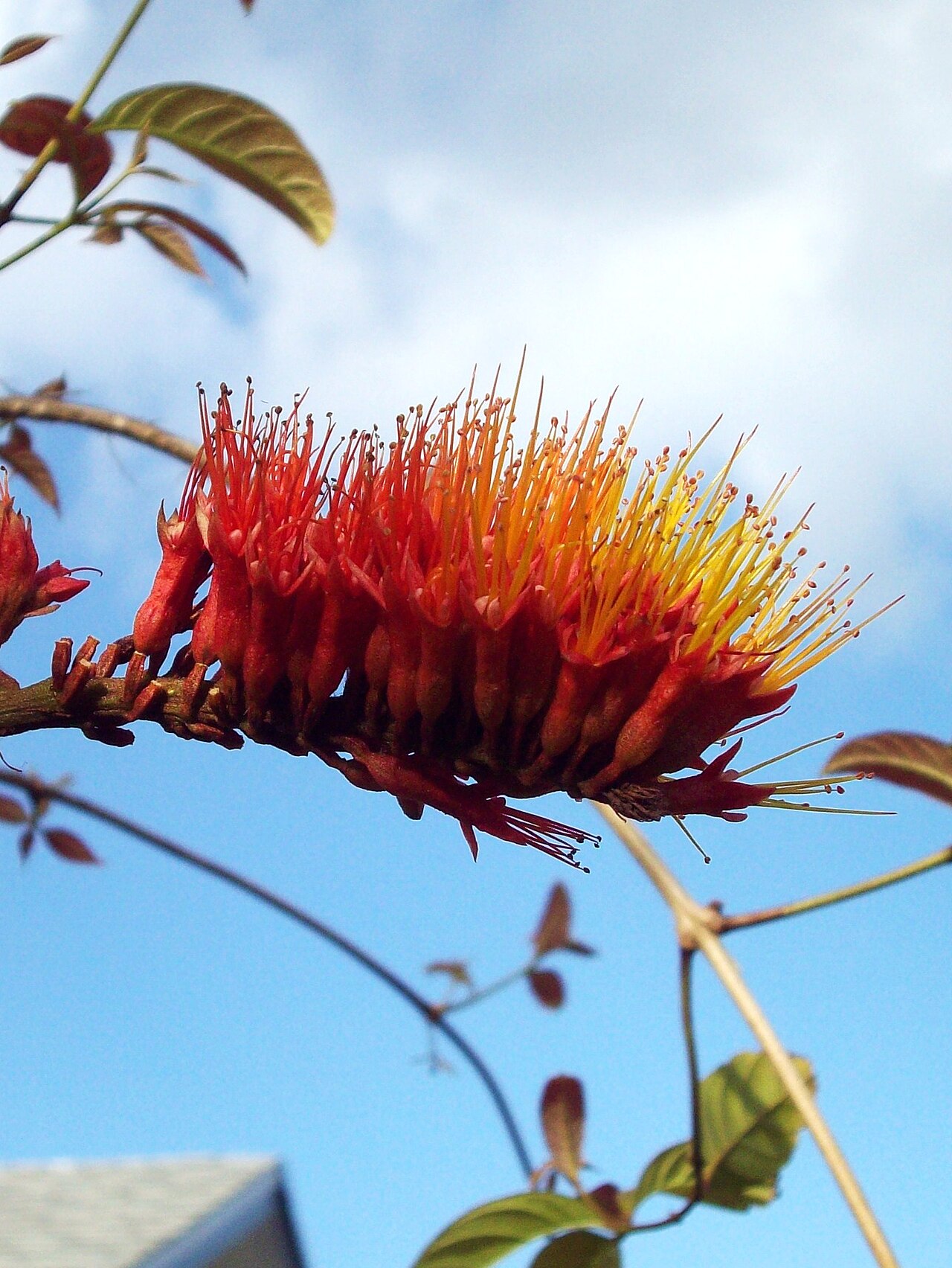
The botanical garden of Bangladesh Agricultural University (BAU), on the bank of the Brahmaputra in Mymensingh, has a monkey brush vine in flower beside its herbal garden. Its bright red flower clusters look like a monkey's tail dipped in paint, or a coloured brush, which is where the English name Monkey Brush Flower comes from.
The plant is Combretum rotundifolium, of the family Combretaceae. It is native to tropical South America, especially the Amazon basin and the humid forests around it, and is now grown by gardeners in many countries for its looks.
It is a woody climbing shrub. Given support, its branches can climb 20 to 30 feet; it may also spread as a bush or scramble over nearby trees and structures. The leaves are simple, opposite, oval to elliptic and slightly thick.
The flowers come from the branch tips or the upper leaf axils, many to a dense cluster. The petals are small, but the stamens are long, thread-like and spread outwards, which gives the whole cluster its brush shape. After flowering the plant sets four-winged fruits that are spread by the wind, and the bright flowers draw a range of pollinators.
For gardeners: the plant does best in a warm, humid climate, with plenty of light, well-drained soil and something to climb. It grows in full sun or part shade with proper care, and can be trained over a garden entrance, an arch or a sturdy trellis.
A foreign ornamental climber flowering in an agricultural university's garden in Bangladesh is of interest to nurseries and home gardeners. The piece was written for Samakal by a professor of botany who writes on nature.
Photo: Eric Bronson / Wikimedia Commons (CC BY 2.0)
Source: samakal


Comments
(0)