
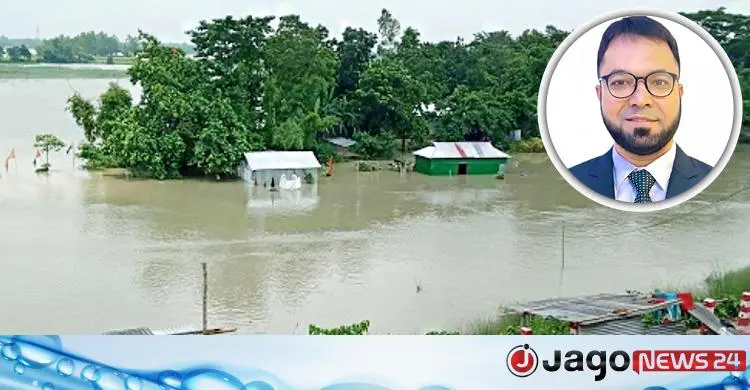
Predicting river levels early and accurately has long been a major challenge in flood-prone Bangladesh, particularly in areas where data is scarce. A team of researchers at Bangladesh Agricultural University (BAU) has now developed a highly effective forecasting model using Artificial Intelligence (AI)-based machine learning and deep learning, aimed at tackling climate-driven floods and issuing warnings in data-poor areas.
The research was led by Dr. Md. Touhidul Islam, associate professor in BAU's Department of Irrigation and Water Management, with Prof. Dr. A. K. M. Adham of the same department and undergraduate and postgraduate students. It was funded by the Ministry of Science and Technology (MoST) and the University Grants Commission (UGC), with technical and administrative support from the Bangladesh Agricultural University Research System (BAURES).
How the model was built
Work began in mid-2025. The team analysed 26 years of weather and river data, from 1999 to 2024, collected at four key stations on the Old Brahmaputra: Islampur, Sarishabari, Dewanganj and Mymensingh. Using rainfall, temperature, river water level and flow, they tested several AI models to predict how much the river would rise or fall. The study was published in 2026 in a Q1–Q2 international journal.
Results
- Using past water-level data, the Random Forest (RFM) model achieved accuracy of up to 99.16 percent.
- In data-scarce areas, using only rainfall and temperature, the deep learning model (LSTM) achieved up to 81.45 percent accuracy.
- A support vector machine (SVM) model was also used.
- A model built for one area also worked effectively in other areas.
Prof. Adham said such accuracy despite limited data shows great potential for data-poor regions.
Why it matters to farmers
If the technology is used in the field, farmers will benefit directly, the researcher said. With accurate advance warning of floods, they can harvest ripe rice and other crops early, move livestock to safety and plan irrigation to use water properly, reducing major financial losses.
The innovation is ready as an operational framework that could be linked directly to the national river network forecasting centre. It is not a commercial product but a software-based digital innovation, so farmers would pay nothing to use it. With government support and technical help, the researchers say, it could be developed into a full operational system, expanded across regions and delivered to farmers cheaply by app or mobile message.
Source: Jagonews24. First published in Bengali on The Agro News.

Comments
(0)