
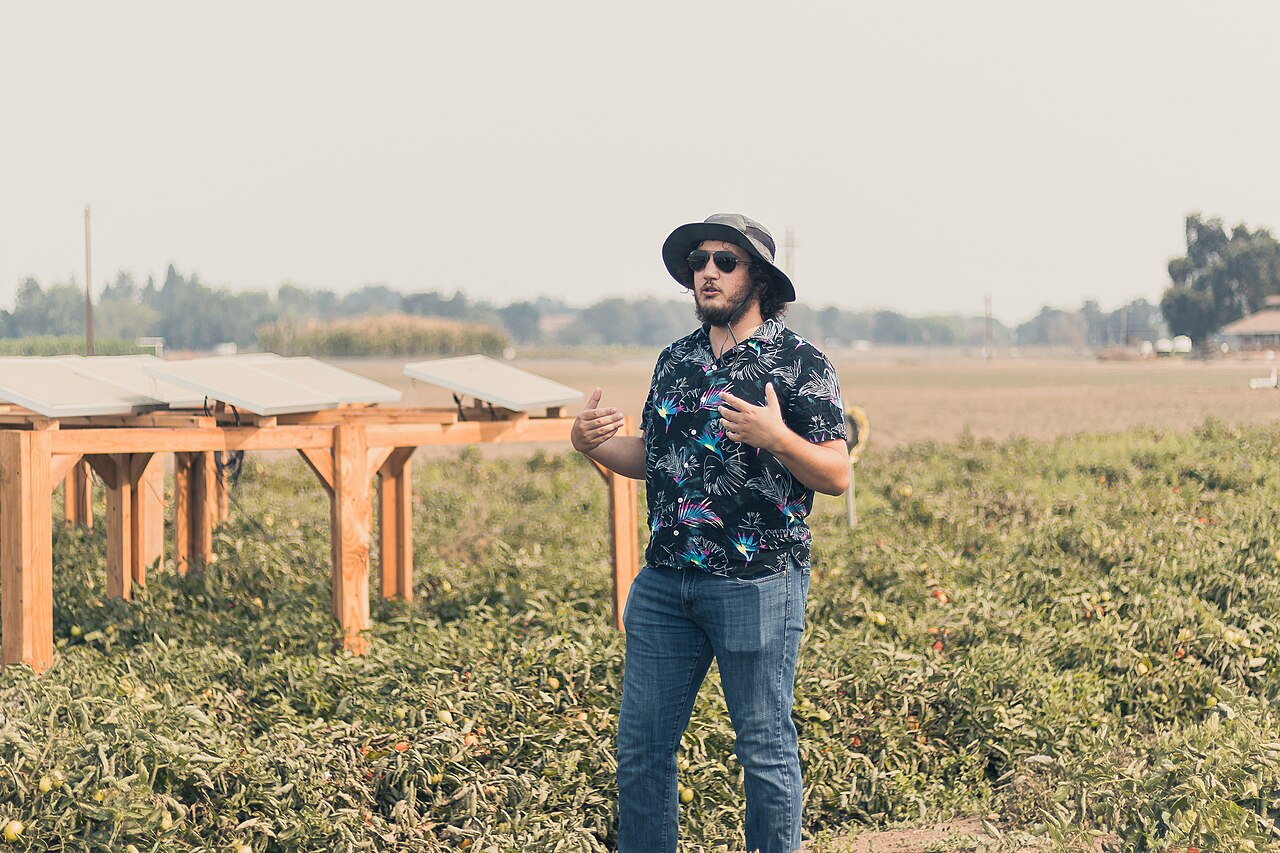
Mounting solar panels high over farmland and farming underneath, the approach known as agrivoltaics, could ease Bangladesh's competition between food and energy for scarce land, argue agricultural development worker and researcher Shahidul Islam and Professor Chayan Kumar Saha of Bangladesh Agricultural University. In a joint column in Samakal they set out field results from a working system in Nakla upazila of Sherpur.
The problem they describe is familiar. Solar power has the brightest prospects among Bangladesh's renewables, yet farmland is already short for growing food, so setting land aside for panels is a hard policy choice. In an agrivoltaic layout the panels sit above or beside the crop so that farming continues. The electricity can run irrigation pumps, crop drying and processing, small food mills and other village needs, and daytime surplus fed to the grid through net metering can earn extra income.
According to the authors, the organisation Mati Bangladesh installed two agrivoltaic systems with a combined 35.3 kilowatts at its Mati Eco-Village in Nakla in early 2025. The 8.8-kilowatt unit serves irrigation and the 26.5-kilowatt unit a safe-food processing centre, with a 5.1 kilowatt-hour battery for night use. In this remote village on the Brahmaputra chars the same power also supplies a school, a day-care centre and a training centre.
Three master's students supervised by Professor Saha measured the system's technical performance. It generated 39,233.14 kilowatt-hours in 2025 and 21,146.80 kilowatt-hours from January to June 2026. Turmeric under the panels yielded 2 kilograms per square metre against 1.25 kilograms in the open field, and brinjal also outyielded the open field in the summer and winter seasons of 2025. In summer 2026 water spinach (gima kalmi) and tomato matched open-field yields, while cucumber reached about 90.91 percent.
The systems were connected for net metering in February 2026 and have run on-grid since March; Mati Bangladesh estimates they have avoided about 7.88 tonnes of carbon dioxide since then. The authors caution that the results cannot be applied directly to every crop, soil and climate in the country, and that long-term trials in different regions are needed to settle panel layout, height and shading.
The obstacles are real. Panels, inverters, batteries and frames are a heavy upfront cost for an ordinary farmer, so the authors see cooperatives or producer groups as the more practical owners. The Nakla system took about 10 months to get its net-metering connection, and billing for surplus power remained complicated afterwards. They call for trials across agro-ecological zones and for pilots that bring together universities, power agencies, private companies and farmer cooperatives. The views are the writers' own.
Photo: UC Davis College of Engineering / Wikimedia Commons (CC BY 2.0)
Source: Samakal

Comments
(0)