
Rising sea levels, water shortages and falling agricultural output could force about 13.3 million people in Bangladesh, roughly 7.5 percent of the population, to move elsewhere within the country by 2050, according to the Asian Development Bank's 'Asia-Pacific Climate Report 2026: Coastal Risks on the Rise', Samakal reported. The report was released on Wednesday.
Under a high greenhouse-gas emissions scenario, the report says, about 17.5 million people in Bangladesh could be hit by coastal flooding every year by 2100, and annual economic losses from flooding could reach 15 percent of GDP. Poverty and flood risk are closely linked on the coast: those most exposed have the least capacity to cope, adapt or recover.
For farming, the key finding is subsidence. Besides global sea-level rise, parts of Bangladesh's coastal delta are sinking by 4 to 55 millimetres a year in places, raising the risk of losing farmland and worsening coastal inundation. In the dry season, salinity in coastal groundwater often exceeds the World Health Organization's limit, and the report also notes a link between saline water and high blood pressure in pregnancy.
Chattogram's built-up area grew from 66.1 square kilometres in 2016 to 73.5 in 2025, and about a quarter of it lies where water could pool in a severe coastal flood. Over the same period settlement grew by 16.2 percent in flood-prone areas against 9.7 percent in safer ones. Under high emissions, disruption at Chattogram port could put about $1.4 billion of economic activity a year at risk by 2050 and $13.6 billion by 2100, at 2020 values.
Across 30 coastal economies of Asia and the Pacific, flood losses now run at about $27 billion a year. Without effective adaptation they could reach $172 billion to $199 billion a year by 2050 and $520 billion to $739 billion by 2100. The ADB estimates that investing $9 billion to $19 billion a year in coastal protection could avoid $178 billion to $360 billion a year in potential flood damage.
Yevgeniy Zhukov, director general of the ADB's climate change and sustainable development department, said coastal areas are important engines of growth for the region but are increasingly at risk from sea-level rise and extreme weather, and that long-term, adaptive and risk-informed solutions are needed now.
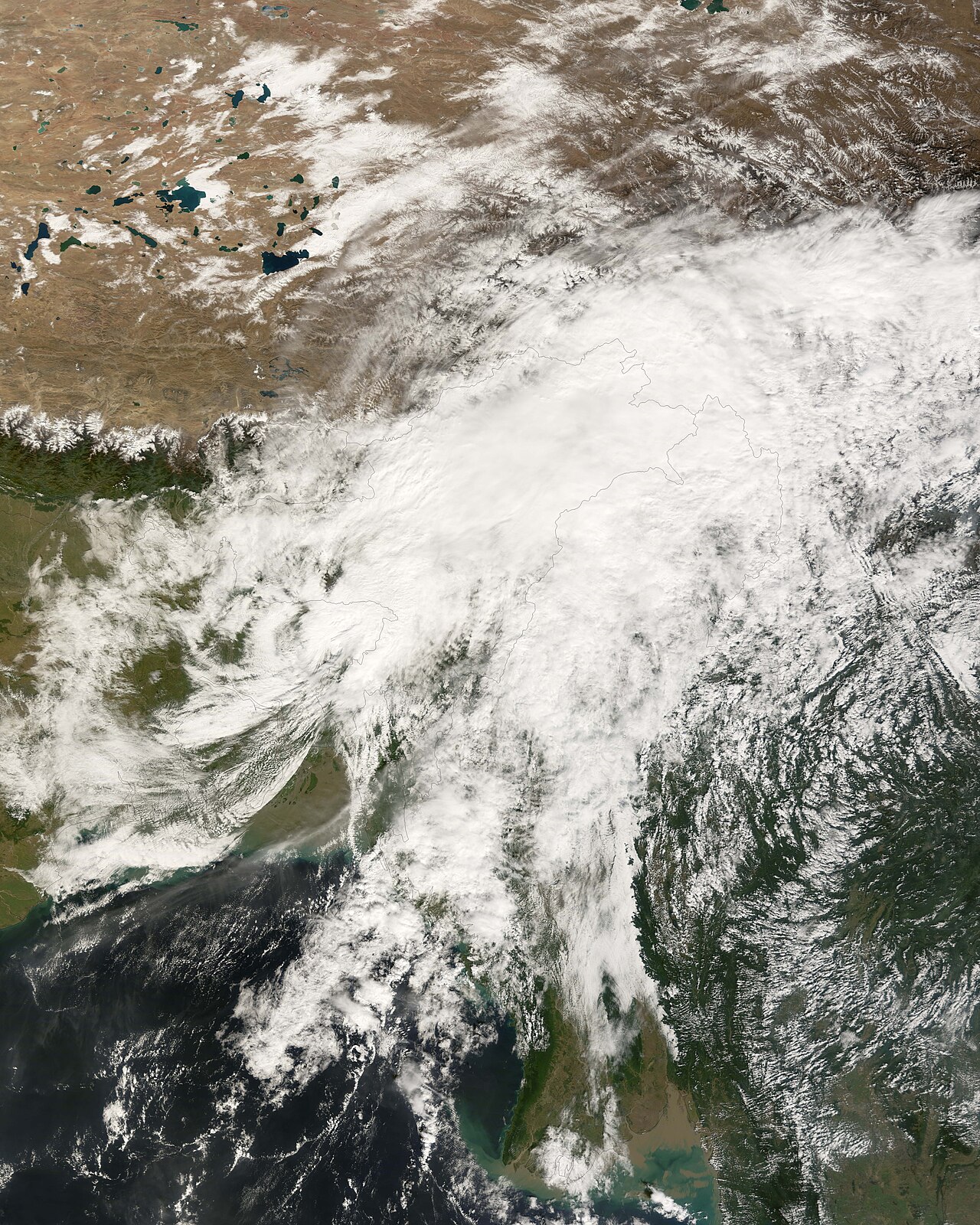
Photo: Cyclone Sidr over the Bay of Bengal coast (2007), NASA / Wikimedia Commons (Public domain)
Source: Samakal


Comments
(0)