
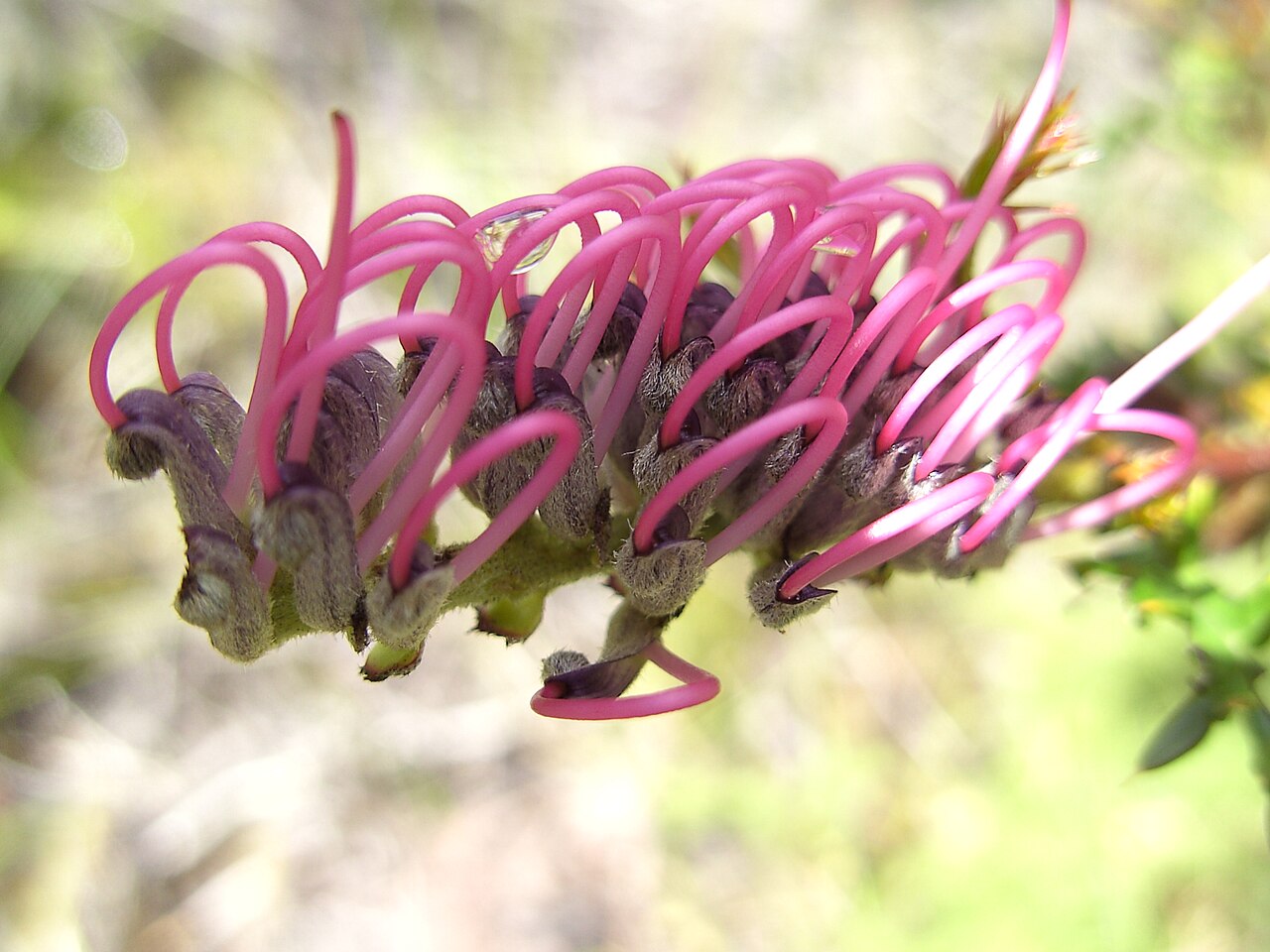
At Barishal Nursery in Savar, outside Dhaka, a shrub is flowering whose blooms seem to have no petals at all, the flower heads looking like a spider's legs or a toothbrush. The nursery manager called it a bottlebrush, but writing in Prothom Alo, Mrityunjay Roy traced it to the genus Grevillea and found the closest match in the species Grevillea acanthifolia.
The nursery's owner, Md Ibrahim, said he brought a few grevillea seedlings from Thailand and is growing them on as mother plants; they flower almost all year. He collected them for the strange shape of the flowers and has several kinds.
Grevillea belongs to the Proteaceae family, about 2,000 species in some 80 genera, whose flowers have no separate petals and sepals but a single ring of four petal-like parts called tepals. The genus alone has 380 species, commonly called spider flowers, and is named after Charles Francis Greville, an 18th-century botanist and co-founder of the Royal Horticultural Society.
Grevillea acanthifolia, the acanthus-leaved grevillea, has no Bengali name. The English botanist Allan Cunningham (1791-1839) found it in 1817 on an expedition in eastern Australia, growing in peaty swamps of the Blue Mountains in New South Wales and along the Cox's River, and published its formal description in 1825.
It is a perennial shrub. The two plants in Savar are about 1.25 metres tall with branches spreading in every direction. The stiff, prickly, bright green leaves are deeply divided into 9 to 14 lobes, 4 to 9 cm long and 3 to 7 cm wide. The pink to purple flowers sit on one side of a 3 to 10 cm flower head, each with a long red style tipped with green pollen-bearing tissue. It flowers all year but most from October to February, followed by a hairy fruit called a follicle.
The shrub is native only to New South Wales, on high, wet and swampy ground. Bangladesh has records of one other grevillea, Grevillea robusta or silver oak, but no official record of this species. Its striking looks have made it a garden ornamental in many countries, and it has now spread here too.
Photo: Ian Sutton / Wikimedia Commons (CC BY 2.0)
Source: Prothom Alo


Comments
(0)