
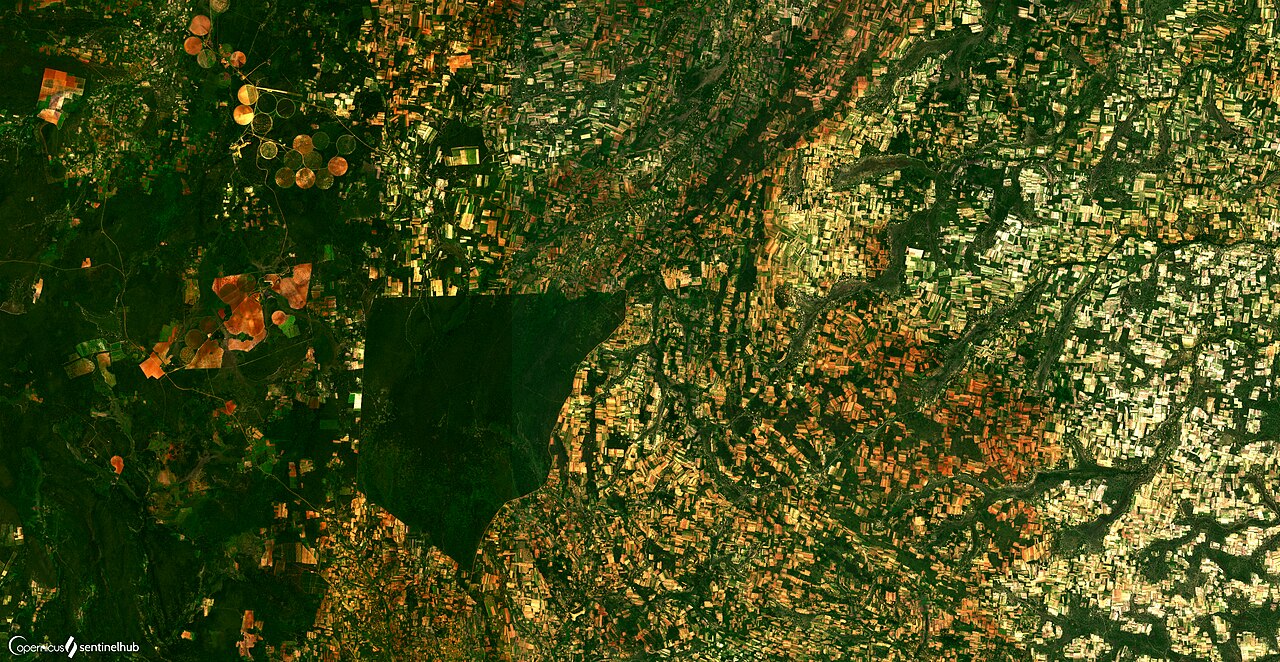
A Nagpur start-up, VarshaKrishi, is offering small farmers a free weekly crop watch built from satellite images of their own field, its founder Tanmay Sahare wrote in Rural Voice on 1 November. The farmer needs no sensor, form or new equipment: they open the app on a phone and tap their field on a satellite picture.
Within minutes, he writes, the system reads the last 18 months of satellite history for that field, checks every pass for cloud, measures how green the crop is and compares the field with its own past and with the fields around it. A field falling behind its neighbours is usually the first sign that something needs attention. Rainfall for the area is set against its 30-year normal, so the farmer can tell whether a week was really dry before deciding to irrigate.
The farmer then gets one WhatsApp message a week, in Marathi, Hindi or English and under 300 characters, saying what the satellite saw, what the weather says and what to check, with the date and source of the data. In the monsoon, when cloud hides a field, the message says so and radar and weather data are used instead.
Sahare gives an example from a 3.2-acre field near Katol in Nagpur district, where the crop's greenness fell by 38% between 10 and 20 May 2026 while surrounding fields fell by 22%. A weekly message, he writes, would have told the farmer to walk that field and check it before the change could be seen from the bund.
The basic weekly field watch is free for every farmer in India. More detailed advice, such as when to irrigate and by when to act, is offered only for crops whose model an agronomist has reviewed, and can be paid for by the farmer, subsidised through a scheme or sponsored by a farmer producer organisation. The company says it sells no seed, fertiliser, pesticide or loans. Each farmer also gets a one-page report with 18 months of field history to show an agriculture officer, a bank or an insurer.
The first crop is the Nagpur orange, because growers in Vidarbha face high stakes with every irrigation and spray decision. The start-up says it is in talks with farmer organisations and development groups, that registration for the 2026-27 season is open, that it publishes its methods and a year of readings for the Katol field under an open licence, and that an Indian patent application for a method using one low-cost in-field reading was published in August 2026.
VarshaKrishi is recognised by India's Department for Promotion of Industry and Internal Trade. Sahare studies aerospace engineering at IIT Kanpur and is an entrepreneur-in-residence fellow at the institute's 5G/6G Centre of Excellence. The claims about the service are the company's own.
Photo: Sentinel Hub / Wikimedia Commons (CC BY 2.0)
Source: Rural Voice
Comments
(0)