
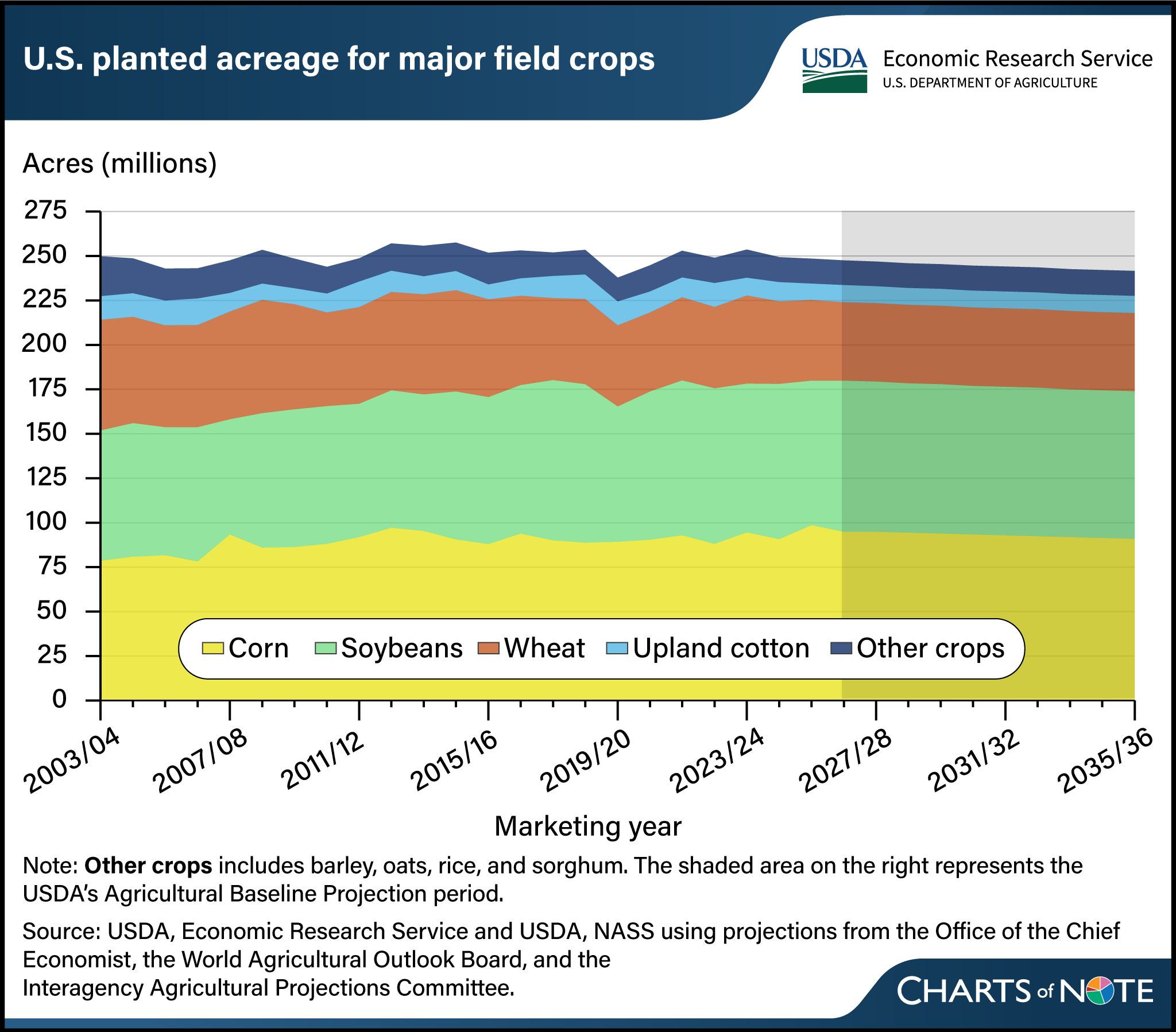
The land the United States plants to its eight major row crops is projected to shrink by 2.4 percent over the next decade, according to USDA's long-term agricultural projections.
Taken together — corn, soybean, wheat, upland cotton, oats, rice, sorghum and barley — the eight are projected to fall from 247.6 million acres in the 2026/27 marketing year to 241.6 million acres by 2035/36.
The projection describes an acreage base that is stable to softening, still dominated by corn and soybeans but easing down from recent highs. What drives it is the margin: crop prices steady to slightly higher, input prices rising, and the squeeze between them persisting.
Corn carries much of the decline. After reaching 98.8 million acres in 2025/26, corn area is projected to drop to 95.0 million acres in 2026/27 and ease further to 91.0 million by 2035/36.
Soybeans go the other way first. The crop is projected to rise to 85.0 million acres in 2026/27, the sixth-highest figure on record, before slipping back to 83.0 million later in the period.
Wheat stays flat throughout at 44.0 million acres, down from 45.3 million in 2025/26 and well below its historical levels.
One distinction matters for anyone reading the numbers as a market signal. These are USDA's long-term baseline projections, released in February 2026 as USDA Agricultural Projections to 2035, and they are not the same thing as the survey-based Prospective Plantings report of 31 March, which records what growers say they intend to plant in the coming season. The chart was compiled by Brian Williams, Erik Dohlman and Matthew Miller.
Source: USDA Economic Research Service



Comments
(0)