
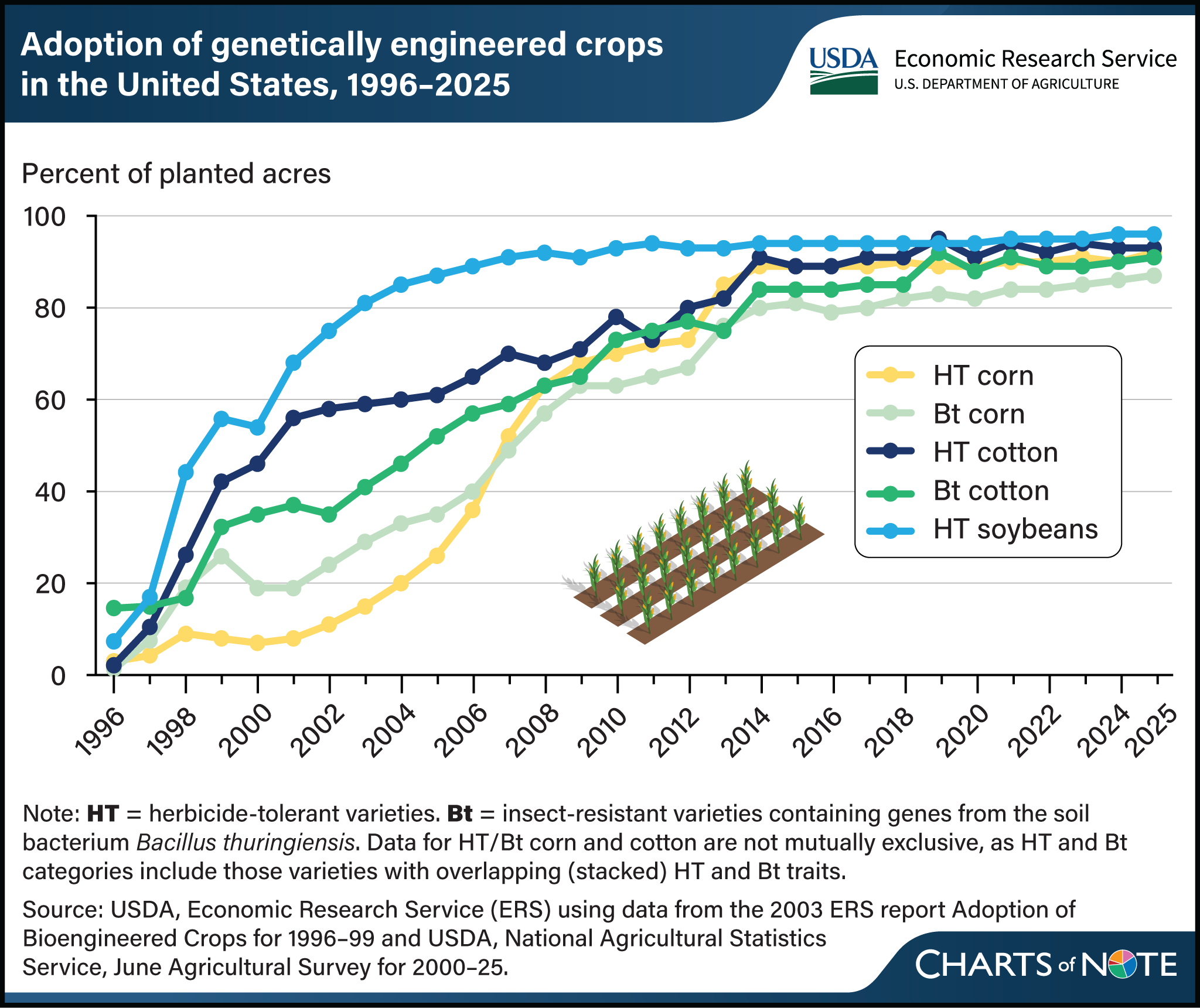
Adoption of genetically engineered (GE) crops by US farmers continued to increase in 2025, the US Department of Agriculture's Economic Research Service (ERS) said in a new Chart of Note.
Today more than 90 percent of corn, cotton and soybean acres in the United States are planted with seed carrying at least one GE trait, according to the ERS data product Adoption of Genetically Engineered Crops in the United States. By 2008 the share had already passed 50 percent for all three crops.
GE seeds were introduced commercially for major US field crops in 1996, and adoption rose quickly in the years that followed. The two main trait types are herbicide tolerance (HT) and insect resistance; the latter most commonly uses genes from the soil bacterium Bacillus thuringiensis (Bt). A growing share of seed is "stacked", combining both HT and insect-resistance traits.
Other traits have been developed, including non-Bt insect resistance, resistance to drought, viruses or fungi, and enhanced protein, oil or vitamin content, but HT and Bt remain the traits most commonly used in US crop production.
HT seed is also widely used for alfalfa, canola and sugar beet, but most GE acres are in the three major field crops: corn, cotton and soybeans. The chart appears on the ERS Biotechnology topic page, published in December 2025.
Source: ers_usda



Comments
(0)