
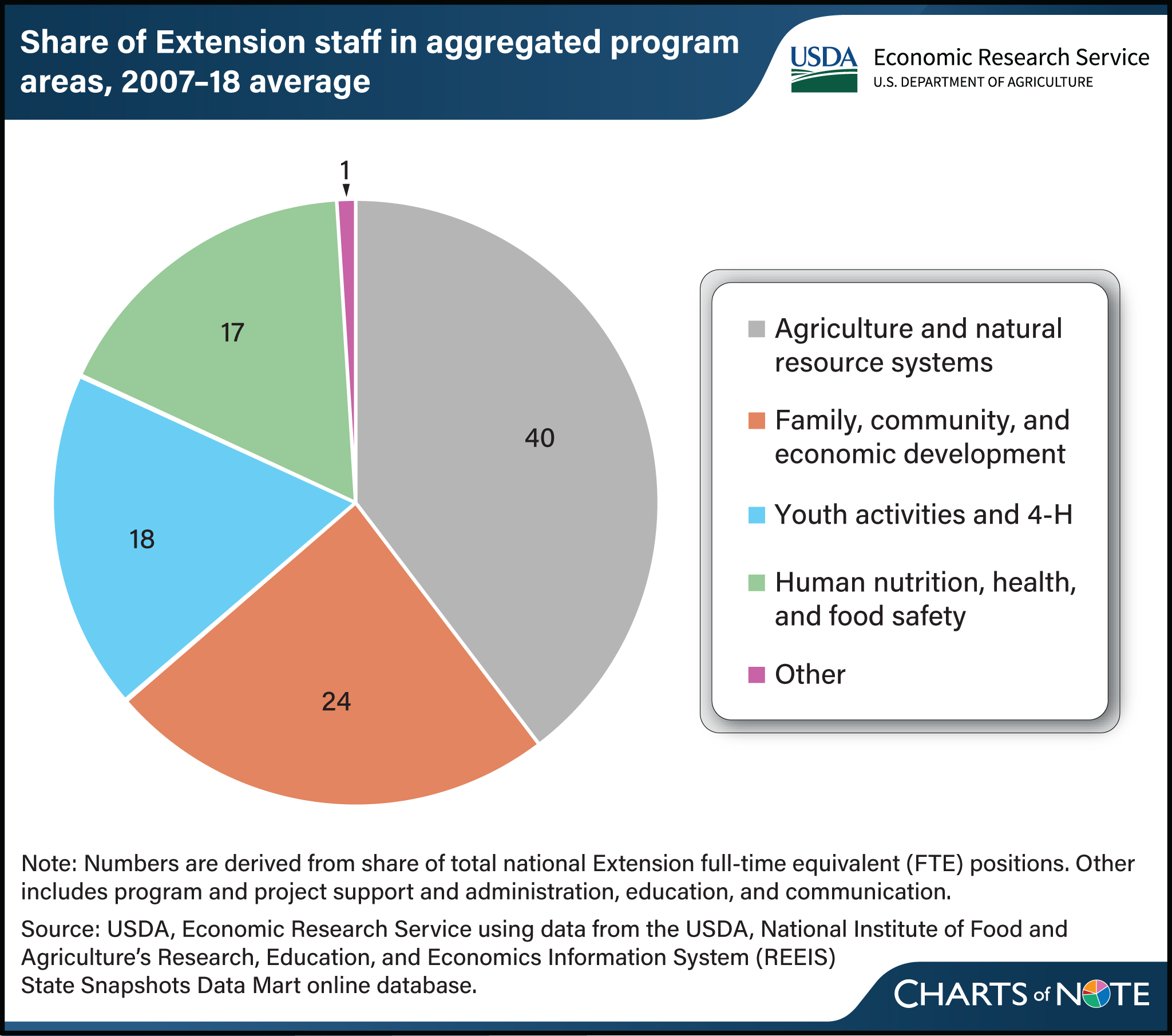
Agriculture and natural resources is the biggest single job of the US Cooperative Extension System, the network that gives farmers, households and communities advice and informal education. Averaged over 2007 to 2018, about 40 percent of Extension jobs, counted as full-time equivalents, went to that program area, according to a Chart of Note from the USDA's Economic Research Service (ERS).
Extension works through the land-grant colleges and universities in partnership with federal, state and local governments, and its programmes vary with each region's needs. ERS groups them into four broad areas: agriculture and natural resources; family, community and economic development; human nutrition, health and food safety; and youth activities and 4-H.
After farming and natural resources, family, community and economic development took 24 percent of Extension staff. ERS notes that this area covers the economic development of products, markets and communities, and that it can complement the agriculture and natural resource programmes.
Youth and 4-H activities accounted for 18 percent of staff, and human nutrition, health and food safety for 17 percent.
The chart, by Tatiana Borisova, draws on the ERS report Cooperative Extension in Transition: Trends Through 2024, published in September 2026.
For farmers, the figures show where the public advisory service puts its people: close to two in every five Extension posts are given to the questions growers and land managers bring, from crops and livestock to soil and water.
Source: USDA Economic Research Service

Comments
(0)