
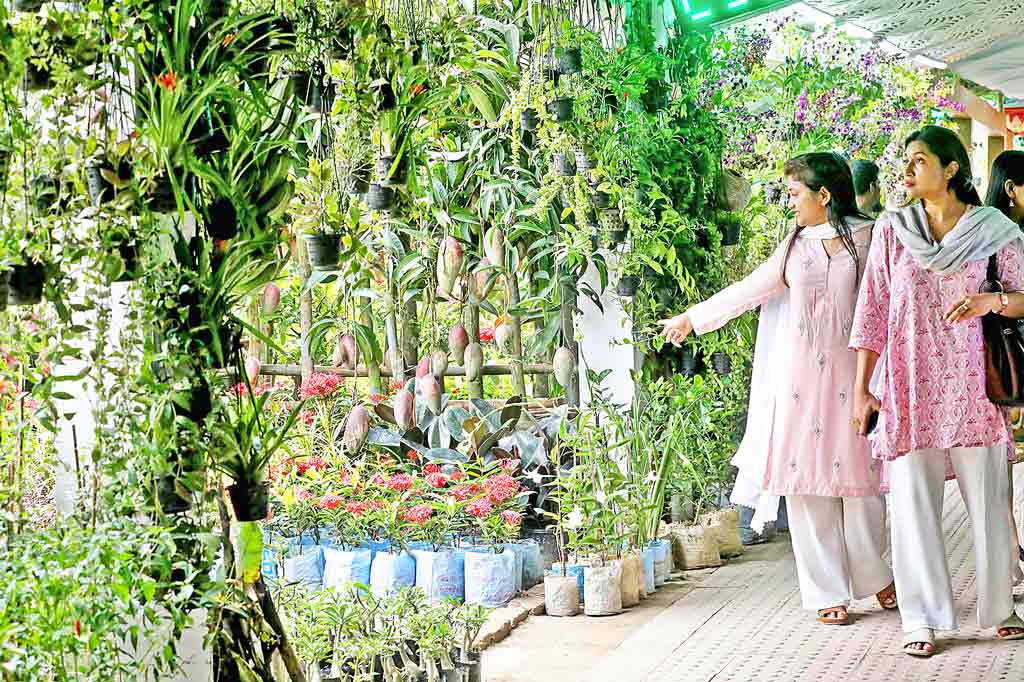
In a column on Ajker Patrika's op-ed page, Mrityunjay Roy puts forward several citizens' proposals for the national tree fair. His central point is that the fair has in effect become a fair for urban gardeners, so its name, its record-keeping and its pricing need to change.
He recalls the history: on World Environment Day in 1991 every citizen was asked to plant a tree, and on 13 August that year the drive was launched by planting a mahogany at Shalna in Gazipur. The Forest Department began a national tree fair in 1994, now held every year at the old trade-fair ground in Agargaon, Dhaka.
Citing the Forest Department, he writes that this year's month-long fair, which ended last month, had 74 stalls and nurseries and sold 1.6 million saplings worth Tk 16 crore, 100,000 more than last year. But he estimates that a proper survey would show 80-85 per cent were not trees at all but plants for rooftops and homes, and suggests the sales figures record what share are trees.
The Nagar Krishi Foundation surveyed about 200 visitors at the fair. According to the column, about 90 per cent lived in Dhaka, about 60 per cent were women, nearly all had gardens on roofs, balconies or indoors, and about 90 per cent went home satisfied. Many suggested smaller specialist fairs for indoor plants, roses and orchids, or bougainvillea.
On prices, he notes that the figures imply an average of Tk 100 a sapling, yet some imported fruit saplings were priced at Tk 30,000-50,000. He proposes an agreed price list, tags giving the plant and variety name, a space where urban gardeners can sell or swap their own saplings, and organised visits for students.
He also suggests fixed annual dates and tree fairs in all 64 districts on the same day, pointing to India's Van Mahotsav, held on 1-7 July since K M Munshi started it in 1950. The views are the writer's own; this summary is The Agro News's.
Photo: Zahidul Islam / Ajker Patrika
Source: Ajker Patrika

Comments
(0)