
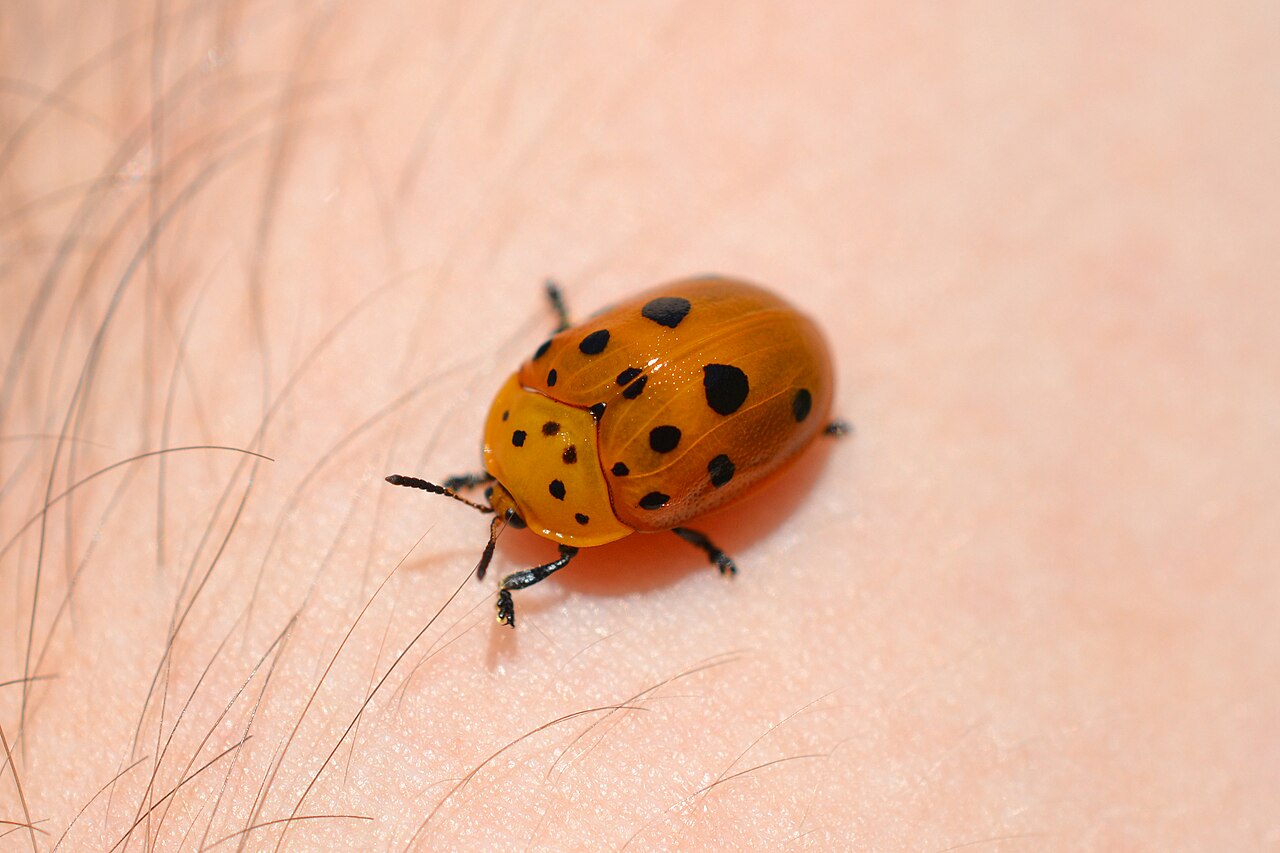
A protein family best known for colouring insects yellow has been put to an entirely different use by tortoise beetles: building the protective capsules that carry a bacterium the beetles cannot live without. The finding comes from the John Innes Centre, the Sainsbury Laboratory and the Max Planck Institute, and is published in Nature Communications.
Tortoise beetles depend on the bacterium Candidatus Stammera to digest the pectin and cellulose in the plants they eat. The partnership is about 60 million years old, and Stammera has lost so much of its genome that it can barely survive on its own. The mother beetle packs the bacteria into small gelatinous spheres and glues them to the outside of each egg, where they sit exposed for around 11 days until the larva hatches and eats them.
To find out what the spheres are made of, the team sequenced and assembled the first reference genome of any tortoise beetle, Chelymorpha alternans. A gene coding for a Yellow protein turned out to be highly active in glands linked to the ovaries of adult females and almost undetectable in males. Mass spectrometry confirmed the protein in the spheres, and structural modelling showed they are built almost entirely from it, formed into a dense, glue-like matrix. When the gene was knocked down, the spheres lost their shape and the bacteria dried out more easily.
"We did not expect a gene from the Yellow family, best known for pigmentation and behaviour, to be responsible for something as physical as building a protective capsule around a bacterium," said Dr Hassan Salem, a group leader at the John Innes Centre. Yellow proteins were first linked to behaviour more than 80 years ago, when differences in yellow pigment were shown to decide courtship success in fruit flies.
The farming interest lies in the beetles' wider family. Leaf beetles, to which tortoise beetles belong, are significant crop pests, and the researchers say the better their biology is understood, the better their activity might be disrupted. The study may also have implications for engineering plants to resist insect feeding by targeting a beetle's bacterial partner.
The team's next step is to work out, at the biochemical level, how the Yellow protein forms its protective matrix.
Photo: Andrew C / Wikimedia Commons (CC BY 2.0)
Source: John Innes Centre
Comments
(0)