
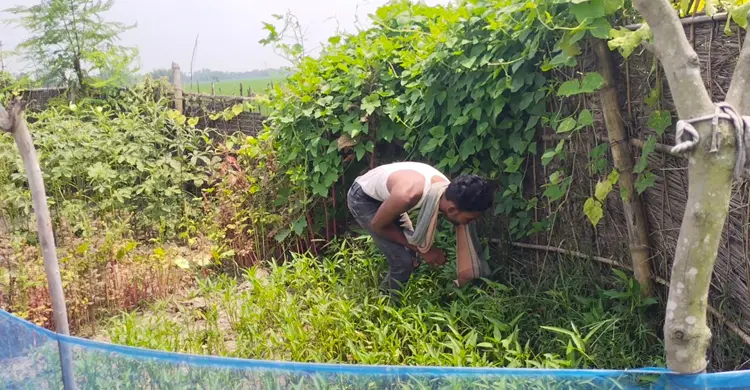
Jorina Khatun lives in Boro Palashbari union of Baliadangi upazila in Thakurgaon district. Having no land of her own, she was given a house under the government's Ashrayan housing project. On a small patch beside the house she has set up a family nutrition garden. The vegetables it produces meet her family's nutritional needs, and she sells some of the greens and vegetables, earning about Tk 1,000 to Tk 1,500 a month.
"All kinds of vegetables are expensive now, but that heat hasn't reached my home. Instead I'm getting by well eating the vegetables grown in my yard, and meeting my neighbours' needs too," she said.
Khademul Islam of the same Ashrayan project has set up a family nutrition garden like Jorina's. Its vegetables feed his family, and he sells some at the market and gives some to neighbours. The money he used to spend buying vegetables every month is now all saved.
About 10,000 families take part
With the help of the Department of Agricultural Extension (DAE) in Thakurgaon, about 10,000 families in the district have set up such nutrition gardens on fallow land and homestead yards. These gardens produce vegetables worth crores of taka every year, meeting nutritional needs and making the families more self-reliant.
According to the DAE, the government took up a nationwide project in 2020 for such family nutrition gardens and ginger and turmeric cultivation, aimed at achieving food security and meeting family nutrition needs. The government aims to create 5 lakh nutrition gardens across the country, so that at least 5 lakh families can eat safe vegetables and save a large amount of money.
The gardens grow beans, chillies, leafy greens, bottle gourd, pumpkin and sweet potato, along with ginger and turmeric. Beneficiaries say each garden can produce more than about 200kg of vegetables a year.
The DAE says these gardens can meet 4-50 percent of nutritional needs and 5-30 percent of protein needs. If a vegetable garden on one and a half decimals of land produces 300kg a year, the 2,700 gardens in the district would produce about 5,49,700kg of vegetables, it says. At an average of Tk 30 a kg, that would be worth Tk 2 crore 10 lakh 94 thousand, so families under the government's nutrition garden scheme are saving large sums.
"We haven't bought vegetables for six months"
Jorina Khatun said her garden has red amaranth, Malabar spinach and taro leaves, which she eats herself, gives to neighbours and also sells. She has sold aubergines and green chillies, and can sell about Tk 1,000 of vegetables a month.
Another woman, Maleka, said: "My garden has okra, yardlong beans, bitter gourd, ridge gourd, sponge gourd and chillies. You won't believe how many crops a small space can grow unless you see it. We haven't bought any vegetables for six months. What we get from the garden is plenty. Not only that, I have also sold Tk 1,000 worth of vegetables."
"You don't need much land here; you can grow a lot of vegetables on a little land. I would ask everyone to make a safe vegetable garden like this," she said.
DAE: fallow land coming under cultivation
Md Sirajul Islam, deputy director of the district DAE, said that in line with the prime minister's directive that "not an inch of land should be left uncultivated", the project is giving input support to small and marginal farmers to ensure nutrition through nutrition gardens. Because such gardens in the homestead easily meet family members' nutritional needs, families are now turning to gardening, he said.
"Under our own project there are more than 2,007 nutrition gardens in the district. After meeting their families' nutritional needs, many are also selling one to one and a half maunds of vegetables from these gardens, so they are gaining financially," he said.
"Land that used to lie fallow is coming under cultivation through the nutrition gardens. We run such projects to meet nutritional needs. Various seed companies and individuals have also given seed support at the DAE's request as social responsibility, speeding up the work," he added.
Source: Jagonews24. First published in Bengali on The Agro News.
Comments
(0)