
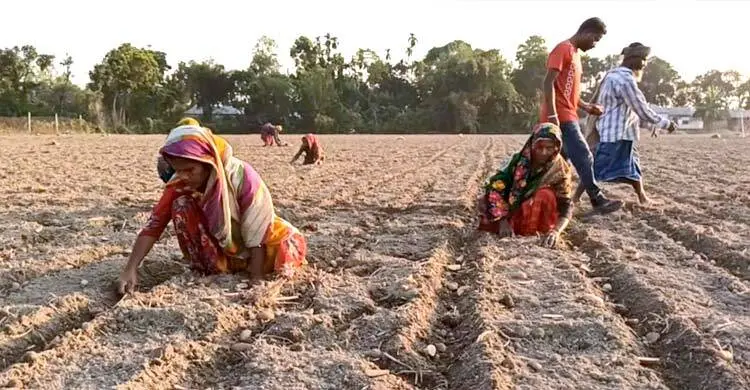
Thakurgaon farmers grow early potatoes every year in the hope of extra profit. Transplanted aman has not yet been fully harvested and threshed in the district's five upazilas, but farmers are busy planting early potatoes on newly cleared land. This time, with production costs far higher, they are taking a risk. Because potatoes fetched good prices last year, they are taking it with some hope.
Early varieties named Diamond, Asterix and Cardinal have been planted across the district. These become ready for sale 55-60 days after planting. The district has a target of 27,500 hectares of potatoes this season, and early potatoes have been planted on 2,700 hectares so far.
Seed and fertiliser costs
This year farmers are buying potato seed from outside at Tk 80-85, up Tk 25-30 on last year and more than double the price of the season before. A sack of fertiliser costs up to Tk 200 more. With extra irrigation and pesticide, production costs are abnormally high: from Tk 40,000 a bigha before, they have risen to Tk 70,000 a bigha.
Government-supplied potato seed this year has been priced at Tk 57 to Tk 66 a kg depending on the variety, but supply falls short of demand. Sources say BADC produces 20-25 per cent of potato seed; farmers keep the rest at home or it is produced by various private NGOs and companies. With too little government seed, farmers are forced to buy at higher prices. Last year they could buy seed at Tk 50-60, up from Tk 30-35 the season before; this year they are paying up to Tk 80-85.
Dealers buy triple super phosphate (TSP) at the government price of Tk 1,250 but sell it at Tk 1,350. Diammonium phosphate (DAP), at a government price of Tk 950, sells at Tk 1,050. Muriate of potash (MOP), at Tk 900, is sold at Tk 1,000. Urea, at a government price of Tk 1,250, is sold to farmers at Tk 1,350.
But farmers are having to pay Tk 1,700 for Tunisian TSP and Tk 2,200 for local TSP, Tk 1,100 for Moroccan DAP and Tk 1,500 for local DAP, and Tk 1,200 for Canadian MOP, while Russian MOP is at the government price. Several farmers said no dealer gives receipts, and dealers refuse to sell fertiliser if a receipt is requested.
Farmers fear losses
Farmers say they are taking on the higher costs because potato prices were good over the past two seasons. If they could get seed, fertiliser and pesticide at government rates, costs could come down somewhat. Without a fair market price, they will lose their capital.
Tarikul, a farmer of Nargun union, said: "Last year the cost doubled as potato seed, fertiliser and pesticide prices rose. This year costs have gone up even more. If we don't get prices like last time, we will be ruined in the field."
Sohel Rana of Akcha union said: "Just a year before last, potatoes on 50 decimals cost Tk 30,000-40,000. Last year that rose to Tk 50,000-55,000, and this year the same land costs Tk 70,000. I grow potatoes every year and have done so again, but I am very worried about the market."
The agriculture office, however, says potatoes are likely to fetch good prices, and the agriculture department expects a good yield this season unless there is a major natural disaster.
Agriculturist Mst Nazma Akter, acting deputy director of the Department of Agricultural Extension (DAE) in Thakurgaon, said: "We regularly go to the field and advise potato farmers. Thakurgaon's soil and climate are well suited to potatoes. But production costs are higher this time. I hope farmers will be able to recover their costs through fair market prices."
Source: Jagonews24. First published in Bengali on The Agro News.


Comments
(0)